
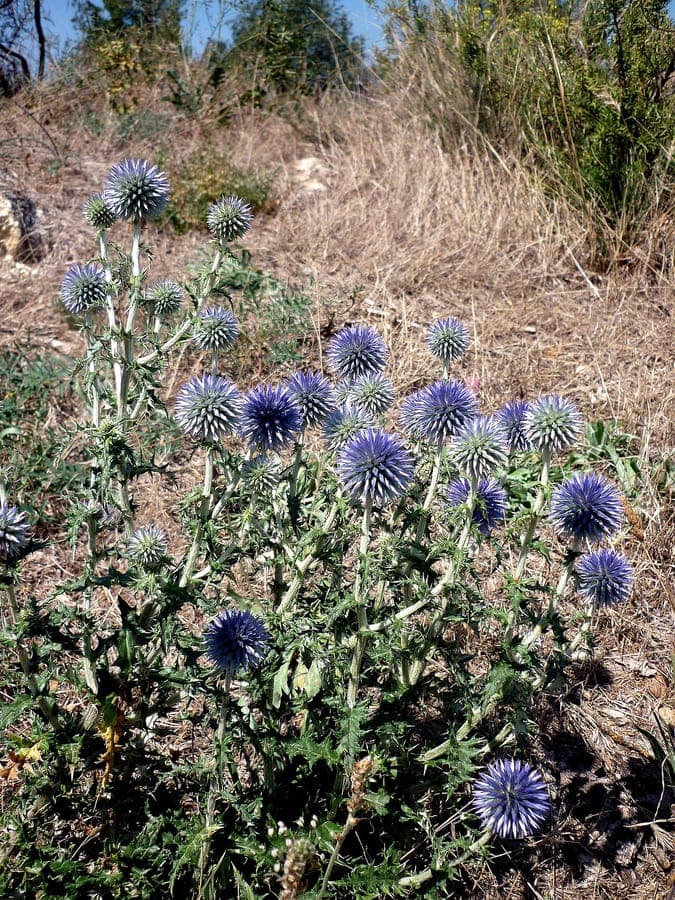
Isidre blanc / CC BY-SA 4.0, via Wikimedia Commons
Globe thistle: complete guide
Echinops ritro
¿Quieres ver Globe thistle: complete guide en tu jardín?
1 minuto, sin tarjeta de crédito
Overview
Globe thistle (Echinops ritro), also called small globe thistle or southern globe-thistle, is a classic, frost-hardy perennial from the Asteraceae family native to Europe to Mongolia. This elegant plant reaches 60-100 centimetres in height and distinguishes itself with characteristic blue-purple, spherical flowers and finely cut, silvery-spiny grey-green foliage. Globe thistle is an absolute master plant for bee-friendly gardens - bees, bumblebees, and butterflies can spend hours on a single flower head - and demands virtually no maintenance. The plant is extremely drought-tolerant, pest-resistant, and grows well in challenging soils. This makes globe thistle ideal for rural borders, dry slopes, urban gardens, and minimalist gardens where maintenance is a concern. On gardenworld.app, you can create garden designs where globe thistle plays a structuring role.
Appearance and bloom
Globe thistle grows into an elegant, upright plant with fine, much-branching stems. The foliage is notably finely cut, almost feathery, grey-green with soft, delicate spines - a subtle, refined texture. From July to September, dozens to hundreds of blue-purple (sometimes more blue, sometimes more purple), spherical flowers (roughly 3-4 centimetres in diameter) crown the fine stems. Each sphere comprises countless minute, two-coloured florets providing nourishment to numerous insects. Following flowering, decorative seed structures with fine hairs form, highly attractive to birds. The plant provides garden interest from May to December.
Ideal location
Globe thistle demands full sun - at least six hours of direct sunlight daily. Part shade is possible but results in less blooming and lanky growth. The plant appreciates warm, sheltered spots and thrives even on dry, windy sites. In warm, sheltered urban gardens, it feels at home. Also suitable for green roofs and other elevated, dry sites where other plants struggle.
Soil requirements
Globe thistle grows on virtually any soil, from very poor sandy ground to quite heavy clay. The plant even thrives on limestone (alkaline) soils and develops optimally there. For mixed borders, simply plant it like any other perennial - no special soil preparation is needed. The plant makes very few demands regarding soil amendment.
Diseño gratis
¿Quieres ver Globe thistle: complete guide en tu jardín? Crea un diseño gratis ahora.
Watering
Globe thistle is extremely drought-tolerant once established. During the first growing season (May-September), provide regular water to encourage strong roots. After establishment, natural rainfall suffices in virtually all years. The plant actually prefers somewhat dry to wet conditions - too much water can even cause problems.
Pruning
Globe thistle requires no pruning. Remove spent flowers in October-November if you wish to prevent self-seeding (but leave them for birds). For a tidy winter appearance, you may cut back all stems in November, though the dried stems are also decorative. Pinching in May-June produces more compact growth.
Maintenance calendar
March-April: Plant emerges. Light feed with organic fertiliser. Check for insect damage.
May-June: Strong growth. Finely cut foliage forms the structural element. No watering needed. Optional: pinch for more compact form.
July-September: Flowering. Bees very active. Don't remove spent flowers - leave for bird food.
October-November: End of flowering. Dried stems remain ornamental. Optional cutting back for tidier appearance.
December-January: Plant under snow/frost. Dried stems provide bird food.
Winter hardiness
Globe thistle is hardy to approximately -20°C (USDA zone 4). The plant overwinters without difficulty across temperate Europe. The natural structure with fine stems helps shed ice and snow.
Companion plants
Globe thistle combines beautifully with other robust perennials such as Rudbeckia, Achillea, Salvia, Gaura, and Coreopsis. For a naturalistic wildflower border, plant with Echinacea, Leucanthemum, and Geum. Grass-like structural plants such as Stipa, Panicum, and Festuca enhance the effect. Also lovely combined with purple foliage such as Heuchera 'Obsidian' and silvery foliage such as Artemisia.
Conclusion
Globe thistle is a classic, highly reliable perennial for gardeners who love easy maintenance, pollinator plants, and robust growth. The elegant, finely cut foliage and countless blue-purple flowers make this plant unforgettable. Globe thistle supports gardenworld.app's vision of low-maintenance gardens that are still wildlife-friendly. Plant globe thistle this season and enjoy years of attraction for insects and birds.
¿Quieres ver Globe thistle: complete guide en tu jardín? Crea un diseño gratis ahora.
Sube una foto, elige un estilo y obtén un diseño fotorrealista con lista de plantas en menos de un minuto.
Más de 10.000 jardines diseñados
Sin tarjeta de crédito


Plantas similares
Blue globe thistle: complete guide
Echinops bannaticus
Everything about blue globe thistle (Echinops bannaticus): cultivation, flowers, pollinators and pruning. Practical tips for this imposing perennial in borders.
Blue eryngo: complete guide
Eryngium planum
Everything you need to know about Blue eryngo (Eryngium planum): growing conditions, soil, pruning and hardiness. Perfect for dry gardens.
Centaurea montana: complete guide
Centaurea montana
Master mountain cornflower, a hardy perennial with reliable blue blooms. Complete care guide for borders and cottage gardens.