
No machine-readable author provided. Pethan assumed (based on copyright claims). / CC BY-SA 3.0, via Wikimedia Commons
Blue globe thistle: complete guide
Echinops bannaticus
¿Quieres ver Blue globe thistle: complete guide en tu jardín?
1 minuto, sin tarjeta de crédito
Overview
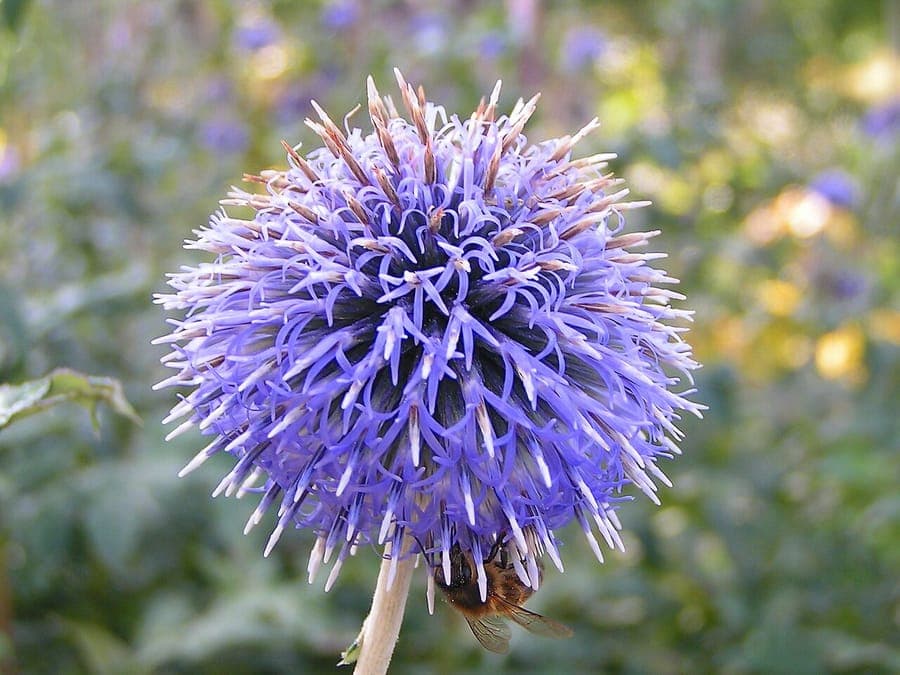
Blue globe thistle (Echinops bannaticus) is an imposing, frost-hardy perennial from the Asteraceae family native to south-eastern Europe. This spectacular plant reaches 120-150 centimetres in height and is distinguished by its characteristic blue, spherical flowers floating above spiny, grey-green foliage like delicate, translucent orbs. Blue globe thistle is an excellent pollinator plant - bees, bumblebees, and butterflies can spend hours on a single flower head - and strongly supports pollinator-friendly gardens. The plant is extremely drought-tolerant, pest-resistant, and demands minimal maintenance, making it ideal for naturalistic gardens, borders with challenging conditions, and as under-planting for larger structural plants. On gardenworld.app, you can create garden designs where blue globe thistle plays a structuring role.
Appearance and bloom
Blue globe thistle builds itself into a broad, upright plant with strongly branching stems. The foliage is intensely spiny, grey-green, rough-textured, and provides formidable contrast with smoother-leaved plants. From July to September, hundreds of improbably spherical, aqua-blue-tinged flower heads (roughly 4-5 centimetres in diameter) crown the stems. Each sphere comprises countless minute, two-coloured florets. After flowering, ethereal seed structures form that are remarkably decorative and attract many birds. The plant provides garden interest from June to January - even the dried seed heads remain ornamental.
Ideal location
Blue globe thistle demands full sun - at least 6-8 hours of direct sunlight daily. Part shade is unsuitable - in excessive shade the plant becomes lank and flowers sparsely. The plant appreciates warm, sheltered positions against south-facing walls. Also suitable for dry, windy garden sites. Note that the plant's heavy structure can cause tipping in very windy gardens, though this is preventable through companion planting and staking.
Soil requirements
Blue globe thistle grows on practically any well-draining soil. The plant accepts even poor, dry sandy ground and thrives equally on clay and alkaline (limestone-rich) soils. For optimal growth in mixed perennial borders, no special soil preparation is usually required. In exceptional cases on extremely heavy clay, sand and compost may be added, but this is rarely necessary.
Diseño gratis
¿Quieres ver Blue globe thistle: complete guide en tu jardín? Crea un diseño gratis ahora.
Watering
Blue globe thistle is extremely drought-tolerant once established and requires minimal water. In its first growing season (May-September), water regularly to encourage strong roots. After establishment, natural rainfall suffices in most years. In very dry summers you may water, but this is often unnecessary. The plant prefers somewhat dry to wet conditions.
Pruning
Blue globe thistle requires no pruning per se. Remove spent flower heads in October-November to prevent self-seeding (unless you wish to attract birds). For a tidier appearance, cut back faded stems in November. For more compact growth, pinch stem tips in May-June.
Maintenance calendar
March-April: Plant emerges. Apply light feed with organic fertiliser. Watch for slugs.
May-June: Vigorous growth. Plant builds height. No watering needed. Optional: pinch stem tips for more compact form.
July-September: Flowering. Bees and pollinators very active. Minimal maintenance. No extra water needed.
October-November: Flowering finished. Seed set. Remove flower heads if you wish to prevent self-seeding, or leave for birds.
December-January: Plant retreats underground. Dried stems remain ornamental.
Winter hardiness
Blue globe thistle is hardy to approximately -20°C (USDA zone 4). The plant overwinters without difficulty across temperate Europe. The inherent silvering helps the plant withstand winter storms. In very wet, waterlogged winters, drainage problems may arise - ensure good drainage.
Companion plants
Blue globe thistle combines beautifully with low-growing, contrasting foliage such as Artemisia, silvery Senecio, and dark-leaved plants such as purple-leaved Heuchera. For a naturalistic mixed border, plant with Achillea, Salvia, Echinacea, and other robust perennials. In limestone gardens it combines nicely with Eryngium. Grasses such as Stipa and Calamagrostis work well as under-planting.
Conclusion
Blue globe thistle is a spectacular, robust perennial for gardeners who love pollinator plants, natural gardens, and minimal maintenance. The striking blue flowers, architectural structure, and robust character make this plant unforgettable. Blue globe thistle supports gardenworld.app's vision of biodiverse, pollinator-friendly gardens requiring minimal care. Plant blue globe thistle this season and enjoy years of attraction for bees and pollinators.
¿Quieres ver Blue globe thistle: complete guide en tu jardín? Crea un diseño gratis ahora.
Sube una foto, elige un estilo y obtén un diseño fotorrealista con lista de plantas en menos de un minuto.
Más de 10.000 jardines diseñados
Sin tarjeta de crédito


Plantas similares
Globe thistle: complete guide
Echinops ritro
Everything about globe thistle (Echinops ritro): cultivation, flowers, bees and drought tolerance. Tips for this classic perennial in mixed borders.
Alpen-mannstreu: complete guide
Eryngium alpinum
Discover Eryngium alpinum: care, soil, bloom season and ideal garden placement. A stunning, drought-tolerant perennial for sunny borders.