
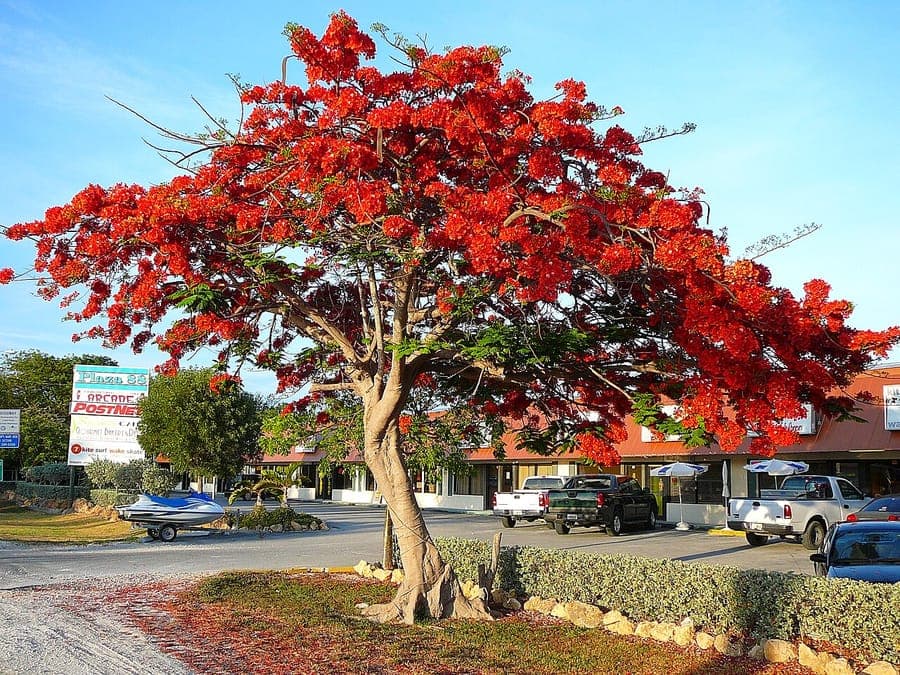
Averette / CC BY-SA 3.0, via Wikimedia Commons
Flamboyant: complete guide
Delonix regia
¿Quieres ver Flamboyant: complete guide en tu jardín?
1 minuto, sin tarjeta de crédito
Overview
The Flamboyant (Delonix regia) is one of the most spectacular trees in tropical and subtropical climates. This tree, native to Madagascar, is renowned for its breathtaking fiery-red flowers that blanket the entire crown during the growing season. With its broad, umbrella-shaped canopy and fine, feathery foliage, the Flamboyant adds dramatic tropical character to any garden design.
The tree reaches heights of 10 to 12 meters in warm, dry climates. Its rapid growth rate and spectacular blooms make it a favorite choice for southern gardens and as a container plant in cooler regions.
Appearance & Bloom
The Flamboyant distinguishes itself through its characteristic appearance. The tree has a broad, flattened crown with thin, delicate leaves. Each leaflet is bipinnate, creating a silky appearance.
The flowers are the star of the show. From June to August, they appear in large, brilliant clusters. Each flower has four fiery-red or orange-red petals and a bright yellow or red-streaked fifth petal. The fragrance is subtle but pleasant.
After blooming, long, leathery seed pods appear with dark brown seeds. These seed capsules are also decorative and persist on the tree for extended periods.
Ideal Location
The Flamboyant thrives best in warm, sunny locations. This is a full-sun plant requiring at least 6 to 8 hours of direct sunlight daily.
The tree is frost-sensitive and cannot tolerate temperatures below 10 degrees Celsius. In temperate climates, it is typically grown as a container plant that moves indoors during winter.
Provide shelter from strong winds, although the tree is reasonably wind-resistant once established.
Soil
The Flamboyant is not particular about soil type but thrives best in well-draining, nutrient-rich soil. The optimal pH ranges between 4.0 and 7.0, favoring slightly acidic to neutral soil.
Heavy clay soils should be amended with organic material and sand to improve drainage. In pots, use a mix of potting soil, perlite, and peat moss.
The tree tolerates dry soil well but grows faster and blooms more profusely with regular feeding.
Watering
The Flamboyant is drought-tolerant once established, thanks to its deep root systems. However, young trees need regular moisture during their first growing season.
Water deeply but infrequently. Ensure the soil dries between waterings. Excessive water can lead to root rot.
During the blooming period and active growing season, soil moisture can be higher. In dry seasons, especially for container plants, weekly watering is necessary.
Diseño gratis
¿Quieres ver Flamboyant: complete guide en tu jardín? Crea un diseño gratis ahora.
Pruning
The Flamboyant benefits from regular pruning to encourage growth and form. The tree grows naturally into an attractive shape, but pruning promotes a denser silhouette and more blooms.
Pruning is best done in late winter or early spring, before the growing season. Remove dead, damaged, or crossing branches.
Formative pruning can be more intensive on young trees to achieve desired shape. On older trees, maintenance pruning is usually sufficient.
Maintenance Calendar
Spring (March-May): Begin regular watering as temperatures rise. Feed every two weeks. Perform pruning.
Summer (June-August): This is the blooming period. Ensure consistent moisture. Feed monthly. Remove spent flowers.
Autumn (September-October): Reduce feeding as the growth cycle ends. Gradually decrease watering frequency.
Winter (November-February): In warm climates, the tree grows slowly. In cooler regions, bring container plants indoors. Minimal feeding and water.
Winter Hardiness
The Flamboyant is not winter-hardy in temperate climates. It can briefly tolerate frost to about -2 degrees Celsius, but prolonged frost damages or kills the tree.
In cold regions, it is essential to keep this tree in a pot and move it indoors before temperatures drop below 10 degrees Celsius. A warm veranda, greenhouse, or living room is ideal.
Mulching around the base helps protect young trees in the ground against light frost.
Companion Plants
The Flamboyant works well with other tropical and subtropical plants that love sun and warmth. Good combinations include:
Low-growing shrubs beneath the tree, such as bougainvillea or lantana, accentuate its beauty.
The tree also benefits from palms, agapanthus, and sun-lovers.
Avoid dense shade producers beneath the tree, as its roots consume nutrients and moisture.
Closing Thoughts
The Flamboyant is an unparalleled tree for those wanting drama and color in their garden. With attention to sunlight, drainage, and nutrition, this tree delivers stunning floral displays year after year. Let its fiery-red splendor enchant you.
Looking for a supplier? Visit gardenworld.app/en or gardenworld.app/nl for more information and resources.
¿Quieres ver Flamboyant: complete guide en tu jardín? Crea un diseño gratis ahora.
Sube una foto, elige un estilo y obtén un diseño fotorrealista con lista de plantas en menos de un minuto.
Más de 10.000 jardines diseñados
Sin tarjeta de crédito


Plantas similares
Tall Silky Lupine: complete guide
Lupinus elatus
Tall silky lupine is a fast-growing Californian perennial with silvery foliage and blue-purple flower spikes, ideal for a prairie-style garden.
Garfield Lupine: complete guide
Lupinus garfieldensis
The Garfield lupine is a rare, fast-growing American perennial for alkaline, dry grassland gardens, with striking blue flower spikes.
Lupinus elegans: complete guide
Lupinus elegans
Lupinus elegans, the elegant lupine, is a spectacular blooming plant from Mexico with blue flower spikes. Care, cultivation and garden use.