
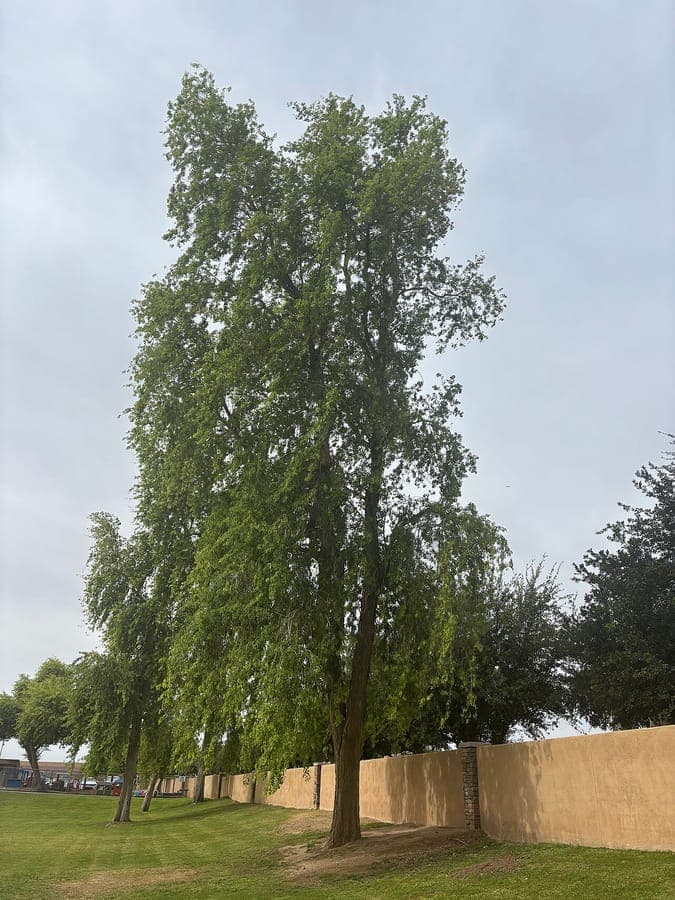
5ezez8 / CC BY 4.0, via Wikimedia Commons
Sheesham: complete guide
Dalbergia sissoo
¿Quieres ver Sheesham: complete guide en tu jardín?
1 minuto, sin tarjeta de crédito
Overview
Sheesham, or Indian rosewood (Dalbergia sissoo), is an important tree from South Asia and is widely cultivated in tropical and subtropical areas. This tree from the Fabaceae family grows from Afghanistan and Pakistan to Myanmar, with the largest concentrations in India and Nepal.
The tree is known for its valuable hardwood and is also prized in landscape design. It is a fast-growing tree that provides a full, green crown. In gardens, it is valued for its aesthetic appeal, shade production, and ecological benefits.
Dalbergia sissoo is renowned for its traditional use for both timber production and shading in gardens and plantations. Due to its fast growth rate and robustness, it is a popular choice for reforestation and landscaping projects in dry and semi-arid regions.
Appearance and bloom
Sheesham grows into a large tree with a height of 20-25 meters and proportional width. The tree has a dense, rounded crown with pinnate leaves. The leaves are alternately arranged and compound with 7-19 small, elliptical leaflets.
The flowers are small, yellow to pale yellow, and appear in late spring through early summer. They are highly fragrant and attract pollinators. The seed pods are flat, approximately 5-8 cm long, and ripen to yellow-brown.
The trunk is straight and sturdy, with gray to yellow-brown bark. The wood is extremely hard and dark (deep brown to black) when properly seasoned. The tree offers a beautiful silhouette in landscapes.
Ideal location
Sheesham thrives best in full sun. The tree is extremely sun-tolerant and can endure very high temperatures. Plant it in locations where it receives at least 6-8 hours of direct sunlight daily.
The tree is also very wind and salt-spray tolerant, making it suitable for coastal and windy areas. It can be planted as a specimen tree as a focal point or in rows for windbreaks and shade.
Avoid wet, swampy areas or locations with permanent water sources. The tree grows better on dry, elevated terrain.
Soil
Sheesham is very flexible regarding soil conditions. It thrives in all soil types, from sandy to clay. The tree can adapt to pH values of 4.5 to 8.5, though optimal pH is between 6.0 and 8.0.
The tree is tolerant of poor soils and dry conditions. It is even useful for soil rehabilitation in eroded areas due to its nitrogen-fixing capabilities.
Nevertheless, it grows better in well-draining soils. Add organic material to the planting hole to improve water retention, though this is not strictly necessary.
Diseño gratis
¿Quieres ver Sheesham: complete guide en tu jardín? Crea un diseño gratis ahora.
Watering
Young trees need regular watering, especially in the first year. Water deeply and less frequently rather than shallow and often, which encourages deep root development.
Mature trees are very drought-tolerant and need little to no supplemental water in dry regions. However, in very dry seasons, water during extreme heat periods.
In regions with rainy seasons, supplemental irrigation is usually unnecessary. The tree can endure long dry periods by drawing from deeper water sources.
Pruning
Sheesham requires minimal pruning. The tree naturally forms an attractive shape. Remove only dead, diseased, or interfering branches.
Tops can be removed from young trees to stimulate a more compact, bushier form, but this is optional. Pruning is best done in late winter or early spring.
Heavy pruning is usually not needed and can disrupt the tree's natural form. Ensure pruning wounds close quickly to prevent infections.
Maintenance calendar
JANUARY-FEBRUARY: Light pruning during winter dormancy. MARCH-APRIL: Clear dead branches; water regularly. MAY-JUNE: Full growth; top young trees for better form. JULY-AUGUST: Caution during extreme heat; water deeply. SEPTEMBER-OCTOBER: Flowering period; support young trees. NOVEMBER-DECEMBER: Winter preparation; check for fungal growth.
Winter hardiness
Sheesham is a tropical to subtropical type and cannot tolerate heavy frost. Minimum temperatures below 0 degrees Celsius will cause leaf drop and branch dieback.
In temperate climates, winter protection or container cultivation in a greenhouse is necessary. The tree grows better in regions where minimum winter temperatures remain above 5 degrees Celsius.
The tree can tolerate short frost periods and will usually recover with new growth in spring, provided the frost period is not extended.
Companion plants
Combine Sheesham with other drought-tolerant trees for a xeriscape effect. Other hardwood trees such as Acacia and Teak can grow well together.
Low-water groundcover plants like Lantana and Salvia add color. Grassy plantings create texture.
The tree provides perfect shade for shade-loving plants. Ferns and shade-loving shrubs can thrive under its canopy.
Closing thoughts
Sheesham is a true all-rounder in tropical and semi-arid gardens. With its rapid growth, minimal maintenance requirements, and impressive appearance, it is an ideal choice for diverse gardening projects.
Visit OBI or Hornbach for quality hedging plants and seedlings. For more information about drought-tolerant trees, visit gardenworld.app.
On gardenworld.app you will find helpful tools and inspiration for designing sustainable gardens with trees like Sheesham that offer both beauty and practical benefits.
¿Quieres ver Sheesham: complete guide en tu jardín? Crea un diseño gratis ahora.
Sube una foto, elige un estilo y obtén un diseño fotorrealista con lista de plantas en menos de un minuto.
Más de 10.000 jardines diseñados
Sin tarjeta de crédito


Plantas similares
Tall Silky Lupine: complete guide
Lupinus elatus
Tall silky lupine is a fast-growing Californian perennial with silvery foliage and blue-purple flower spikes, ideal for a prairie-style garden.
Garfield Lupine: complete guide
Lupinus garfieldensis
The Garfield lupine is a rare, fast-growing American perennial for alkaline, dry grassland gardens, with striking blue flower spikes.
Lupinus elegans: complete guide
Lupinus elegans
Lupinus elegans, the elegant lupine, is a spectacular blooming plant from Mexico with blue flower spikes. Care, cultivation and garden use.