
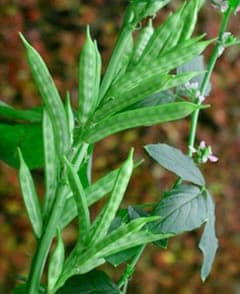
த*உழவன் / Public domain, via Wikimedia Commons
Guar: complete guide
Cyamopsis tetragonoloba
¿Quieres ver Guar: complete guide en tu jardín?
1 minuto, sin tarjeta de crédito
Overview
The Guar plant or Cyamopsis (Cyamopsis tetragonoloba) is an erect annual legume from the Fabaceae family, originally from Pakistan and West India. This plant produces square, green pods filled with seeds that yield guar gum, an important thickening agent in food production.
Appearance and Bloom
The Guar plant grows as an upright, hairy herb to 60-90 cm tall. The stems are thick and branched. The leaves are compound, prickly and green. The flowers are small, white to pink blooms that occur in clusters. The characteristic square pods are 7-10 cm long, green and possess four rounded ridges. Each pod contains 4-8 round seeds.
Ideal Location
The Guar plant prefers full sun with at least 6-8 hours of direct sunlight daily. This is a warmth-lover that grows best in temperatures of 20-30 degrees Celsius. The plant appreciates shelter from strong winds due to its upright form. Place in open sunny locations with good air circulation.
Soil
Moderately fertile, well-drained soil is ideal. pH around 6.0-7.0 is optimal. The plant accepts poor soil but grows better in well-prepared soil with organic material. Good drainage is crucial; avoid waterlogged soil.
Diseño gratis
¿Quieres ver Guar: complete guide en tu jardín? Crea un diseño gratis ahora.
Watering
Regular watering is important, especially during flowering and pod development. Keep soil consistently moist but not waterlogged. Water at the base to prevent leaf rot. In dry periods water regularly; in wet seasons water less.
Pruning
Minimal pruning is needed. Only remove damaged or dead leaves. Side branches can be carefully removed if plant grows too dense, but caution is recommended as plant must grow upright.
Maintenance Calendar
May-June: Sow or transplant young plants. July-August: Water regularly, check for pests. September-October: Flowering and pod development, continue watering. November: Harvest when pods are green and young; seeds mature.
Winter Hardiness
The Guar plant is not hardy. This is a warmth-loving annual plant that dies in cold. In temperate zones it is grown annually. No frost tolerance.
Companion Plants
Other legumes work well; nitrogen-fixing helps both plants. Onions and garlic can grow nearby. Vegetables such as tomato and pepper grow well in the same warmth. Avoid shading by larger plants.
Closing
The Guar plant is a nutritious and interesting vegetable plant for warm gardens. Besides consuming young pods, the seeds are valuable for guar gum production. This makes it a doubly useful plant. For home gardens, the young pods are a tasty addition to dishes. Discover more vegetable plants on gardenworld.app/en and gardenworld.app/nl
¿Quieres ver Guar: complete guide en tu jardín? Crea un diseño gratis ahora.
Sube una foto, elige un estilo y obtén un diseño fotorrealista con lista de plantas en menos de un minuto.
Más de 10.000 jardines diseñados
Sin tarjeta de crédito


Plantas similares
Tall Silky Lupine: complete guide
Lupinus elatus
Tall silky lupine is a fast-growing Californian perennial with silvery foliage and blue-purple flower spikes, ideal for a prairie-style garden.
Garfield Lupine: complete guide
Lupinus garfieldensis
The Garfield lupine is a rare, fast-growing American perennial for alkaline, dry grassland gardens, with striking blue flower spikes.
Lupinus elegans: complete guide
Lupinus elegans
Lupinus elegans, the elegant lupine, is a spectacular blooming plant from Mexico with blue flower spikes. Care, cultivation and garden use.