
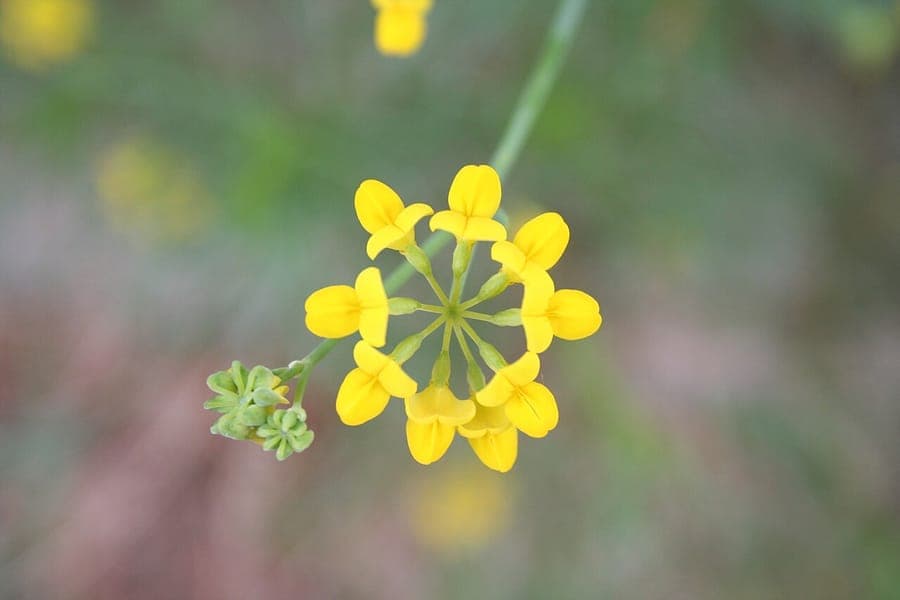
Mario Modesto Mata / CC BY 3.0, via Wikimedia Commons
Coronilla minima: complete guide
Coronilla minima
¿Quieres ver Coronilla minima: complete guide en tu jardín?
1 minuto, sin tarjeta de crédito
Overview
Coronilla minima, commonly known as Dwarf Coronilla or Little Crownvetch, is a charming diminutive shrub native to Mediterranean regions spanning from North Africa and southern Spain to the Alps. This species thrives in the sun-drenched, limestone-rich landscapes of southern Europe and is increasingly popular in northern gardens due to its remarkable frost hardiness.
The plant is prized for its delicate pale yellow to cream flowers that bloom prolifically throughout late spring and early summer. Once established, it demands virtually no supplementary watering or fertilization.
Appearance and Bloom
Coronilla minima forms a dense, rounded shrub reaching 50-60 centimeters in height with an equal spread. The foliage is fine-textured, comprising small pinnate leaves arranged alternately along slender green stems.
Flowers appear in dense, button-like clusters (umbels) at stem tips and leaf axils. Each floret measures roughly 1 centimeter across and ranges in color from pale yellow to ivory cream. The flowering period extends from May through July, with occasional secondary blooming in autumn following summer rain.
Following pollination, small bean-like seed pods develop, typically 2 to 3 centimeters long. These mature to brown in late summer.
Ideal Location
Select a location receiving full, unobstructed sunlight for at least six hours daily. South or west-facing walls and slopes are ideal. The plant will flower sparsely or not at all in partial shade.
Suitable placements include:
- Sun-exposed south-facing borders
- Raised beds and alpine troughs
- Rock gardens and screes
- Dry slopes and hillsides
- Mediterranean and coastal gardens
- Container displays on sunny patios
Soil
Coronilla minima is notably indifferent to soil fertility, in fact preferring impoverished, well-draining substrates. Heavy, waterlogged soils are detrimental and may induce root rot.
Ideal soil composition:
- Sandy, gritty, or gravelly texture
- Slightly alkaline pH (7.5-8.5)
- Excellent drainage
- Low organic matter content
- Minimal nitrogen
If your garden features heavy clay, incorporate horticultural sand and perlite at planting. This shrub actually performs better in poor soils.
Diseño gratis
¿Quieres ver Coronilla minima: complete guide en tu jardín? Crea un diseño gratis ahora.
Watering
Once established (after 12 months), Coronilla minima requires minimal irrigation even during dry spells. In fact, overwatering poses a greater threat than drought.
Watering schedule:
- First season after planting: twice weekly
- Established specimens: drought-tolerant, irrigation only during extended dry periods
- Winter: no supplementary watering
- Avoid waterlogging at all times
In regions receiving regular summer precipitation, additional watering is rarely necessary.
Pruning
Coronilla minima responds well to light pruning, though it is not essential for plant health. A gentle trim following the blooming period maintains compactness and encourages secondary flowering.
Pruning guidelines:
- After flowering (July-August), cut back stems by one-third
- Remove dead or diseased wood in spring
- Avoid severe pruning into old wood
- Maintain natural form with selective tip-pruning
The plant recovers quickly from moderate pruning.
Maintenance Calendar
- March-April: Light pruning and dead wood removal
- May-July: Flowering period, minimal intervention
- August-September: Possible secondary bloom with favorable conditions
- October-November: Wind-down period
- December-February: Dormant season
Winter Hardiness
Coronilla minima exhibits surprising hardiness, surviving temperatures to -15 to -18°C. This makes it suitable across most of temperate Europe. Severe winters may cause some dieback to green stems, but the plant typically regenerates from the base.
In regions experiencing extreme winter cold (below -20°C):
- Position against south-facing walls
- Provide light mulch protection in November
- Ensure excellent drainage to prevent frost-heave
In milder maritime zones, frost protection is rarely necessary.
Companion Plants
Coronilla minima integrates beautifully with other Mediterranean-origin plants:
- Lavender (Lavandula angustifolia)
- Roses (Rosa spp.)
- Sage (Salvia officinalis)
- Germander (Teucrium)
- Rosemary (Rosmarinus officinalis)
- Pinks and carnations (Dianthus)
- Stonecrops (Sedum spp.)
These combinations create cohesive Mediterranean garden aesthetics.
Closing Thoughts
Coronilla minima represents an exceptional choice for sunny, dry garden situations in temperate climates. Its frost hardiness, drought tolerance, and delicate flowering make it a reliable performer even in marginal conditions.
With minimal maintenance demands and months of color, it suits gardeners with limited time for horticultural pursuits. Properly sited, Coronilla minima will enliven your front garden for decades.
Available from specialist Mediterranean nurseries and quality garden centers.
¿Quieres ver Coronilla minima: complete guide en tu jardín? Crea un diseño gratis ahora.
Sube una foto, elige un estilo y obtén un diseño fotorrealista con lista de plantas en menos de un minuto.
Más de 10.000 jardines diseñados
Sin tarjeta de crédito


Plantas similares
Tall Silky Lupine: complete guide
Lupinus elatus
Tall silky lupine is a fast-growing Californian perennial with silvery foliage and blue-purple flower spikes, ideal for a prairie-style garden.
Garfield Lupine: complete guide
Lupinus garfieldensis
The Garfield lupine is a rare, fast-growing American perennial for alkaline, dry grassland gardens, with striking blue flower spikes.
Lupinus elegans: complete guide
Lupinus elegans
Lupinus elegans, the elegant lupine, is a spectacular blooming plant from Mexico with blue flower spikes. Care, cultivation and garden use.