
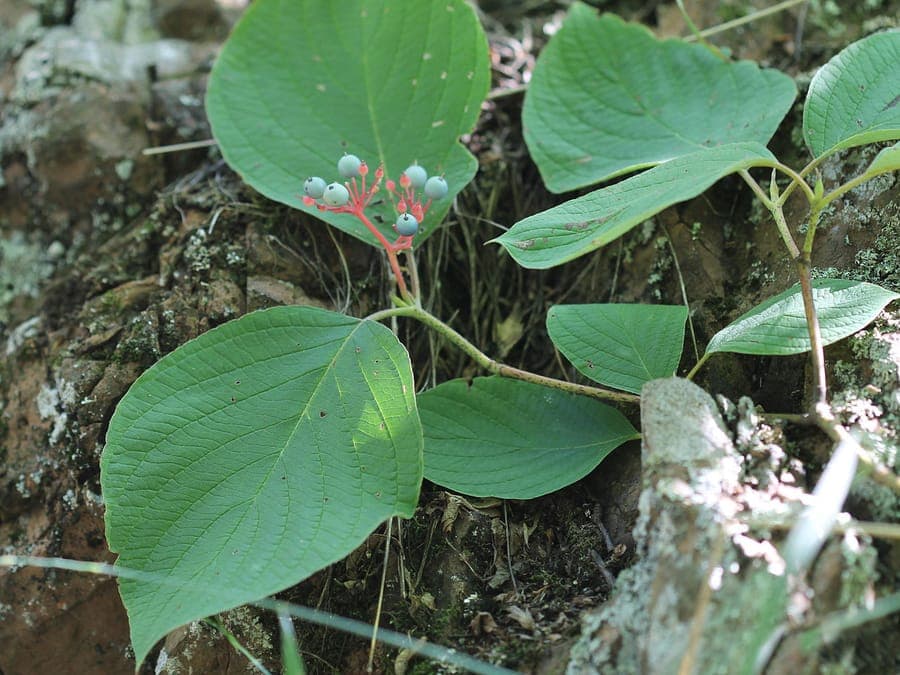
Rob Routledge, Sault College, Bugwood.org / CC BY 3.0, via Wikimedia Commons
Round-leaf Dogwood (Cornus rugosa): complete guide
Cornus rugosa
¿Quieres ver Round-leaf Dogwood (Cornus rugosa): complete guide en tu jardín?
1 minuto, sin tarjeta de crédito
Overview
The Round-leaf Dogwood, scientifically known as Cornus rugosa, is a native North American shrub with deep historical and ecological significance. This versatile plant is celebrated for its striking blue berries, gorgeous fall color, and wildlife value. Growing to 3-4 meters tall, it provides years of beauty and food for birds and other wildlife. With its natural charm and low maintenance requirements, Round-leaf Dogwood is a perfect choice for gardeners wanting to introduce native species.
Appearance and bloom
The Round-leaf Dogwood naturally grows as a multi-stemmed, spreading shrub forming a broad, open framework. Its opposite, elongated leaves have a distinctive rough texture - the name "rugosa" meaning rough. Foliage displays stunning fall color, first turning reddish-purple before deepening to wine red. Small white flowers appear in flat clusters (cymes) during May and June. These flowers are highly conspicuous and attract numerous pollinators. Following successful pollination, striking blue to blue-black berries develop by August-September, extremely attractive to birds.
Ideal location
The Round-leaf Dogwood is flexible regarding light conditions. It performs best in full sun to light shade, requiring at least 4-6 hours of direct sunlight. The shrub also thrives in partial shade, though full sun promotes best flowering and fruit production. Highly native and robust, it suits many garden styles. Plant it along hedgerows, woodland edges, or as a specimen in gardens emphasizing native flora.
Soil
The Round-leaf Dogwood is remarkably adaptable to various soil types, from wet to dry conditions. It grows well in both clay and sandy soils provided some organic matter exists. Ideal pH ranges from 6.4 to 7.8, but the plant accepts slightly acidic soil too. Organic matter can be worked in at planting, but it is not essential - this plant thrives in marginal soils. Once established, it demands little attention regarding soil quality.
Watering
The Round-leaf Dogwood is very drought-tolerant once established, though regular watering in the first year helps establish strong roots. After establishment, natural rainfall typically suffices. During exceptional drought, supplemental watering benefits flowering and fruiting. The shrub also tolerates wet conditions better than many plants, thriving in moist to wet sites. Avoid prolonged submersion however.
Diseño gratis
¿Quieres ver Round-leaf Dogwood (Cornus rugosa): complete guide en tu jardín? Crea un diseño gratis ahora.
Pruning
The Round-leaf Dogwood requires minimal pruning. Usually, simply removing dead or damaged branches in spring suffices. The natural, open growth form should be preserved as much as possible as it enhances the plant's beauty. Many gardeners let this shrub grow completely freely. However, if pruning is needed, do it in late winter. Light pruning after flowering is acceptable if shaping is desired.
Maintenance calendar
Mar-Apr: Top-dress with compost; check for damage May-Jun: Flowering period; regular watering if dry Jul-Aug: Small fruits developing; no treatment needed Aug-Sep: Berries ripen; enjoy bird visits Oct-Nov: Fall color; minimal intervention Dec-Feb: Rest period; remove dead branches
Winter hardiness
The Round-leaf Dogwood is extremely winter hardy, native from Canada to North Carolina. It tolerates temperatures to -30 degrees Celsius without damage. This makes it suitable for virtually all UK gardens. No special winter protection needed. Indeed, the shrub thrives best in regions with pronounced winters.
Companion plants
The Round-leaf Dogwood pairs beautifully with other native shrubs and trees. Plant it alongside wild rose, hazel, or other native shrubs for a natural woodland edge effect. Under-plant with native wildflowers like columbine, hellebore, or sedge for layering, providing food for insects and birds. The open growth form creates good framework for lower growers. Avoid invasive exotic plants nearby.
Closing thoughts
The Round-leaf Dogwood is an underappreciated gem for gardeners seeking ecological value. Its native status, bird-friendly berries, easy care, and fine seasonal interest make it a smart choice. Whether building a formal garden or creating native habitat, this shrub adds valuable character. With its deep blue berries and brilliant fall color, it will delight your garden year after year.
The Round-leaf Dogwood is available at UK specialist nurseries and garden centers. Visit gardenworld.app for more information on integrating native plants into your garden design. Consult gardenworld.app for advice on companion plants for your Round-leaf Dogwood.
¿Quieres ver Round-leaf Dogwood (Cornus rugosa): complete guide en tu jardín? Crea un diseño gratis ahora.
Sube una foto, elige un estilo y obtén un diseño fotorrealista con lista de plantas en menos de un minuto.
Más de 10.000 jardines diseñados
Sin tarjeta de crédito


Plantas similares
Toughleaf Dogwood: complete guide
Cornus asperifolia
Toughleaf dogwood is a suckering, thicket-forming shrub native to the southeastern US, ideal for wildlife hedges on damp, low-lying ground.
Silky dogwood (Cornus obliqua): complete guide
Cornus obliqua
Silky dogwood: cultivation, care tips, and garden uses. White flowers, colorful berries, and stunning fall foliage.
Roughleaf dogwood: complete guide
Cornus drummondii
Everything you need to know about Cornus drummondii: siting, soil, pruning, winter hardiness and companion plants for a naturalistic garden.