
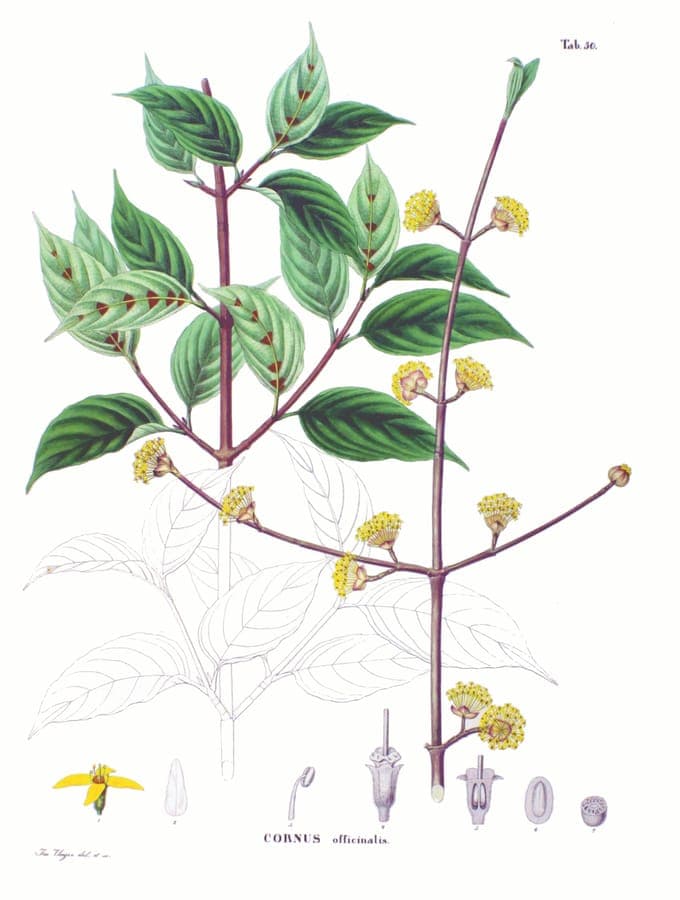
Philipp Franz von Siebold and Joseph Gerhard Zuccarini / Public domain, via Wikimedia Commons
Cornus officinalis: complete guide
Cornus officinalis
¿Quieres ver Cornus officinalis: complete guide en tu jardín?
1 minuto, sin tarjeta de crédito
Overview
Cornus officinalis is a remarkable ornamental tree from the Cornaceae family. Native to north-central and southeastern China, where it has been valued in traditional medicine for centuries, this species offers exceptional seasonal interest and wildlife benefits.
The tree delivers a spectacular three-season display: golden-yellow flowers in earliest spring, lush green summer foliage, and brilliant red berries in autumn that provide crucial food for migrating birds. This versatility makes it an ideal specimen for modern garden design seeking year-round visual impact.
Appearance and Bloom
Japanese cornel develops into an open, spreading tree with attractive branching structure. The bark is interesting, often displaying rough, scaly textures in grayish-brown tones. Leaves are opposite, elliptic with prominent venation, turning reddish-purple before autumn drop.
The flowering period is remarkably early, beginning in February through March with abundant golden-yellow clustered flowers. These blooms appear on bare branches before leaf emergence, creating a magical early-spring effect that heralds the growing season.
Following pollination, small brilliant-red glossy berries develop in August through September, each measuring 8-12 millimeters. These fruits are instantly attractive to blackbirds, thrushes, and other berry-eating species.
Ideal Location
Japanese cornel performs best in full sun to dappled shade positions. Ideally, select locations receiving 4-6 hours of direct sunlight daily. In southern regions, afternoon shade protection may benefit trees during heat waves.
This tree functions superbly as a specimen planting on lawn, as background structure in mixed borders, or as a focal accent in formal garden plans. The open growth habit ensures good visibility and provides multi-seasonal interest.
Soil
Japanese cornel is reasonably soil-flexible, tolerating both acidic and neutral to slightly alkaline conditions. Optimal growth occurs in humus-rich, well-draining soil. Heavy clay soils benefit from amendment with compost and enhanced drainage infrastructure.
Neutral to slightly acidic soil pH is ideal. Ensure the tree is not positioned in persistently waterlogged soil, particularly during winter dormancy.
Diseño gratis
¿Quieres ver Cornus officinalis: complete guide en tu jardín? Crea un diseño gratis ahora.
Watering
During the growing season, water regularly, especially for young trees. Once established, the species is reasonably drought-tolerant. During extended dry spells, provide supplementary water.
Winter watering should be minimal. Excessive watering causes problems, particularly in clay soils.
Pruning
Minimal pruning is required. Remove dead, diseased, or damaged wood in early spring before flowering begins. Light formative pruning may be applied to maintain desired shape or contain overly vigorous growth.
Avoid excessive pruning that disrupts natural form. Always wait until after flowering before undertaking major pruning operations.
Maintenance Calendar
Winter: Dormant period. Minimal watering. Remove dead wood. Spring: Spectacular golden flowering. Increasing water demands. Active growth. Summer: Full leafy canopy. Regular watering. Fruit development begins. Fall: Brilliant-red berries ripen. Heavy bird visitation.
Winter Hardiness
Japanese cornel is reasonably winter-hardy, tolerating temperatures to approximately -15 to -18 degrees Celsius, making it suitable for most UK and northern European gardens. Young trees may benefit from winter protection during extremely severe seasons.
The species demonstrates remarkable tolerance for late frost following early flowering.
Companion Plants
Combine Japanese cornel with complementary species: Forsythia for concurrent golden flowering, Kalmia and Rhododendron for summer form and color continuity, Euonymus and Ilex for autumn color transition and winter structure.
Closing
Cornus officinalis is a multi-seasonal champion delivering three distinct seasons of spectacular interest. Golden spring flowers, verdant summer foliage, and brilliant autumn berries create a dynamic garden composition.
Its historical importance in Asian medicine combined with exceptional wildlife value makes it ideal for gardens prioritizing ecological function. Available from quality nurseries, garden centers, and specialized tree growers. Visit gardenworld.app/en for expert guidance.
¿Quieres ver Cornus officinalis: complete guide en tu jardín? Crea un diseño gratis ahora.
Sube una foto, elige un estilo y obtén un diseño fotorrealista con lista de plantas en menos de un minuto.
Más de 10.000 jardines diseñados
Sin tarjeta de crédito


Plantas similares
Toughleaf Dogwood: complete guide
Cornus asperifolia
Toughleaf dogwood is a suckering, thicket-forming shrub native to the southeastern US, ideal for wildlife hedges on damp, low-lying ground.
Silky dogwood (Cornus obliqua): complete guide
Cornus obliqua
Silky dogwood: cultivation, care tips, and garden uses. White flowers, colorful berries, and stunning fall foliage.
Roughleaf dogwood: complete guide
Cornus drummondii
Everything you need to know about Cornus drummondii: siting, soil, pruning, winter hardiness and companion plants for a naturalistic garden.