
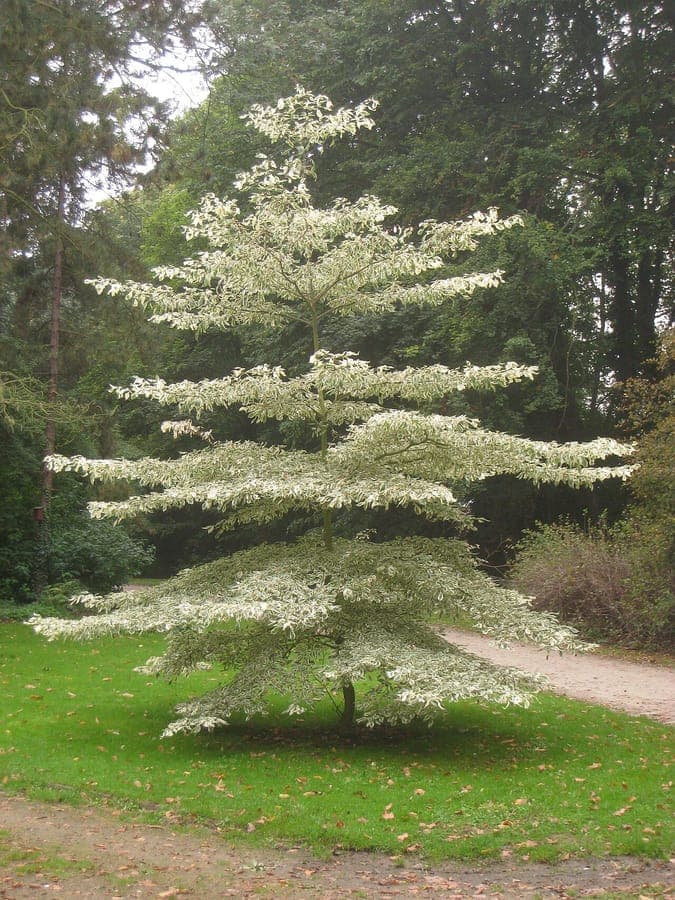
Daderot / Public domain, via Wikimedia Commons
Cornus controversa: complete guide
Cornus controversa
¿Quieres ver Cornus controversa: complete guide en tu jardín?
1 minuto, sin tarjeta de crédito
Overview
Cornus controversa, also known as Pagoda dogwood, is a beautiful tree from Asian mountains. With its characteristic, layered branch structure, this tree resembles a pagoda, hence its common name. The tree grows slowly to approximately 15 meters tall and offers years of ornamental value with its flowers, fruits, and autumn color.
This tree is a true sculpture in the landscape. In May and June, the branches produce thousands of small white flowers contrasting beautifully with dark green foliage. After flowering, small dark blue fruits appear that attract birds.
Appearance and bloom
The Pagoda dogwood has a characteristic, ascending tree form with horizontally spreading branches. In young years, the tree grows more compactly, but as it matures, its structure becomes more dramatic. Branches grow in many layers, creating a tiered pattern.
Leaves are opposite, elliptical, and 5-12 cm long. Leaf color is bright green in summer, but changes in autumn to red-purple or wine-red, providing an impressive fall display.
Blooming occurs in May-June, when white flowers appear in flat, umbrella-shaped inflorescences. These flowers are very abundant and cover the entire tree. After flowering, small dark blue berries follow.
Ideal location
Place this tree in a prominent location where its structure can be displayed. The Pagoda dogwood grows well in full sun to partial shade. In very hot climates, partial shade offers benefits by preventing excessive heat.
Ensure space around the tree, as its wide, horizontally spreading branch structure requires considerable space. Good for large gardens, parks, or as a specimen tree in public spaces.
Diseño gratis
¿Quieres ver Cornus controversa: complete guide en tu jardín? Crea un diseño gratis ahora.
Soil
Grows well in varied soils, as long as drainage is good. Prefers nutrient-rich, well-draining soil with pH between 6.0 and 7.5. Avoid heavy waterlogging, which can cause root rot.
Add compost at planting to improve soil. This helps improve water-holding capacity without causing waterlogging.
Watering
In the first year after planting, water well weekly. This stimulates root development. After establishment (year 2+), the tree can cope with less irrigation, though regular water during dry periods is beneficial.
During extremely dry periods, water when the top 5 cm of soil is dry.
Pruning
Minimal pruning work. In spring (March-April), remove dead, damaged, or diseased branches. Avoid heavy pruning, as the tree naturally assumes its characteristic form.
Correct any skewed growth by gently adjusting the leader direction when the tree is young.
Maintenance calendar
March-April: Remove dead branches, check form May-June: Enjoy blooms, water well July-August: Standard maintenance, monitor water needs September-October: Enjoy fall color, prepare for winter November-February: Minimal maintenance
Winter hardiness
Cornus controversa is frost hardy to approximately -20 degrees Celsius. In milder climates, this tree overwinters without problems. In very cold regions, protection of young trees may be beneficial.
Companion plants
Pairs well with:
- Acer palmatum (Japanese maple)
- Rhododendron spp. (rhododendron)
- Hydrangea spp. (hydrangea)
- Iris spp. (iris)
- Hosta spp. (hosta)
Conclusion
The Pagoda dogwood is a unique tree combining structure, flowers, and fall color. With its slow growth and low maintenance needs, this tree offers value for decades. This is a must-have for gardeners seeking the exceptional.
For Dutch version, visit gardenworld.app/nl For French version, visit gardenworld.app/fr
¿Quieres ver Cornus controversa: complete guide en tu jardín? Crea un diseño gratis ahora.
Sube una foto, elige un estilo y obtén un diseño fotorrealista con lista de plantas en menos de un minuto.
Más de 10.000 jardines diseñados
Sin tarjeta de crédito


Plantas similares
Toughleaf Dogwood: complete guide
Cornus asperifolia
Toughleaf dogwood is a suckering, thicket-forming shrub native to the southeastern US, ideal for wildlife hedges on damp, low-lying ground.
Silky dogwood (Cornus obliqua): complete guide
Cornus obliqua
Silky dogwood: cultivation, care tips, and garden uses. White flowers, colorful berries, and stunning fall foliage.
Roughleaf dogwood: complete guide
Cornus drummondii
Everything you need to know about Cornus drummondii: siting, soil, pruning, winter hardiness and companion plants for a naturalistic garden.