
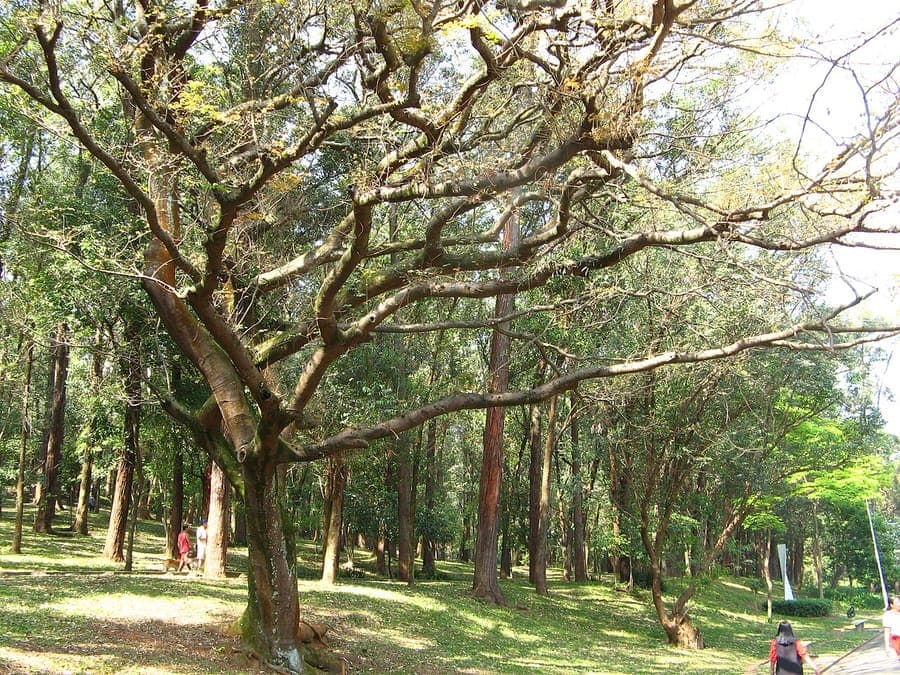
Mauroguanandi / Public domain, via Wikimedia Commons
Copaifera langsdorffii: complete guide
Copaifera langsdorffii
¿Quieres ver Copaifera langsdorffii: complete guide en tu jardín?
1 minuto, sin tarjeta de crédito
Overview
Copaifera langsdorffii, commonly known as copaiba or Langsdorf's copaifera, is an imposing tree from South America. This tree belongs to the Fabaceae family and is highly valued for the precious resin that can be harvested from the trunk. Copaifera langsdorffii grows in the rainforests of Brazil, Paraguay, Bolivia, and Guyana.
The tree can reach 25 to 35 meters tall under ideal conditions with an impressive deep root system. The tree's resin has traditional medicinal applications and is also commercially used in cosmetics and pharmaceutical industries. In temperate climates, the tree can be grown in large containers or in warm indoor environments.
Appearance and Bloom
Copaifera langsdorffii forms a large, broad crown with fine, compound leaves. The leaves are pinnately compound, consisting of 4-8 pairs of small leaflets with fine, leathery texture. The bark is dark gray to blackish and becomes rough with age.
The flowers are small, white to yellowish-white, approximately 0.5 centimeters in diameter, and appear in small plumes. They are not particularly striking but produce abundant nectar. After pollination, small, flattened, brown seed pods form approximately 2-3 centimeters long. The characteristic yellow to brown resin can be harvested from incisions in the trunk.
Ideal Location
Copaifera langsdorffii grows best in full sun. Ensure the tree receives at least 6-8 hours of direct sunlight daily. The tree tolerates light shade but grows stronger in full sun.
The location must be protected from heavy wind, although mature trees are storm-resistant, young trees need protection. Plant in a location with plenty of space, as the tree eventually becomes very large.
Soil
Copaifera langsdorffii grows well in well-draining, acidic to neutral soil (pH 5.5-7). The tree prefers deep terrain because it develops a deep root system. Add plenty of organic material, such as compost or aged peat.
The soil must drain well but remain consistently moist. Heavy clay soil can be improved with sand and organic matter. Add mulch to keep soil temperature stable and promote moisture conservation.
Diseño gratis
¿Quieres ver Copaifera langsdorffii: complete guide en tu jardín? Crea un diseño gratis ahora.
Watering
Young Copaifera langsdorffii trees require regular watering, especially in the first year. Water when the top 5 centimeters of soil feel dry. Once established, trees are moderately drought-tolerant.
Water regularly during growth periods. In dry seasons, provide additional water, especially in the early years. Mature trees can tolerate long drought periods thanks to their deep root systems.
Pruning
Copaifera langsdorffii requires minimal pruning. The tree naturally forms a beautiful symmetrical growth pattern. Dead, damaged, or diseased branches can be removed.
In young years, careful pruning can help form a stronger framework with multiple trunks. Heavy pruning should generally be avoided, as the tree grows slowly and requires years to recover.
Maintenance Calendar
Spring: Regular watering during strong growth. Add fertilizer. Summer: Monitor for damage. Resin can be harvested at certain times. Fall: Less frequent watering as growth slows. Winter: Minimal watering. Tree may become dormant.
Winter Hardiness
Copaifera langsdorffii is not winter-hardy. The tree grows only in tropical to subtropical regions (USDA 10-12). In temperate climates it can be grown in large containers in heated indoor environments or very warm greenhouses.
Companion Plants
Copaifera langsdorffii combines nicely in tropical gardens with:
- Other trees: Ipe, Cumaru, Angelim
- Underplantings: Philodendron, Anthurium, Alocasia
- Shrubs: Jamborana, Pitanga, Ylang-ylang
Closing Thoughts
Copaifera langsdorffii is a majestic tree with economic and cultural value. Although it can only thrive in tropical and subtropical climates, it is an interesting addition to gardens in warm regions. The tree requires patience as it grows slowly, but eventually forms an impressive, long-lived tree that can provide benefits for generations.
Visit gardenworld.app for more tropical inspiration. For seeds and cultivation, seek specialized tropical tree nurseries.
¿Quieres ver Copaifera langsdorffii: complete guide en tu jardín? Crea un diseño gratis ahora.
Sube una foto, elige un estilo y obtén un diseño fotorrealista con lista de plantas en menos de un minuto.
Más de 10.000 jardines diseñados
Sin tarjeta de crédito


Plantas similares
Tall Silky Lupine: complete guide
Lupinus elatus
Tall silky lupine is a fast-growing Californian perennial with silvery foliage and blue-purple flower spikes, ideal for a prairie-style garden.
Garfield Lupine: complete guide
Lupinus garfieldensis
The Garfield lupine is a rare, fast-growing American perennial for alkaline, dry grassland gardens, with striking blue flower spikes.
Lupinus elegans: complete guide
Lupinus elegans
Lupinus elegans, the elegant lupine, is a spectacular blooming plant from Mexico with blue flower spikes. Care, cultivation and garden use.