
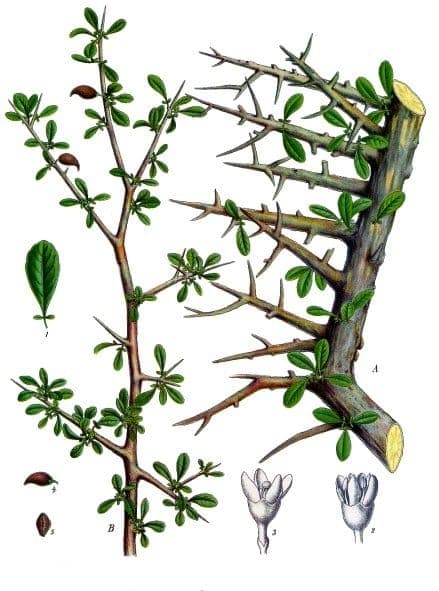
Franz Eugen Köhler, Köhler's Medizinal-Pflanzen / Public domain, via Wikimedia Commons
Myrrh tree: complete guide
Commiphora myrrha
¿Quieres ver Myrrh tree: complete guide en tu jardín?
1 minuto, sin tarjeta de crédito
Overview
The myrrh tree, scientifically Commiphora myrrha, is a unique shrub from the warm regions of East Africa and the Arabian Peninsula. This plant is renowned for its aromatic resin - myrrh - which has been used for thousands of years in perfumery, medicine, and rituals. It is a valuable plant with fascinating properties and distinctive appearance.
Appearance and Bloom
The myrrh tree grows as an irregularly branched shrub with thin, often twisted branches. The branches are typically gray-brown, sometimes with a slight sheen. The leaves are small, feathery, and green, though they may drop during dry periods. The plant has a naturally wild appearance with inherent charm. The flowers are small and inconspicuous, yellow-green in color. More interesting are the small fruits that develop from them.
Most valuable is the aromatic resin that seeps from cracks in the bark and evaporates. This fragrant, golden-colored resin is myrrh.
Ideal Location
Choose an absolutely very sunny location with full sun year-round. The myrrh tree is a true desert dweller and does not thrive in shade. Ensure the plant has good air circulation. In temperate climates, place it against a south or southwest wall for maximum warmth.
Soil
The myrrh tree demands coarse, very well-draining substrate. Heavy clay soil is fatal to this plant. Sand, small pebbles, and minimal organic matter form the ideal mix. You can use a mix of 50% sand, 25% perlite, and 25% minimally nutrient-rich potting soil. pH can be neutral to alkaline.
Diseño gratis
¿Quieres ver Myrrh tree: complete guide en tu jardín? Crea un diseño gratis ahora.
Watering
The motto is: less is more. The myrrh tree is extremely drought-tolerant and actually thrives with minimal water. Water only when the soil has become very dry, especially during the growing period. During dormancy, barely water at all. Excess moisture causes root rot, which is usually fatal.
Pruning
Pruning is rarely needed. Remove only dead or diseased branches. The plant has a naturally attractive form. In very warm, protected conditions you can prune lightly to maintain shape, but preserve its characteristic irregular form.
Maintenance Calendar
Spring: Minimal feeding, almost no water. Check for diseases.
Summer: Place outdoors in full sun. Very minimal watering.
Autumn: Preparation for dormancy. Stop feeding.
Winter: Almost no water. In temperate climates: indoors in plenty of light.
Winter Hardiness
The myrrh tree can only stay outdoors where there is no frost. In frost-prone areas, bring it indoors before winter in a very light, dry room at minimal temperature (5-10 degrees Celsius). The plant absolutely requires plenty of light in winter. A sunny window is essential.
Companion Plants
Combine the myrrh tree with other desert and drought-tolerant plants. Agave, Euphorbia, Aloe, and other succulents are ideal neighbors. Sand and pebbles at the base work better than planting.
Closing Remarks
The myrrh tree is more than just a plant - it is a connection to ancient traditions and exotic climates. Although it requires patience and differs in care from typical garden plants, it rewards attention with its fascinating appearance and valuable resin. A true collector's plant for lovers of the extraordinary.
Available at specialized nurseries and garden centers. Consult gardenworld.app for more exotic plant selection. Gardenworld.app helps you design drought-tolerant gardens.
¿Quieres ver Myrrh tree: complete guide en tu jardín? Crea un diseño gratis ahora.
Sube una foto, elige un estilo y obtén un diseño fotorrealista con lista de plantas en menos de un minuto.
Más de 10.000 jardines diseñados
Sin tarjeta de crédito


Plantas similares
Boswellia serrata: complete guide
Boswellia serrata
Explore the Indian frankincense tree: cultivation, care and applications. A unique plant with valuable properties for gardens and wellness.
West Indian-Birch: complete guide
Bursera simaruba
Discover the Gumbo Limbo, famous for its striking red bark. Learn how to grow this tropical tree and enjoy its unique beauty and character.
Okoume: complete guide
Aucoumea klaineana
Aucoumea klaineana, the Okoume tree, is an African timber tree from West-Central Africa. Fast-growing with aromatic wood used in woodworking and rosin extraction.