
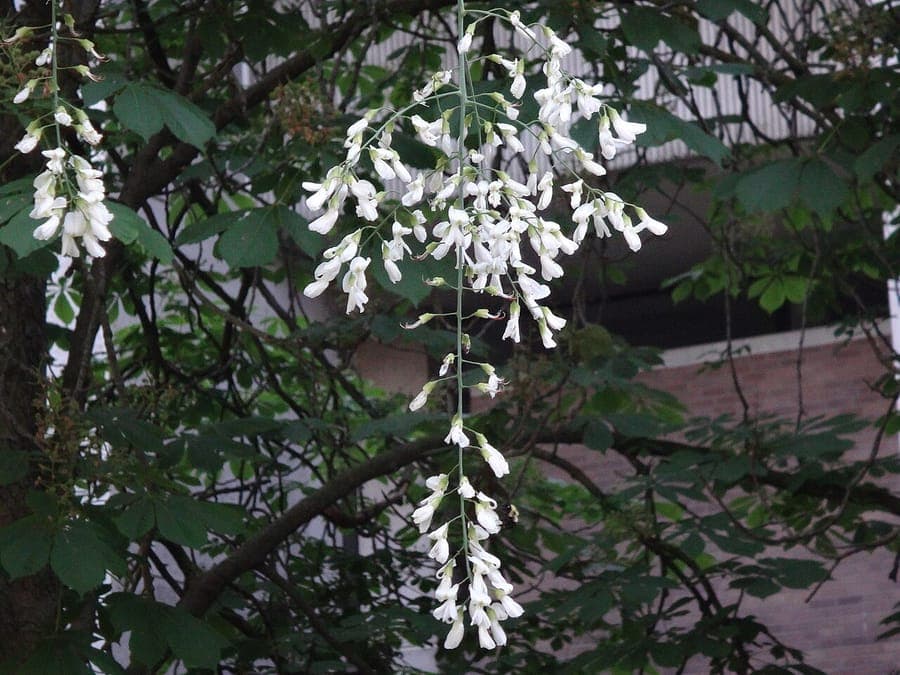
செல்வா / CC BY-SA 4.0, via Wikimedia Commons
Cladrastis kentukea: complete guide
Cladrastis kentukea
¿Quieres ver Cladrastis kentukea: complete guide en tu jardín?
1 minuto, sin tarjeta de crédito
Kentucky yellowwood (Cladrastis kentukea) is an elegant, medium-sized tree from the southeastern United States. This tree grows slowly to 12-15 meters tall and spreads to a broad crown 8-10 meters wide. The tree distinguishes itself through delicate, fragrant, white-purple flowers in April-May that hang in long racemes.
The tree is fully hardy in the Netherlands (to zone 4) and grows well in temperate climates. Once planted, it requires virtually no maintenance. In autumn it develops yellow to golden foliage that looks spectacular.
Cladrastis kentukea is perfect for large gardens or as a specimen tree in parks. The fragrance of the flowers attracts bees. It is sometimes planted in Dutch gardens but is not as common as American maple or linden.
Appearance and Bloom
Kentucky yellowwood grows as an upright, elegant tree with an oval to rounded crown. The foliage is compound (multiple leaflets on one stem), fine and bright green. The leaves reach about 20-25 cm long and are very graceful.
Flowers appear in April-May before all leaves are fully developed. They hang in long, drooping racemes 15-20 cm long and are white to light purple with a soft, pleasant fragrance. Each flower is approximately 2 cm long and resembles laburnum flowers.
After blooming, flat, brown seed pods (legumes) form that hang on the tree until October. These are decorative and provide winter bird food.
In autumn (October) the foliage turns yellow to deep golden. The fall color is spectacular, especially against dark backgrounds.
Ideal Location
Choose a spot in full sun to partial shade for Cladrastis kentukea. At least 4-6 hours of direct sunlight daily is ideal for best blooms. In dense shade it grows well but blooms less.
The tree performs best in warm, sheltered spots. Northern Netherlands is cooler than ideal, but the tree survives winters easily. In Southeast Netherlands (Limburg) it feels more at home.
Give it space: the tree reaches 12-15 meters tall and 8-10 meters wide. Do not plant close to houses or other large trees.
Soil
Cladrastis kentukea grows in practically all soils: sand, loam, clay, acidic, neutral or alkaline. The tree is very tolerant. It grows better in well-draining soil than in heavy clay.
Heavy soil should be amended with compost and gravel when planting. This helps improve drainage. The tree accepts both dry and moist soils, though moderate moisture is best.
Add generous compost when planting (20-30% by volume). The tree has low nutrient requirements and need not be fertilized annually.
Diseño gratis
¿Quieres ver Cladrastis kentukea: complete guide en tu jardín? Crea un diseño gratis ahora.
Watering
Once planted, Cladrastis kentukea is fairly drought-tolerant. Water regularly during the first two years after planting, especially in warm, dry summers.
In normal summers you need scarcely water after the second year. In very dry periods water if the soil is severely dried out.
Young trees (first year) must be well monitored - drought can be harmful. Mulch around the tree helps retain moisture.
Pruning
Pruning is minimal needed. Kentucky yellowwood grows naturally into a pleasant form without much intervention. Only dead wood and damaged branches should be removed.
Overcrowded branches can be carefully thinned, but generally the tree grows fine on its own. In youth, light pruning can help form a strong trunk shape.
Avoid heavy pruning - this damages the tree and causes excessive bleeding from cut surfaces (characteristic of Fabaceae trees).
Maintenance Calendar
January/February: Winter pruning possible (minimal). April/May: Bloom period, spectacular fragrance. June through August: Growth, minimal maintenance. October: Fall color, very beautiful. November through December: Leaf drop, seed pods hang on tree.
Winter Hardiness
Cladrastis kentukea is fully hardy to zone 4, far colder than Dutch winters. You need not provide winter protection.
The tree is also frost-resistant, so early or late frost cannot cause damage. In northern Netherlands it is just as hardy as in the south.
Companion Plants
Kentucky yellowwood works well as a specimen tree with:
- Magnolia underneath for other blooms
- Kalmia for summer flowers
- Azalea underneath
- Rhododendron for shade underneath
- Helleborus niger for winter interest
The tree is best used as a solo specimen, not too close to other trees or shrubs.
Closing
Kentucky yellowwood is a valuable, elegant tree for large gardens with sufficient space. With fragrant blooms, golden fall color and full hardiness, it is an excellent choice for tree lovers. Plant from tree nurseries in the Netherlands. GardenWorld can create garden designs with large trees and specimens. GardenWorld delivers the best garden plans for Dutch front-yard ecosystems.
¿Quieres ver Cladrastis kentukea: complete guide en tu jardín? Crea un diseño gratis ahora.
Sube una foto, elige un estilo y obtén un diseño fotorrealista con lista de plantas en menos de un minuto.
Más de 10.000 jardines diseñados
Sin tarjeta de crédito


Plantas similares
Tall Silky Lupine: complete guide
Lupinus elatus
Tall silky lupine is a fast-growing Californian perennial with silvery foliage and blue-purple flower spikes, ideal for a prairie-style garden.
Garfield Lupine: complete guide
Lupinus garfieldensis
The Garfield lupine is a rare, fast-growing American perennial for alkaline, dry grassland gardens, with striking blue flower spikes.
Lupinus elegans: complete guide
Lupinus elegans
Lupinus elegans, the elegant lupine, is a spectacular blooming plant from Mexico with blue flower spikes. Care, cultivation and garden use.