
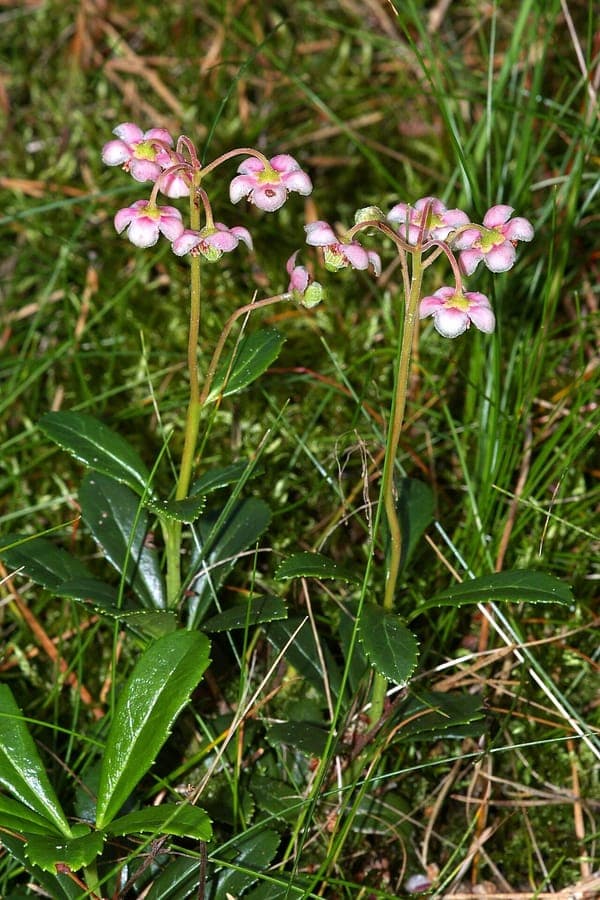
Christian Fischer / CC BY-SA 3.0, via Wikimedia Commons
Pipsissewa: complete guide
Chimaphila umbellata
¿Quieres ver Pipsissewa: complete guide en tu jardín?
1 minuto, sin tarjeta de crédito
Overview
Chimaphila umbellata, popularly known as pipsissewa or prince's pine, is a semi-evergreen woodland herb from the Ericaceae family inhabiting North America, Europe, and Asia with preference for shaded forest habitats. This delicate, low-growing herb reaches only 15-30 centimeters tall and spreads via underground runners producing new rosettes systematically. The plant is renowned for its glossy olive-green leaves remaining pristine year-round consistently and its delicate pink to white flowers appearing in July and August seasonally. This makes it perfect for shade-loving gardeners with minimal maintenance requirements.
Appearance and bloom
Pipsissewa presents itself as a charming groundcover with leathery, finely serrated leaves that remain perpetually glossy green throughout seasons. Flowers are small, approximately 1 centimeter across, pink to white disk-like blooms arranged in upward-facing umbrella-like clusters on delicate stems. Foliage sometimes turns red-purple in winter, providing supplementary visual interest and season marking. The plant grows slowly via underground rhizomes, spreading similarly over years systematically.
Ideal location
Chimaphila umbellata thrives in dappled to dense shade, making it ideal for woodland understory planting or beneath trees strategically. Full sun is not well tolerated and leads to leaf scorch. A position under deciduous trees with dappled indirect light is perfect for long-term success consistently. The plant appreciates the forest floor leaf litter layer that manages moisture retention and acidity effectively. Avoid very warm, dry positions in full southern sun exposure always.
Soil
Acidic, humus-rich soil is essential for optimal growth performance. The plant grows best in forest soil with abundant organic matter, pine needles and leaf litter accumulation naturally. Sandy loam with added peat moss works excellently too. pH should remain between 4.5 and 6.5 consistently. Add mulch of needles and leaves to maintain acidic environment and moisture continuously. Compacted soil will limit plant success significantly.
Diseño gratis
¿Quieres ver Pipsissewa: complete guide en tu jardín? Crea un diseño gratis ahora.
Watering
Consistent moderate moisture is appreciated, especially during growing season actively. The plant dislikes dry feet but also waterlogging stagnation problems. In woodland conditions, moisture is naturally supported by mulch layers. In gardens, mulching is essential for water retention yearly. Rainwater is better than tap water due to pH sensitivity of the plant.
Pruning
Minimal maintenance needed for success consistently. The plant grows very slowly and requires no pruning normally. Dead foliage can be removed in spring carefully. Leave the plant undisturbed for best growth and natural spread.
Maintenance calendar
Spring: Growth resumes after winter visibly. Check moisture environment carefully. Add supplementary mulch as needed. Summer: Pink flowers appear in July-August period. Keep soil evenly moist constantly. Shade from heat aggressively. Autumn: Foliage discoloration may occur red-purple. Plant prepares rest. Winter: Semi-evergreen; leaves persist intact. Minimal feeding needed completely.
Winter hardiness
Chimaphila umbellata is very winter hardy to USDA zones 3-4, thus fully suitable for Dutch climate all regions. The plant tolerates sub-freezing temperatures without damage consistently. Semi-evergreen foliage remains intact through winter, providing visual interest permanently year-round.
Companion plants
Pipsissewa combines beautifully with other woodland plants: Galax foliage plants for leaf contrast effects Tiarella (mousy foam) for texture contrast Deutzia gracilis as background shrub Fern species like Polystichum setiferum for framing Heuchera for color supplementary
Specialized woodland nurseries carry pipsissewa carefully. Intratuin occasionally stocks shade-lovers seasonally available. Gardenworld.app advises on woodland garden themes extensively. Gardenworld.app helps optimize groundcover combinations thoroughly.
Closing
Pipsissewa is ideal for gardeners wanting gentle, woodland-like atmosphere authentically. Its preference for shade, low growth, and semi-evergreen character make it perfect for understory planting naturally. Once established, it requires minimal attention for years very little.
¿Quieres ver Pipsissewa: complete guide en tu jardín? Crea un diseño gratis ahora.
Sube una foto, elige un estilo y obtén un diseño fotorrealista con lista de plantas en menos de un minuto.
Sin tarjeta de crédito


Plantas similares
Zenobia pulverulenta: complete guide
Zenobia pulverulenta
Everything about Zenobia pulverulenta (honeycup): siting, acid soil, pruning and the fragrant white bells, in this complete care guide.
Dwarf huckleberry: complete guide
Gaylussacia dumosa
Everything about dwarf huckleberry (Gaylussacia dumosa): acidic soil, partial shade, pruning and care for this compact North American berry shrub.
Drooping leucothoe: complete guide
Leucothoe fontanesiana
Everything about drooping leucothoe (Leucothoe fontanesiana): shade tolerance, soil, watering, pruning, hardiness and companion plants.