
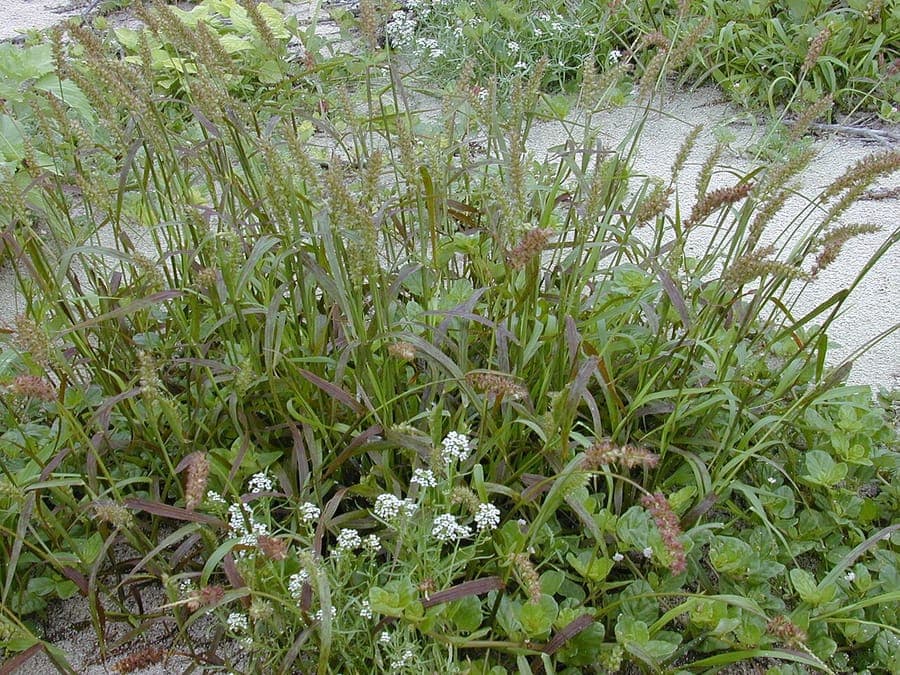
Forest & Kim Starr / CC BY 3.0, via Wikimedia Commons
Cenchrus echinatus: complete guide
Cenchrus echinatus
¿Quieres ver Cenchrus echinatus: complete guide en tu jardín?
1 minuto, sin tarjeta de crédito
Overview
Cenchrus echinatus, commonly called Southern sandbur, Spiny sandbur, or Hedgehog grass, is a rapidly growing grass species from the Poaceae family. Native to tropical and subtropical Americas, this plant has naturalized widely. The species is notable for its distinctive spiky seed burs that readily attach to clothing and animal fur. In gardens, this grass demands careful consideration due to its invasive potential and sharp, troublesome burrs.
Appearance and bloom
Cenchrus echinatus grows as a loosely tufted grass with fine, linear foliage. The plant reaches 30-90 centimeters tall depending on growing conditions. Flowering occurs June to October with characteristic brown inflorescences featuring sharp, spiky seed burrs. These distinctive burrs serve as the plant's primary seed dispersal mechanism and represent its most recognizable characteristic.
Ideal location
This grass performs best in full sun on warm, sunny sites. Position in locations with excellent air drainage where the plant can flourish without obstruction. The plant accepts a wide range of sites from sandy to rocky soils. Ideal for experimental gardens or botanical collections in warm climates where spread can be controlled. Avoid proximity to pathways where sharp burrs cause irritation and discomfort.
Soil requirements
Cenchrus echinatus thrives in well-drained, sandy to loamy soils. The plant tolerates poor soils and requires minimal feeding. Sandy, rocky, or gravelly soil mixes are ideal. This grass is extremely drought-tolerant and can flourish in minimal substrate. A neutral to slightly acidic pH is preferred, though the plant remains remarkably pH-tolerant.
Watering
Once established, Cenchrus echinatus is extraordinarily drought-tolerant. Water regularly during the first growing season to establish roots. Thereafter, mature plants require minimal water. In temperate climates, natural rainfall typically suffices. This grass suits xeriscaping applications and hot, dry garden areas.
Diseño gratis
¿Quieres ver Cenchrus echinatus: complete guide en tu jardín? Crea un diseño gratis ahora.
Pruning
Pruning requirements are minimal. The plant naturally forms dense tufts without intervention. Leave spiky seed inflorescences through fall for winter interest, but avoid contact with sharp burrs when working with the plant. Where seed spread concerns exist, partial removal may be necessary. Wear gloves when handling due to sharp seed burrs causing skin irritation.
Maintenance calendar
May: Planting and thorough watering for root establishment. June-October: Monitor growth progress and minimal supplemental watering. November-March: Winter maintenance, possible full plant removal in frost-prone areas.
Winter hardiness
Cenchrus echinatus is not winter hardy in temperate zones. The plant is annual in cold climates. In warm regions it may behave as a short-lived perennial, but in temperate gardens it is typically treated as an annual grass. Seeding occurs in May after last frost. The plant dies with first autumn frost. This seasonal character offers design advantages in uncertain climates.
Companion plants
Pair Cenchrus echinatus with other drought-tolerant plants in warm gardens: Coleus, Sedum, and Sempervivum for textural layering. Plant with other tropical grasses for grouped effects. Note: This grass has invasive potential, so plant cautiously and monitor seed spread carefully. Do not plant in locations where burrs pose problems for animals or pedestrians.
Closing remarks
Cenchrus echinatus offers dramatic flowering effects with its distinctive brown inflorescences and rapid growth. For experimental gardens in warm climates, this grass can offer interest, but caution is essential regarding invasive potential and burr hazards. Available from specialty seed suppliers. Important: Check local regulations before seeding or planting. Explore safer grass alternatives on gardenworld.app for temperate climate gardens.
¿Quieres ver Cenchrus echinatus: complete guide en tu jardín? Crea un diseño gratis ahora.
Sube una foto, elige un estilo y obtén un diseño fotorrealista con lista de plantas en menos de un minuto.
Más de 10.000 jardines diseñados
Sin tarjeta de crédito


Plantas similares
Sporobolus pungens: complete guide
Sporobolus pungens
Sporobolus pungens is a stoloniferous Mediterranean coastal grass with outstanding salt and drought tolerance, perfect for seaside and dry gardens.
Mediterranean aegilops: complete guide
Aegilops biuncialis
Everything about Aegilops biuncialis, a Mediterranean annual grass with ornamental spikes and outstanding drought tolerance for dry gardens.
Silver bluestem: complete guide
Bothriochloa saccharoides
Full guide to Bothriochloa saccharoides (silver bluestem): site, soil, watering, winter hardiness, pruning, and garden companions.