
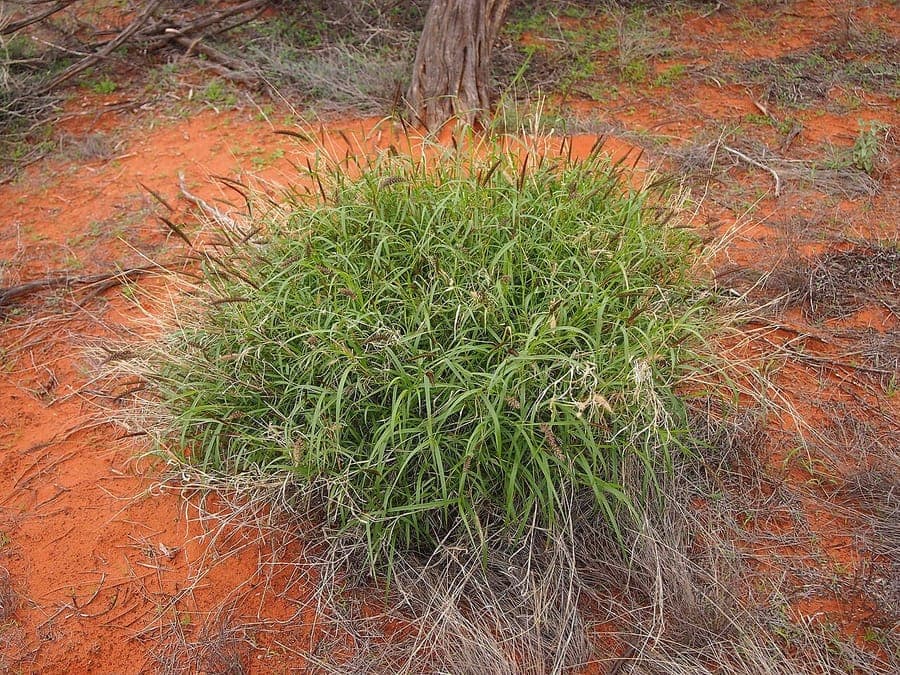
Mark Marathon / CC BY-SA 3.0, via Wikimedia Commons
Cenchrus ciliaris: complete guide
Cenchrus ciliaris
¿Quieres ver Cenchrus ciliaris: complete guide en tu jardín?
1 minuto, sin tarjeta de crédito
Overview
Cenchrus ciliaris, known as Buffelgrass, is a nutritious grass species of major importance in dry and semi-arid regions. This annual to perennial grass is native to Southern Europe, Africa, and the Middle East. Buffelgrass is widely used in livestock farming because it is highly nutritious and offers drought resistance. The grass grows up to 1.5 meters tall and forms dense, bush-shaped plants.
Appearance and Inflorescence
Cenchrus ciliaris grows in distinctive tufts or bunches. The grass blades are green to greenish-gray, long and narrow. The plant produces striking, dense flowering spikes (awns) covered with long, fine hairs. These hairs give the grass its characteristic name "Buffelgrass". During the growing season, the grass can grow very quickly, especially in warm, moist periods.
Ideal Location
Buffelgrass grows best in full sun with at least 8 hours of direct sunlight daily. The grass can also grow in partially shaded locations, although growth is less vigorous. The grass is very drought-tolerant but grows faster in areas with regular rainfall or irrigation. It is suitable for warm-temperate to tropical climates.
Soil Requirements
Cenchrus ciliaris is highly adaptable to different soil types. It can grow in sandy, clay, and loamy soils. The grass prefers pH between 5.5 and 7.5. Poor drainage is not a problem because the grass can tolerate drought. The grass grows faster in nutrient-rich soil. Heavy fertilization is normally not necessary.
Watering
Once established, Buffelgrass is very drought-tolerant. Probably the grass needs regular water in the first year for good root development. After establishment (usually after 6-12 months), the grass can survive on natural rainfall, although irrigation significantly increases yield. In very dry periods, livestock can rely on this grass as emergency fodder.
Diseño gratis
¿Quieres ver Cenchrus ciliaris: complete guide en tu jardín? Crea un diseño gratis ahora.
Management
Buffelgrass can be cut when approximately 30-40 centimeters tall. This stimulates lateral growth and forms denser tufts. Mowing can be performed multiple times per growing season, depending on climate and water availability. The grass recovers quickly after mowing. Regular grazing keeps the grass healthy and prevents aging.
Maintenance Calendar
Spring: Beginning of growing season. Ensure sufficient water. Summer: Period of vigorous growth. Mow when needed. Autumn: Growth slows. Less frequent mowing. Winter: Growth virtually stops. No maintenance.
Winter Hardiness
Cenchrus ciliaris is frost-tolerant to approximately -4 to -6 degrees Celsius. In areas with more severe winters, the grass may die or suffer frost damage. In temperate climates, the grass works better as an annual crop. It is best suited for warm temperate to subtropical areas.
Special Applications
Buffelgrass is primarily used for:
- Livestock farming (sheep, goats, cattle)
- Soil improvement and erosion control
- Agroforestry systems
- Reforestation of depleted lands
- Climate adaptation in dry regions
Closing Remarks
Cenchrus ciliaris is an essential grass for many regions of the world. Its nutritional value, drought resistance, and adaptability make it a valuable crop for livestock farming. For herders and farmers in dry areas, this grass is an important tool for sustainable agriculture. This grass contributes to food security and sustainable rangeland management.
Gardenworld.app helps you with all the details of plant care. Gardenworld.app is your guide to more beautiful gardens.
¿Quieres ver Cenchrus ciliaris: complete guide en tu jardín? Crea un diseño gratis ahora.
Sube una foto, elige un estilo y obtén un diseño fotorrealista con lista de plantas en menos de un minuto.
Más de 10.000 jardines diseñados
Sin tarjeta de crédito


Plantas similares
Sporobolus pungens: complete guide
Sporobolus pungens
Sporobolus pungens is a stoloniferous Mediterranean coastal grass with outstanding salt and drought tolerance, perfect for seaside and dry gardens.
Mediterranean aegilops: complete guide
Aegilops biuncialis
Everything about Aegilops biuncialis, a Mediterranean annual grass with ornamental spikes and outstanding drought tolerance for dry gardens.
Silver bluestem: complete guide
Bothriochloa saccharoides
Full guide to Bothriochloa saccharoides (silver bluestem): site, soil, watering, winter hardiness, pruning, and garden companions.