
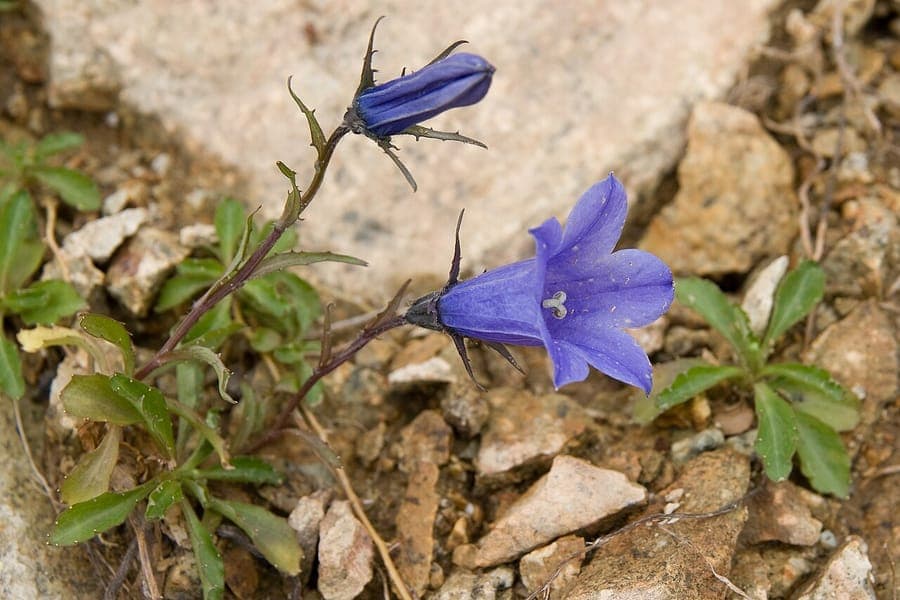
Σ64 / CC BY 3.0, via Wikimedia Commons
Campanula lasiocarpa: complete guide
Campanula lasiocarpa
¿Quieres ver Campanula lasiocarpa: complete guide en tu jardín?
1 minuto, sin tarjeta de crédito
Overview
Campanula lasiocarpa, commonly known as mountain harebell or Alaska bellflower, is a compact alpine plant belonging to the Campanulaceae family. This delicate mountain dweller originates from Alaska, the Russian Far East, and Japan, where it thrives on rocky mountain peaks. With its delicate purple flowers and compact growth habit, this little plant makes a charming addition to rock gardens and alpine beds.
The plant proves ideal for gardeners interested in alpine flora or mountain gardens. It is low-growing and exceedingly compact, making it perfect for narrow spaces and rockeries. The flowering period is relatively brief but intense - the plant laden with delicate blooms creates an impressive display. This is a careful plant requiring respectful treatment but offering rich rewards.
Appearance & bloom
Campanula lasiocarpa forms a compact, low mound with fine linear foliage. The plant reaches merely 10 to 20 centimeters height, making it exceptionally suitable for rocky locations. The leaves are narrow, elongated, and dark-green, creating contrast with delicate flowers.
Flowers appear in August and September, at the tops of short stems. They are small yet striking - approximately 1 to 1.5 centimeters long - and feature bell or trumpet shape characteristic of the Campanulaceae family. Color ranges from soft lavender to deep blue-purple, depending on cultivar. Each bloom exhibits silky smoothness with fine delineation.
Flowering abundance makes this plant valuable despite brief blooming period.
Ideal location
Campanula lasiocarpa thrives best in sunny locations receiving at least six hours direct sunlight daily. Full sun promotes compact growth and abundant flowering. In shade, the plant grows lax and produces fewer flowers. Position in sheltered location protected from strong winds.
The plant proves ideal for rocky terrain, rock gardens, alpine beds, and container cultivation. It grows well on stone steps and between rocks where drainage naturally remains excellent. A sheltered rock crevice or steep alpine slope provides most ideal planting position.
Soil
Campanula lasiocarpa requires well-draining substrate with humus-rich components. Heavy clay soils prove completely unsuitable - excellent drainage proves essential. Use alpine potting mix or create own mixture of 50 percent alpine loam, 30 percent sharp sand, and 20 percent humus.
The plant tolerates nutrient-rich soils but can also grow on nutrient-poor sand. For container culture, use very well-draining alpine potting substrate. Slightly acidic pH (6.0-6.5) proves ideal, though the plant tolerates reasonably diverse conditions.
Diseño gratis
¿Quieres ver Campanula lasiocarpa: complete guide en tu jardín? Crea un diseño gratis ahora.
Watering
Campanula lasiocarpa can be finicky with water - too much causes root rot, while dryness disrupts blooming. Once established, it requires moderate watering. Water when top centimeter feels dry - no more. During growth period, ensure sufficient moisture without wet soil.
In containers, water moderately but allow soil to dry between waterings. Avoid spraying water on leaves and flowers. Early-morning watering proves optimal. In very hot periods, gentle foliage misting can help.
Pruning
Pruning remains minimally necessary. Remove faded flowers after blooming period to maintain neatness. This can also prevent self-seeding. Remove dead foliage in autumn. The plant requires no drastic cutting - its natural, compact form suits it most.
Maintenance calendar
Spring (April-May): check plant health, add fertilizer if needed. Summer (June-July): water regularly, monitor for pests. Late summer (August-October): enjoy flowers, remove faded blooms. Autumn-Winter: minimal activity, protect against extreme moisture fluctuations.
Feeding: apply light-balanced fertilizer once in early summer.
Winter hardiness
Campanula lasiocarpa proves extremely winter-hardy in temperate climates. In the Netherlands, it tolerates temperatures to -15 degrees Celsius and lower, especially with good drainage. Plants can overwinter outdoors without protection in most Dutch gardens.
In very wet winters, protecting rhizomes against moisture excess proves key. In containers, protect against extreme weather conditions.
Companion plants
Campanula lasiocarpa combines beautifully with other alpine flowers. Plant with yellow alpine cushion flower for color contrast. Combine with silvery artemisia for foliage interest. Alpine sedums complement compact form.
Other possibilities: alpine Phlox, Dianthus, Saxifrage, or other mountain flowers. These plant combinations create interesting alpine tapestries.
Closing thoughts
Campanula lasiocarpa represents a precious gem for alpine gardeners. Its compact form, delicate purple flowers, and long mountain heritage make it a valuable plant. With good care and respectful treatment, it offers years of blooms.
Find seed through online seed banks specializing in alpine plants. For container-grown specimens, check specialized alpine nurseries. For inspiration and advice, visit gardenworld.app. Adding this mountain bellflower will elevate your rock garden to new heights.
¿Quieres ver Campanula lasiocarpa: complete guide en tu jardín? Crea un diseño gratis ahora.
Sube una foto, elige un estilo y obtén un diseño fotorrealista con lista de plantas en menos de un minuto.
Más de 10.000 jardines diseñados
Sin tarjeta de crédito


Plantas similares
Campanula alaskana: complete guide
Campanula alaskana
Discover Campanula alaskana, the delicate alpine bellflower from Alaska. Growing tips, hardy requirements, and design ideas for rock gardens and alpine troughs.
Campanula scouleri: complete guide
Campanula scouleri
Discover Campanula scouleri, the refined Pacific bellflower. Growing tips, care requirements, and design ideas for woodland and mountain gardens.
Doublehorn calicoflower: complete guide
Downingia bicornuta
All about Downingia bicornuta - the doublehorn calicoflower: sowing, location, bloom and care for this rare annual in your garden.