
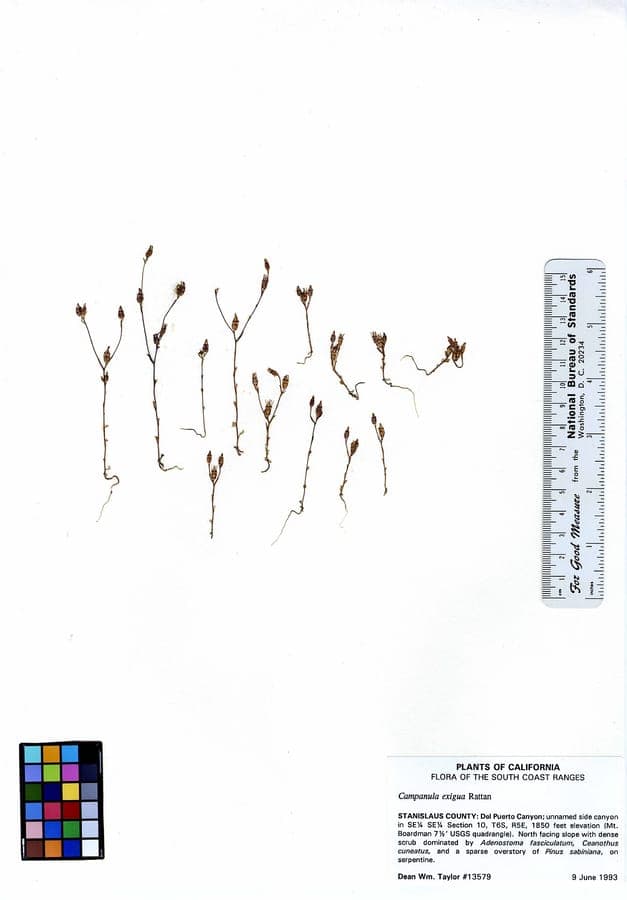
Dean Wm. Taylor / CC BY 2.0, via Wikimedia Commons
Campanula exigua: complete guide
Campanula exigua
¿Quieres ver Campanula exigua: complete guide en tu jardín?
1 minuto, sin tarjeta de crédito
Overview
Campanula exigua, commonly known as Chaparral harebell or Chaparral bellflower, is a delicate mountain plant native to California, USA. This plant grows naturally in chaparral habitats, dry rocky slopes where water is limited and only the hardiest plants survive.
The species name exigua means "small" or "meager," referring to the compact growth habits of this plant. Despite her modest size, Campanula exigua offers much value for xeriscaping gardens and dry rock combinations.
Appearance and Bloom
Campanula exigua grows as an extremely compact plant, usually only 5-15 cm tall. The plant forms dense rosettes or small mounds of fine green foliage. The leaves are small, linear to spatulate, green in color.
The flowers are small and delicate, usually sky to violet-blue in color. They appear along the stems or in small clusters, approximately 1 cm long, gently bell-shaped. The blooming period is late spring through early summer (May-July), depending on region and moisture availability.
Ideal Location
Campanula exigua thrives best in very sunny locations with at least 7-8 hours of direct sunlight daily. Full sun is essential for healthy growth and rich blooming. Partial shade is not well tolerated.
Dry, windy positions are ideal. The plant grows well on sunny slopes, rocky banks, and in open garden areas where water is limited. Protection from strong afternoon sun in very warm climates may be appreciated.
Soil
Campanula exigua requires very well-draining soil with low nutrient value. The plant actually grows better in very poor soils. Heavy clay must be strongly improved with coarse sand, gravel, and small rocks. The ideal soil is sandy to gravelly, with minimal organic matter.
The pH can range from slightly acidic to alkaline. The plant tolerates mineral-rich soils. In fact, very nutrient-rich soils can lead to excessive foliage and reduced blooming.
Diseño gratis
¿Quieres ver Campanula exigua: complete guide en tu jardín? Crea un diseño gratis ahora.
Watering
Well-established Campanula exigua is extremely drought-tolerant. Young plants should be watered regularly for the first year to establish. After that, minimal watering is needed.
In very dry areas, extra watering during very dry periods may be beneficial, but this is not essential. Winter watering must be very limited. The plant must be kept dry, especially at frost.
Pruning
Regular pruning is not needed. Spent flower stem stubs can be removed after blooming for a neater appearance. Dead or damaged leaves can be carefully removed.
The plant grows naturally compact and requires minimal shaping.
Maintenance Calendar
Spring (March-May): Growing period begins, regular watering for young plants, inspect for winter damage.
Summer (June-August): Maintain moderate watering, no further fertilization, deadhead spent flowers.
Autumn (September-October): Very gradually reduce watering, prepare for winter.
Winter (November-February): Minimal watering, maintain very dry conditions.
Winter Hardiness
Campanula exigua is very cold-hardy in temperate climates. The plant can tolerate temperatures down to -15 to -20 degrees Celsius when dry. The greatest risk in winters is water accumulation, not frost.
In zones with much winter rain, better drainage must be provided. The plant can survive very cold, dry winters outdoors without protection.
Companion Plants
Campanula exigua combines well with other dry-growing California and Mediterranean plants:
- Penstemon species
- Lupinus benthamii
- Achillea species
- Salvia species
- Zauschneria species
- Eriogonum species
- Sisyrinchium bellum
Closing
Campanula exigua is a unique mountain plant from California that offers much value for xeriscaping designs and dry gardens. The compact growth habits and delicate blue flowers provide visual interest in a small, drought-tolerant package. Perfect for gardeners in dry climates or those wishing to create a low-water garden. Available at select nurseries. Discover more California plants at gardenworld.app.
¿Quieres ver Campanula exigua: complete guide en tu jardín? Crea un diseño gratis ahora.
Sube una foto, elige un estilo y obtén un diseño fotorrealista con lista de plantas en menos de un minuto.
Más de 10.000 jardines diseñados
Sin tarjeta de crédito


Plantas similares
Campanula alaskana: complete guide
Campanula alaskana
Discover Campanula alaskana, the delicate alpine bellflower from Alaska. Growing tips, hardy requirements, and design ideas for rock gardens and alpine troughs.
Campanula scouleri: complete guide
Campanula scouleri
Discover Campanula scouleri, the refined Pacific bellflower. Growing tips, care requirements, and design ideas for woodland and mountain gardens.
Doublehorn calicoflower: complete guide
Downingia bicornuta
All about Downingia bicornuta - the doublehorn calicoflower: sowing, location, bloom and care for this rare annual in your garden.