
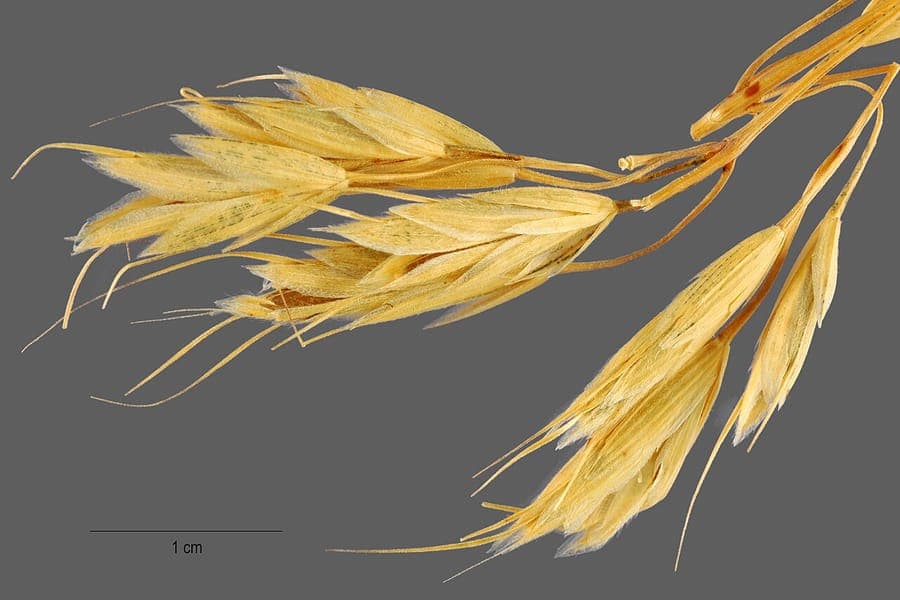
Jose Hernandez. Provided by ARS Systematic Botany and Mycology Laboratory. Soviet Union (Former), Turkistan. / Public domain, via Wikimedia Commons
Bromus squarrosus: complete guide
Bromus squarrosus
¿Quieres ver Bromus squarrosus: complete guide en tu jardín?
1 minuto, sin tarjeta de crédito
Overview
Bromus squarrosus, or corn brome, is a fascinating wild grass occurring from Central Europe through the Balkans, Mediterranean, Iran, and eastward to Mongolia. This annual grass is recognized by its characteristic, angular panicles that spread sharply outward.
The plant typically reaches 30 to 80 centimeters tall. The unique panicle structure, with spreading spikelets that protrude at sharp angles, gives the grass its distinctive appearance.
Appearance and Bloom
Bromus squarrosus has narrow to medium green blades that alternate along straight, sturdy stems. The plant has an upright, open growth habit.
Panicles appear from May to August and are highly distinctive. Unlike most grasses, these panicles form angular, star-like spreading structures. Individual spikelets protrude sharply outward, particularly sideways, justifying the name "squarrosus" (angular). The panicles can reach 8 to 15 centimeters long. The awns are very long and split, contributing to the angular appearance.
Ideal Location
Bromus squarrosus thrives best in open, sunny locations with at least 6 to 8 hours of direct sunlight. The grass is drought-resistant and grows well in various locations, from arable land to rising slopes.
In its native habitat, it grows on moderately fertile, well-drained soils from plains to low mountains. The plant tolerates cold winters and warm summers well.
Soil
Bromus squarrosus is quite flexible regarding soil quality. It grows well in moderately fertile, well-drained soils. The plant tolerates calcareous soils and can also grow in more acidic soils.
No special soil preparation is essential. The plant prefers moderately moist, well-structured soil. Waterlogging should be avoided.
Diseño gratis
¿Quieres ver Bromus squarrosus: complete guide en tu jardín? Crea un diseño gratis ahora.
Watering
Once established, watering is rarely necessary. The plant is moderately drought-tolerant and grows better with regularly moist conditions. During the first growing season, regular water should be provided until roots are well-developed.
Once established, this grass needs less maintenance than many other species, although it grows better with adequate moisture.
Pruning
This plant requires no pruning. The panicles may be cut after seed maturation if self-seeding is to be prevented. However, many gardeners leave panicles standing for their characteristic form and bird food.
Maintenance Calendar
Spring (March-May): Direct sowing outdoors after frost danger has passed, regular watering. Summer (June-August): Observe flowering and characteristic angular panicles. Autumn (September-October): Seeds ripen and disperse. Winter (November-February): Plant dies back, seed overwinters.
Winter Hardiness
Bromus squarrosus is an annual that dies after seed maturation. However, the plant is fairly cold-tolerant and can withstand freezing temperatures. Seeds can overwinter and germinate the following spring.
Companion Plants
Bromus squarrosus grows well with:
- Other Mediterranean and Central European grasses
- Flowering herbs and wildflowers
- Drought-tolerant plants
- Seed-producing bird-feeding plants
Conclusion
Bromus squarrosus is a fascinating wild grass with highly distinctive panicles. The plant grows easily from seed and thrives with minimal maintenance. This makes it perfect for natural landscapes and gardens embracing more wild geometric forms.
Seeds are available from specialist suppliers including Intratuin and Gamma. Try this geometric grass and enjoy its unique structure and bird-feeding qualities. Learn more at gardenworld.app/en for wild grasses.
¿Quieres ver Bromus squarrosus: complete guide en tu jardín? Crea un diseño gratis ahora.
Sube una foto, elige un estilo y obtén un diseño fotorrealista con lista de plantas en menos de un minuto.
Más de 10.000 jardines diseñados
Sin tarjeta de crédito


Plantas similares
Sporobolus pungens: complete guide
Sporobolus pungens
Sporobolus pungens is a stoloniferous Mediterranean coastal grass with outstanding salt and drought tolerance, perfect for seaside and dry gardens.
Mediterranean aegilops: complete guide
Aegilops biuncialis
Everything about Aegilops biuncialis, a Mediterranean annual grass with ornamental spikes and outstanding drought tolerance for dry gardens.
Silver bluestem: complete guide
Bothriochloa saccharoides
Full guide to Bothriochloa saccharoides (silver bluestem): site, soil, watering, winter hardiness, pruning, and garden companions.