
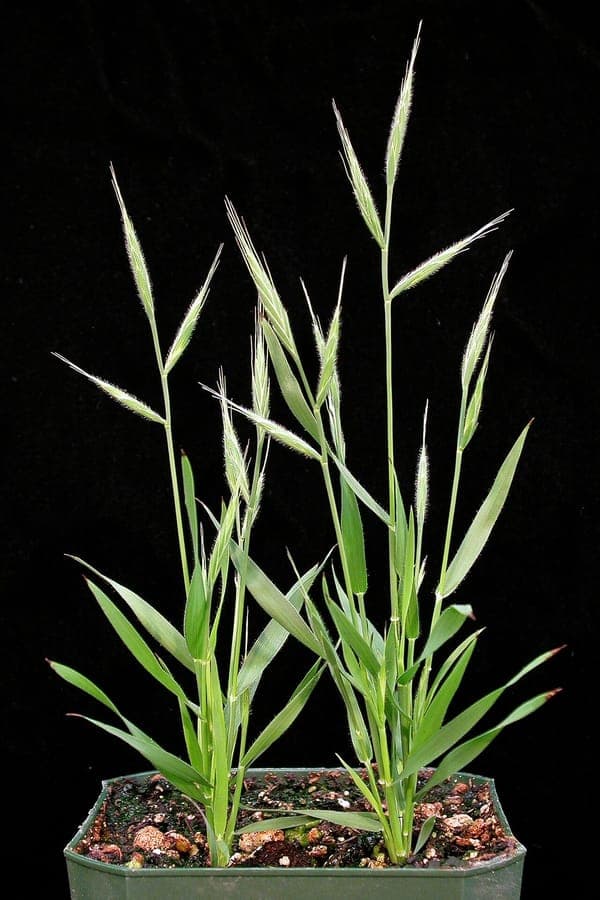
Neil Harris, University of Alberta / CC BY-SA 4.0, via Wikimedia Commons
Purple false brome: complete guide
Brachypodium distachyon
¿Quieres ver Purple false brome: complete guide en tu jardín?
1 minuto, sin tarjeta de crédito
Overview
Brachypodium distachyon, known as purple false brome or two-spikelet brachypodium, is an interesting ornamental grass from the Poaceae family. This plant native to southern Europe and the Mediterranean region is particularly valuable for its architectural structure and decorative spikelets. Unlike many other grasses, this species has a compact growth pattern with beautiful purple tints.
The plant is increasingly used in modern garden designs for its texture and interesting visual structure. With minimal care and elegant habit, it is a perfect choice for gardeners who want something different.
Appearance and bloom
Brachypodium distachyon grows into a compact, upright plant reaching 20 to 50 centimeters in height. The plant forms dense tufts of fine, light gray-green colored leaves. The leaves are linear and have a soft texture that gives the plant an elegant appearance.
The most striking feature is the inflorescence. It consists of two (or sometimes three) characteristic spikelets appearing erect at the top of stem clusters. The spikelets have a beautiful purple-brown color that sometimes becomes almost red. Each spikelet consists of several florets packed closely together.
Blooming time is from May to July. The spikelets remain decoratively intact for a long time and can even be used for dried flowers and arrangements. The plant thus provides interest from early summer through autumn.
Ideal location
Brachypodium distachyon thrives best in sunny locations receiving at least 6 hours of direct sunlight daily. In full sun the spikelets color most beautifully and achieve their characteristic purple tint.
The plant can also grow in partial shade, but will be less compact there and the spikelets will not color as nicely. Place the plant in a sunny spot in your garden.
Brachypodium distachyon is very wind-tolerant due to its low growth habit and flexible leaves. It even forms an attractive silhouette against the wind.
Soil requirements
Brachypodium distachyon grows well in virtually all well-draining soil types. The plant is not very critical and can even grow in poor soil. It prefers, however, dry to moderately moist, well-draining substrate.
Heavy clay soils can be problematic because they tend to have water stagnation. Improve heavy soils by adding sand and organic material. The plant prefers pH between 4.5 and 8.0, so it is suitable almost everywhere.
This is a very low-maintenance plant regarding feeding. Rich soils don't need to be used - the plant actually grows better in average to moderately poor soils.
Diseño gratis
¿Quieres ver Purple false brome: complete guide en tu jardín? Crea un diseño gratis ahora.
Watering
Brachypodium distachyon is relatively drought-tolerant once established. During the first growing season, water regularly to establish a good root system. Water when the top layer of soil feels dry.
Once well established (after the first season), the plant can grow without supplementary water, even in dry summers. However, during very dry periods some water can help keep the plant in optimal condition.
In containers water more regularly than in open ground. Always ensure good drainage to prevent waterlogging.
Pruning
Brachypodium distachyon requires little pruning. In early spring you can remove dead leaf material from the previous year. This helps promote new growth.
Also remove damaged leaves as they appear. Beyond that, pruning is not needed - let the plant retain its natural form.
Maintenance calendar
MARCH-APRIL: Plant out in open ground or container. Water well when planting.
MAY-JULY: Characteristic two-spikelet inflorescence appears. Enjoy the purple tints.
AUGUST-OCTOBER: Spikelets dry and turn golden-brown. Can be used for dried arrangements.
NOVEMBER-FEBRUARY: Plant is evergreen in temperate climates. Minimal care needed.
Winter hardiness
Brachypodium distachyon is an evergreen to winter-deciduous perennial depending on climate. In temperate climates it survives winter well and forms non-leaf-shedding tufts. The foliage can partially die in very cold winters but the plant itself does not die.
In very cold climates (below -10 degrees Celsius) the plant can suffer damage. Plant it therefore in well-draining locations to prevent winter water stagnation.
Companion plants
Brachypodium distachyon combines beautifully with other ornamental grasses and perennials. Group with dwarf conifers for structure. Also combine with flowering perennials like Salvia and Lavender.
In borders it works well between larger plants as a structural element. In containers it combines well with other grasses and Mediterranean plants.
Conclusion
Brachypodium distachyon is an excellent choice for gardeners who want something different. With its beautiful purple spikelets and low maintenance requirements, it is a valuable element in any garden design. Find this plant at specialized garden centers or online suppliers.
For more information about ornamental grasses and garden plants, visit gardenworld.app. More garden inspiration also available on gardenworld.app.
¿Quieres ver Purple false brome: complete guide en tu jardín? Crea un diseño gratis ahora.
Sube una foto, elige un estilo y obtén un diseño fotorrealista con lista de plantas en menos de un minuto.
Más de 10.000 jardines diseñados
Sin tarjeta de crédito


Plantas similares
Sporobolus pungens: complete guide
Sporobolus pungens
Sporobolus pungens is a stoloniferous Mediterranean coastal grass with outstanding salt and drought tolerance, perfect for seaside and dry gardens.
Mediterranean aegilops: complete guide
Aegilops biuncialis
Everything about Aegilops biuncialis, a Mediterranean annual grass with ornamental spikes and outstanding drought tolerance for dry gardens.
Silver bluestem: complete guide
Bothriochloa saccharoides
Full guide to Bothriochloa saccharoides (silver bluestem): site, soil, watering, winter hardiness, pruning, and garden companions.