
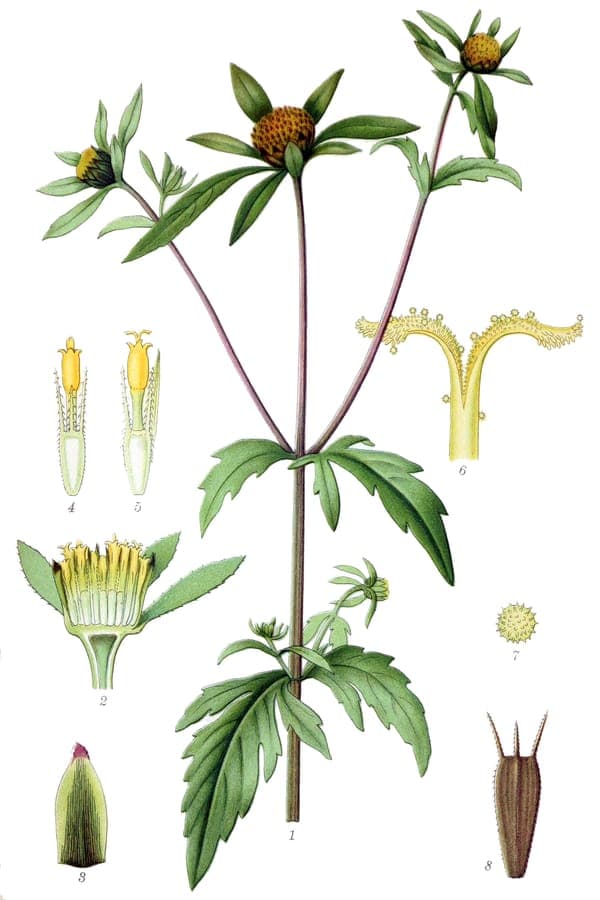
Mentz, August, 1867-1944 & Ostenfeld, C. H. (Carl Hansen), 1873-1931 / Public domain, via Wikimedia Commons
Trifid bur-marigold: complete guide for wetland margins and water edges
Bidens tripartita
¿Quieres ver Trifid bur-marigold: complete guide for wetland margins and water edges en tu jardín?
1 minuto, sin tarjeta de crédito
Overview
Trifid bur-marigold (Bidens tripartita) is a native annual plant from the Asteraceae family (daisy family), widely distributed across temperate regions of the northern hemisphere. The name "bur-marigold" references characteristic needle-barbed seed-fruits that readily adhere to clothing and animal hair. This is a valuable plant for wet gardens and natural pond-margin plantings, where it produces small yellow flowers and provides food for pollinators and birds.
Appearance and bloom cycle
Trifid bur-marigold grows as a compact, upright plant reaching approximately 30-60 cm in height. Leaves are characteristically three-part (hence the name), narrow and finely toothed. Stems often develop red tinting. During summer and autumn, numerous small yellow flowers appear in terminal clusters. These flowers provide food for numerous insects. Following bloom, the plant develops characteristic seed-fruits bearing two to four long, barbed "needles." These "bristles" readily attach to clothing and animals, facilitating plant dispersal.
Ideal location
Trifid bur-marigold thrives along pond margins, in shallow water zones, beside ditches, and in boggy garden corners. The plant favours moist to wet, open positions in full sun to dappled shade. Trifid bur-marigold is a pioneer plant: it establishes rapidly in disturbed wet soil and organic-rich zones. In modern naturalistic gardens, trifid bur-marigold is valued for ecological merit and rapid vegetation of bare wet areas.
Soil requirements
Trifid bur-marigold is highly undemanding about soil composition. This is fundamentally a fertile wetland plant thriving in wet clay, peaty substrates, and muddy ground. Indeed, the richer (and wetter) the soil, the better trifid bur-marigold prospers. The plant tolerates inundation well. In gardens, incorporate moist, organically-rich potting mix into shallow water zones.
Watering
Trifid bur-marigold must remain constantly moist. This is not a plant for dry soil. Plant it along water margins where soil remains permanently wet, or in shallow water zones. In ornamental ponds, position trifid bur-marigold on plant shelves at 5-15 cm depth. Trifid bur-marigold tolerates inundation well. Monitor during dry periods that wetland zones do not desiccate.
Diseño gratis
¿Quieres ver Trifid bur-marigold: complete guide for wetland margins and water edges en tu jardín? Crea un diseño gratis ahora.
Pruning and maintenance
Trifid bur-marigold requires no formal pruning. For tidier appearance, you may remove spent flowers to encourage later growth. If plants become overcrowded, selectively remove some stems. After first frost, the plant dies back, but typically self-seeds for the following season.
Maintenance calendar
March-April: Trifid bur-marigold establishes from self-sown seed in wet zones, or start seed indoors.
May-June: Peak growing season. Plant grows rapidly.
July-September: Flowering and seed production. Plant is abundant with yellow flowers.
October-November: Seed-fruits mature. Plant dies back in first frost.
December-February: Subterranean rest phase. Seeds overwinter in soil and water.
Winter hardiness
Trifid bur-marigold is not winter-hardy. This is an annual that dies at first frost. However, the plant produces abundant seed that overwinters in soil and water. Seeds germinate anew the following spring. For assured return, allow some seed-fruits to fall on wet soil in autumn.
Companion planting
Trifid bur-marigold pairs with other wetland margin residents:
- Reed grasses (complementary height)
- Cattails (larger partner)
- Water-lilies (visual focal points in water)
- Marsh forget-me-not (smaller partner)
- Water avens (similar ecology)
Trifid bur-marigold itself contributes to healthy aquatic ecosystems by providing food for insects and birds.
Conclusion
Trifid bur-marigold is a reliable, low-maintenance choice for wet gardens. Fast-growing, valuable for pollinators and birds, and easily established from seed: trifid bur-marigold delivers multiple benefits. Using gardenworld.app, integrate trifid bur-marigold into your water and wetland garden zones. Trifid bur-marigold, combined with other wetland plants, provides robust foundation for ecological water margins.
Available through aquatic plant nurseries or collected from wild seed sources.
¿Quieres ver Trifid bur-marigold: complete guide for wetland margins and water edges en tu jardín? Crea un diseño gratis ahora.
Sube una foto, elige un estilo y obtén un diseño fotorrealista con lista de plantas en menos de un minuto.
Más de 10.000 jardines diseñados
Sin tarjeta de crédito

