
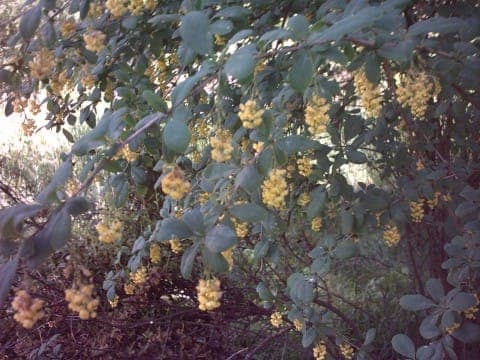
Wikimedia Commons / CC BY-SA 3.0, via Wikimedia Commons
Berberis canadensis: complete guide
Berberis canadensis
¿Quieres ver Berberis canadensis: complete guide en tu jardín?
1 minuto, sin tarjeta de crédito
Overview
Berberis canadensis, commonly known as American barberry or Allegheny barberry, is an excellent native North American ornamental shrub native to mountainous regions of eastern and southeastern United States. This evergreen to semi-deciduous shrub reaches 1 to 2 meters tall and equally wide. The plant is renowned for sharp thorns, bright yellow spring blooms, and characteristic red berries persisting through winter. It ranks among nature's finest defensive hedges and provides crucial wildlife food.
Appearance and Bloom
This shrub forms dense branching growth with fine, elongated leaves approximately 2 to 4 centimeters long. Foliage is dark green and glossy, remaining evergreen in most climates. Simple sharp spines emerge singly from leaf axils. From May to June, inconspicuous yellow flowers appear in small clusters along stems. Each bloom measures merely millimeters across. Following pollination, glossy red berries form, approximately 8 to 10 millimeters in diameter, persisting for months and providing vital food for birds and small wildlife.
Ideal Location
Berberis canadensis thrives in full sun to partial shade. Full sun yields maximum flowering and berrying with brightest colors. The plant is rugged, tolerating wind and harsh conditions admirably. Perfect for defensive hedges, woodland margins, and as a specimen plant in larger gardens. The species also succeeds in containers.
Soil
This barberry is remarkably unfussy and grows in nearly all soils. The plant prefers well-drained, non-waterlogged ground but accepts dry conditions reasonably well. Acidic to neutral to slightly alkaline pH is acceptable. Heavy clay may be amended, though better performance occurs in better-structured soils.
Watering
After establishment, the plant is exceptionally drought-tolerant requiring minimal supplemental water. In dry summers, regular watering may be needed, but in many climates is unnecessary. At planting and during first growing seasons, water regularly until roots establish deeply.
Diseño gratis
¿Quieres ver Berberis canadensis: complete guide en tu jardín? Crea un diseño gratis ahora.
Pruning
Berberis canadensis requires minimal pruning. The plant naturally develops attractive compact form. For hedging purposes, winter pruning (January-March) may be applied. Remove dead wood as needed. Growth is slow enough that regular pruning is optional.
Maintenance Calendar
Spring (March-May): Plant blooms. Ensure adequate soil moisture. Remove any winter damage.
Summer (June-August): Berries develop. Drought stress may impact growth. Prune only if needed for form.
Autumn (September-October): Berries mature and redden. Bird activity increases. Enjoy fall colors.
Winter (November-February): Plant is dormant. Apply winter pruning if hedging required. Berries persist on plant.
Winter Hardiness
Berberis canadensis is exceptionally hardy, tolerating temperatures to -25 to -30 degrees Celsius and below. Native to North American mountain regions, it knows how to endure cold. Perfect for North European gardens.
Companion Plants
Berberis canadensis pairs well with:
- Ilex (holly) for contrasting red berries
- Photinia (red photinia) for burgundy foliage
- Viburnum (snowball bush) for white flowers
- Sarcococca (sweet box) for fragrance
- Ilex verticillata (possum haw) for bird attraction
- Euonymus (spindle tree) for foliage texture
Ensure companion plantings share similar water requirements.
Final Thoughts
Berberis canadensis is an invaluable North American native shrub for average garden use. The sharp thorns make it unsuitable near play areas, but perfect for defensive hedges and bird-attraction plantings. Minimal maintenance, beautiful flowers, and long-persisting red berries make it a smart choice. This practical, hardworking plant deserves greater recognition in European gardens.
Find barberry shrubs and hedging plants at specialty nurseries. Gardenworld.app helps design bird-friendly gardens.
¿Quieres ver Berberis canadensis: complete guide en tu jardín? Crea un diseño gratis ahora.
Sube una foto, elige un estilo y obtén un diseño fotorrealista con lista de plantas en menos de un minuto.
Más de 10.000 jardines diseñados
Sin tarjeta de crédito


Plantas similares
Bambú celeste: guía completa
Nandina domestica
Todo sobre el bambú celeste (Nandina domestica): plantación, poda, resistencia al invierno y efectos de color. Advertencia: las bayas son tóxicas para aves y mascotas.
Colorado barberry: complete guide
Berberis fendleri
Everything about Berberis fendleri, the Colorado barberry with yellow flowers and red berries. Perfect as a thorny hedge or specimen shrub in dry gardens.
Jeffersonia diphylla: complete guide
Jeffersonia diphylla
Discover Twinleaf, a charming woodland plant from North America. White flowers, unique foliage, perfect for shady borders.