
Swallowtail Garden Seeds / Public domain, via Wikimedia Commons
King Begonia: complete guide
Begonia rex
¿Quieres ver King Begonia: complete guide en tu jardín?
1 minuto, sin tarjeta de crédito
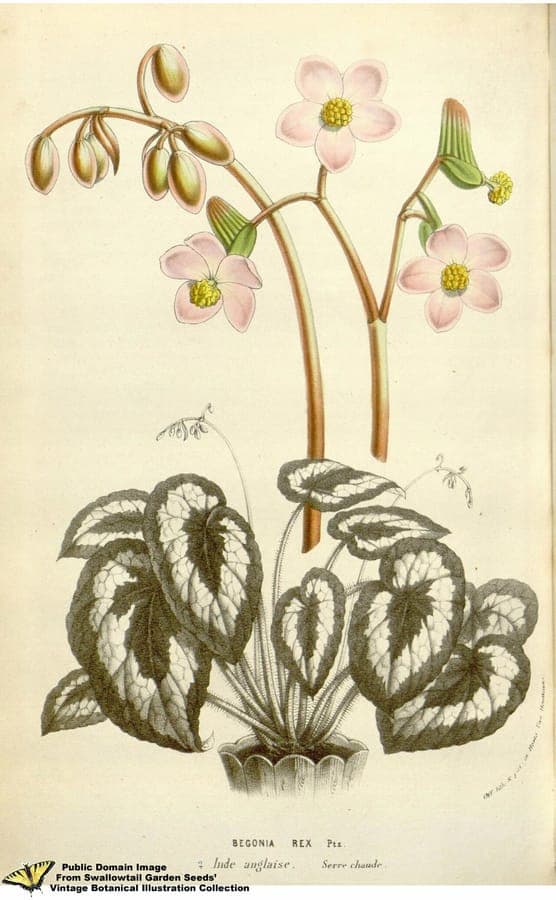
The king begonia, Begonia rex, is truly royalty among foliage plants. Native to the mountains of Assam and Myanmar, this species became a sensation when introduced to European gardeners in the nineteenth century and remains one of the most coveted houseplants today. The leaves are artistic masterpieces: reaching 25 cm in length, asymmetrical in form, predominantly silvery-gray to silver-pink on top with dark green and copper-colored bands and margins. The leaf undersides are purple-red to deep plum.
The plant develops a compact growth habit, usually 20-35 cm tall, with incredibly diverse cultivars and varieties. Some feature nearly fluorescent silver markings, others are almost entirely red or purple. There are cultivars with ruffled edges, with crinkled textures, and even spiral-patterned leaves in shades of pink, silver, and burgundy. Early spring brings delicate pale pink or white flowers, though the foliage is the true spectacle.
The painted-leaf begonia is more demanding than its cousins, requiring consistency above all: consistent light, consistent moisture, consistent warmth, and consistent humidity. This is a plant for patient gardeners, but it rewards attention with a truly spectacular display that will captivate visitors and fellow plant enthusiasts.
Light should be bright but indirect. Mixed shade environments work well - a north-facing window is ideal, or protect other orientations with sheer screening. The plant cannot tolerate bright direct sun, which causes leaf burn, but it also needs sufficient light to maintain vibrant coloring. Inadequate light causes pale, dull foliage.
Soil composition is absolutely crucial. Use the same well-draining mix as for other begonias: 50% rich potting soil, 30% perlite, and 20% orchid bark. Excellent drainage prevents root rot but combined with regular light moisture keeps the plant thriving.
Watering requires careful attention. The plant wants consistently moist but never waterlogged soil. Water when the top 1 cm of soil feels dry. Use room-temperature water and apply it carefully at soil level, never on the leaves - water on foliage causes permanent blemishes and fungal problems. This is a plant that prefers watering from below.
Humidity is critical for success. This plant demands 70-80% ambient humidity to truly thrive. A single begonia surrounded by dry air will sulk, drop leaves, and develop spider mite problems. The best approach is to create a humidity microclimate. Group multiple plants together, place pots on pebble trays filled with water, or use a room humidifier. Misting the air around the plant (not the leaves) can help, but it is not sufficient alone.
Temperature must be stable and warm. Keep temperatures between 18-24 degrees Celsius. The plant absolutely hates sudden temperature swings and cold drafts. Never place it near doors, air conditioning units, or radiators. Move it away from windows in winter if cold drafts occur.
Feeding: Apply half-strength houseplant fertilizer every two weeks during the growing season (March-October). Stop feeding entirely during winter dormancy when growth slows.
Pruning: Remove flowers as soon as they appear to direct the plant's energy toward foliage production. Remove any damaged or yellowing leaves promptly.
Propagation is possible from leaf cuttings, which is fascinating and rewarding. Cut a healthy, mature leaf and insert it into a 50-50 mix of sand and peat moss in a humid propagation environment. New plantlets will emerge from the leaf veins within several weeks to months. This requires patience but is deeply satisfying.
Pests can be problematic in dry conditions. Scale insects and spider mites love the warm, dry air that is anathema to begonias. Inspect regularly and treat early infestations with neem oil or insecticidal soap.
The painted-leaf begonia is better suited to collectors and advanced gardeners than beginners, but if you have the time and patience to provide perfect conditions, the rewards are extraordinary. Each new leaf unfurling is an event, each variegation pattern unique and stunning.
Find these begonias at specialty plant retailers and quality garden centers. Major chains like garden centers, and online plant merchants often stock multiple cultivars. Prices range from 15 to 50 euros depending on rarity and maturity. Visit gardenworld.app to explore how to incorporate rare and spectacular foliage plants like Begonia rex into your garden design.
¿Quieres ver King Begonia: complete guide en tu jardín? Crea un diseño gratis ahora.
Sube una foto, elige un estilo y obtén un diseño fotorrealista con lista de plantas en menos de un minuto.
Más de 10.000 jardines diseñados
Sin tarjeta de crédito


Plantas similares
Begonia bowerae: complete guide
Begonia bowerae
The eyelash begonia is a compact, elegant foliage plant with striking embroidered leaves. Perfect for indoor and shade gardens.
Begonia brevirimosa: complete guide
Begonia brevirimosa
Discover the Exotica begonia, a tropical houseplant with spectacular foliage. Learn how to care for this rare plant at home.
Begonia fuchsioides: complete guide
Begonia fuchsioides
Discover the Fuchsia begonia, a stunning houseplant with vibrant red flowers. Learn how to successfully grow and care for this Colombian tropical beauty.