
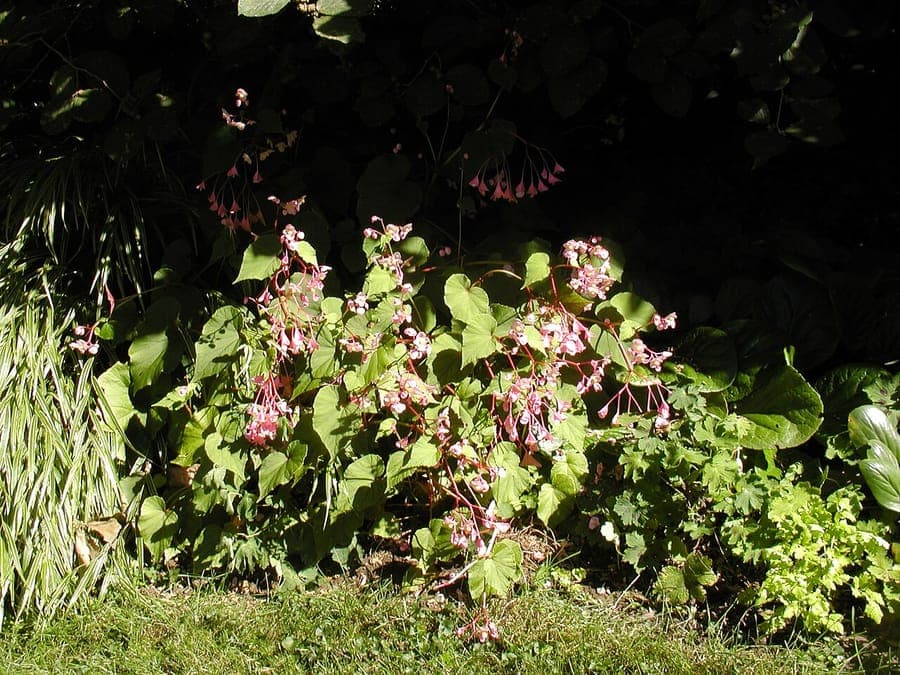
User:SB_Johnny / CC BY-SA 3.0, via Wikimedia Commons
Hardy Begonia: complete guide
Begonia grandis
¿Quieres ver Hardy Begonia: complete guide en tu jardín?
1 minuto, sin tarjeta de crédito
Overview
Hardy Begonia (Begonia grandis) is a remarkable perennial plant from Central and South China. Unlike most begonias, this is a hardy plant that returns year after year. The plant is celebrated for its pleasant pink to white flowers and elegant foliage.
This plant is perfect for shady corners of gardens where other plants struggle. Hardy Begonia blooms in late summer through autumn, providing color when many other flowers fade.
Appearance and bloom
Begonia grandis grows to 45-60 cm height with a compact, mounding growth habit. The leaves are asymmetrically heart-shaped, usually green to bronzy, sometimes with red veins. The foliage is quite decorative in itself.
Flowers appear from August to October in loose clusters. They are small, pink to white, often with yellow stamens. The flowers are male and female on the same plant, which is interesting from a botanical standpoint.
The plant dies back in winter and re-emerges in spring.
Ideal location
Hardy Begonia thrives best in shade to half-light. This is an excellent choice for north and east-facing sides of houses, under deciduous trees, and in woodland areas. The plant can also grow in full sun in cooler climates with adequate moisture.
Avoid direct summer heat and intense midday sun in warmer areas.
Soil
The plant loves moisture-retaining, well-draining soil rich in organic matter. This can be a mixture of garden soil, peat moss, and compost. Acidic soil is preferred.
Perfect for rock gardens or woodland floor-like environments. The plant thrives in settings with lots of organic debris.
Diseño gratis
¿Quieres ver Hardy Begonia: complete guide en tu jardín? Crea un diseño gratis ahora.
Watering
Hardy Begonia loves regular moisture, especially during growth and blooming periods. Water 2 to 3 times per week, depending on weather. Ensure the soil stays moist but not waterlogged.
Additional watering during dry periods is essential. Once dormant in winter, water is barely needed.
Fertilizing
Add fertilizer once a month during growth and bloom periods. Use a balanced formula or something richer in phosphate for more flowers. Organic fertilizer also works well.
No fertilization needed in winter.
Maintenance calendar
Spring: New growth appears, light feeding Summer: Regular watering, continued feeding Autumn: Blooming, watering remains important Winter: Plant dies back, no maintenance
Winter hardiness
Hardy Begonia is hardy to about -10 degrees Celsius, although this can vary by climate. In Germany, the Netherlands, and Belgium, they usually overwinter outside without protection.
In colder regions, mulching can be beneficial to protect the roots.
Tuber propagation
The plant forms underground tubers that can be dug up and stored. This offers a way to propagate the plant or maintain supplies for the next season.
In spring, these tubers can be replanted.
Companion plants
Hardy Begonia pairs beautifully with:
- Hosta
- Ferns
- Helleborus
- Tiarella
- Astilbe
Pest control
The plant is relatively pest-free. Occasionally slugs and springtails may appear. Natural pest control is preferred.
Closing
Hardy Begonia is an excellent choice for shade gardens. With its late flowers, it adds autumn color when other plants fade. With regular watering and some attention, this plant will bloom for years. Find Hardy Begonia at major garden centers. Discover on gardenworld.app how this plant fits into your shady corners. Gardenworld.app helps you create the perfect shade plant combination.
¿Quieres ver Hardy Begonia: complete guide en tu jardín? Crea un diseño gratis ahora.
Sube una foto, elige un estilo y obtén un diseño fotorrealista con lista de plantas en menos de un minuto.
Más de 10.000 jardines diseñados
Sin tarjeta de crédito


Plantas similares
Begonia bowerae: complete guide
Begonia bowerae
The eyelash begonia is a compact, elegant foliage plant with striking embroidered leaves. Perfect for indoor and shade gardens.
Begonia brevirimosa: complete guide
Begonia brevirimosa
Discover the Exotica begonia, a tropical houseplant with spectacular foliage. Learn how to care for this rare plant at home.
Begonia fuchsioides: complete guide
Begonia fuchsioides
Discover the Fuchsia begonia, a stunning houseplant with vibrant red flowers. Learn how to successfully grow and care for this Colombian tropical beauty.