
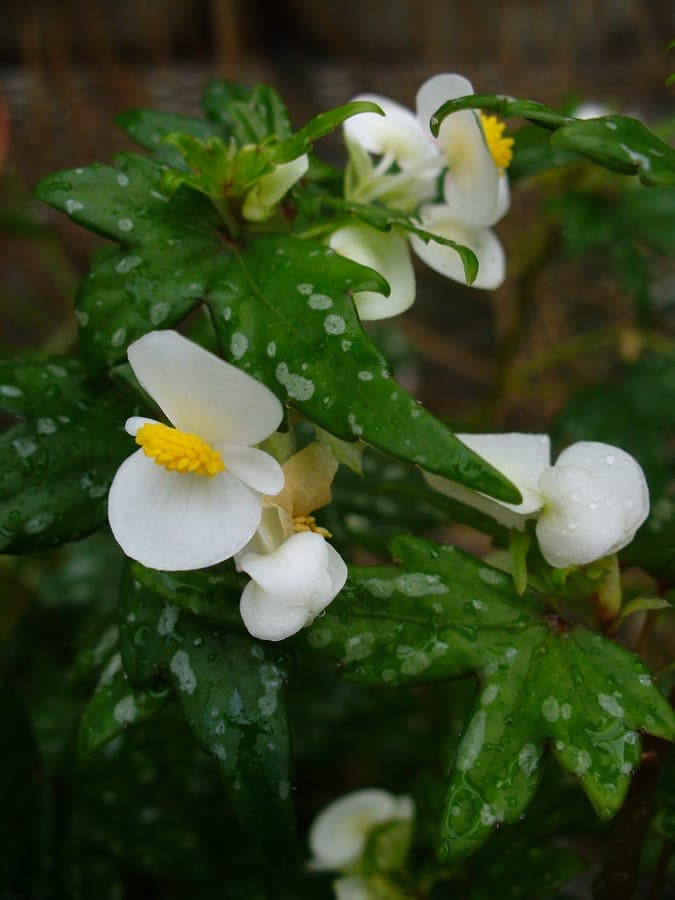
Scott Zona / CC BY 2.0, via Wikimedia Commons
Mapleleaf begonia: complete guide
Begonia dregei
¿Quieres ver Mapleleaf begonia: complete guide en tu jardín?
1 minuto, sin tarjeta de crédito
Overview
Mapleleaf begonia (Begonia dregei), also known as grape-leaf begonia, is a fascinating begonia species from the Begoniaceae family. Native to the Eastern Cape and KwaZulu-Natal in South Africa, it grows in moist, shaded forest environments.
This begonia stands out for its unique maple-shaped leaves and compact growth habit. It is ideal for indoor environments and can also grow outdoors in summer.
Appearance and bloom
Mapleleaf begonia forms a compact plant with characteristic, deeply lobed leaves resembling maple leaves. Foliage is approximately 10-15 centimeters wide, dark green with reddish undersides and veins.
The plant reaches 20 to 40 centimeters tall and naturally forms a neat, ball-shaped shrub. Leaves have interesting texture and color variation.
Flowers appear during summer (May to October) in clusters of small, white to pink blooms. These flowers are not the highlight of this plant, but contribute to its overall appearance.
Ideal location
Mapleleaf begonia grows best in bright, indirect daylight. Direct sun can cause leaf scorch.
- Light: Bright, indirect daylight; 3 to 4 hours daily ideal
- Temperature: Minimum 10-12 degrees Celsius; ideal 15-20 degrees
- Humidity: Prefers moderate to high air humidity
- Airflow: Prefers good ventilation
Soil
For container plants, recommend:
- Loose, nutrient-rich potting soil
- Good drainage (add perlite or peat)
- Slightly acid to neutral pH (6.0 to 7.0)
- Avoid heavy clay
Diseño gratis
¿Quieres ver Mapleleaf begonia: complete guide en tu jardín? Crea un diseño gratis ahora.
Watering
Mapleleaf begonia prefers regularly moist soil, but not waterlogged. Follow this guideline:
- Growing season: Regular watering; ensure soil never dries completely
- Winter: Less water; allow soil to dry more between waterings
- Drainage: Ensure good water flow-off
- Preference: Use soft water (rainwater)
Pruning
Mapleleaf begonia does not need intensive pruning, but you can:
- Remove spent flowers to encourage new blooming
- Early spring trim back long stems slightly
- Remove dead foliage regularly
Maintenance calendar
- March-May: Growing season begins; repot; water regularly
- June-September: Peak growth; feed regularly
- October-November: Growth slows; water less
- December-February: Winter dormancy; minimal water; keep cool
Winter hardiness
Mapleleaf begonia is not frost-hardy in temperate climates. It must overwinter indoors. In South Africa it grows year-round outdoors in shaded forest environments.
Companion plants
In a conservatory environment, Mapleleaf begonia combines well with:
- Ficus pumila (creeping fig) - similar moisture needs
- Hosta (plantain lily) - shade lover
- Alocasia - tropical relative
- Rhaphidophora (spaghetti plant) - similar environment
Propagation
Mapleleaf begonia propagates easily via:
- Leaf cuttings: Healthy leaf in warm, moist soil
- Stem cuttings: In spring; plant in moist soil
- Division: When repotting
Closing
Mapleleaf begonia is a fascinating, compact houseplant providing years of enjoyment. With regular watering, adequate light, and warm conditions, it proves a reliable, attractive plant. For more tips on begonias and tropical houseplants, visit gardenworld.app. Transform your home into a tropical paradise with gardenworld.app.
¿Quieres ver Mapleleaf begonia: complete guide en tu jardín? Crea un diseño gratis ahora.
Sube una foto, elige un estilo y obtén un diseño fotorrealista con lista de plantas en menos de un minuto.
Más de 10.000 jardines diseñados
Sin tarjeta de crédito


Plantas similares
Begonia bowerae: complete guide
Begonia bowerae
The eyelash begonia is a compact, elegant foliage plant with striking embroidered leaves. Perfect for indoor and shade gardens.
Begonia brevirimosa: complete guide
Begonia brevirimosa
Discover the Exotica begonia, a tropical houseplant with spectacular foliage. Learn how to care for this rare plant at home.
Begonia fuchsioides: complete guide
Begonia fuchsioides
Discover the Fuchsia begonia, a stunning houseplant with vibrant red flowers. Learn how to successfully grow and care for this Colombian tropical beauty.