
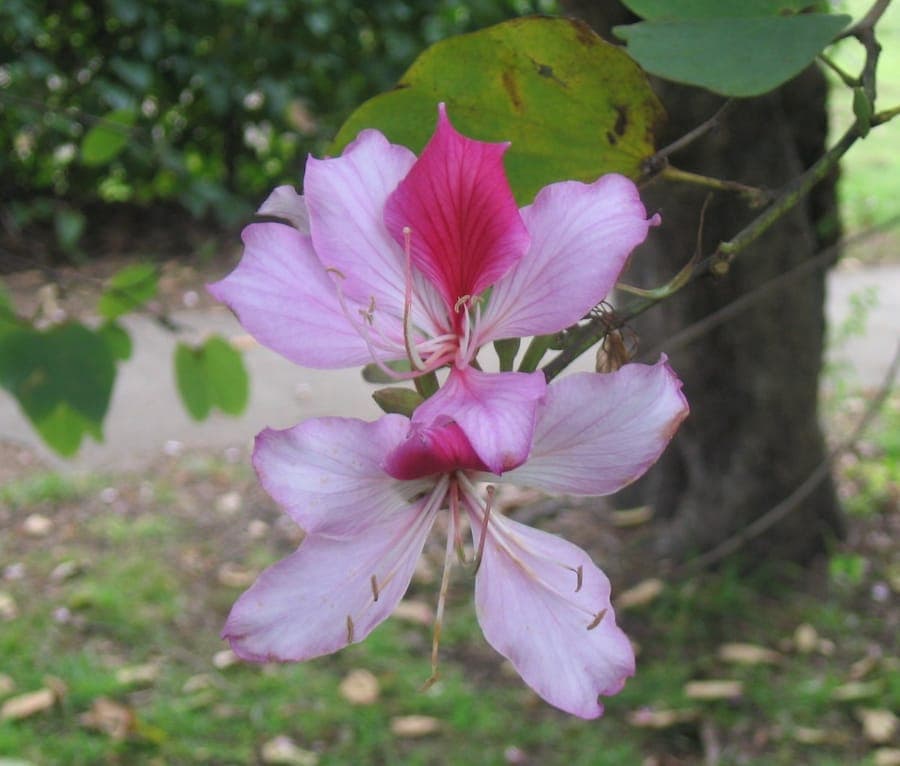
Peter1968 at English Wikipedia / CC BY 2.5, via Wikimedia Commons
Bauhinia variegata: complete guide
Bauhinia variegata
¿Quieres ver Bauhinia variegata: complete guide en tu jardín?
1 minuto, sin tarjeta de crédito
Overview
Bauhinia variegata, known as mountain ebony, orchid tree, or pink camel's-foot, is a stunning Asian tree from the Fabaceae family. This tree originates from the Indian subcontinent to southern China and is renowned for its spectacular orchid-like flowers in pink to purple with dark spots.
In warm climates, Bauhinia variegata grows into a medium-sized tree of 6 to 10 meters. In cooler conditions, it remains smaller and is often cultivated as an ornamental shrub or in containers. The tree is semi-evergreen and sheds leaves in cold or dry periods.
Appearance and flowering
Bauhinia variegata has unique heart-shaped leaves with a distinctive notch at the apex. Leaves are dark green, glossy, and measure about 10 to 15 centimeters across. This striking leaf pattern enhances the tree's beauty.
The flowers are the main attraction. They appear in early spring (February to May in warm climates) and bloom for weeks. The flowers are large, 6 to 8 centimeters across, pink to purple with dark spots and streaks. They resemble orchids and give the tree its romantic appeal.
After flowering, long, flat seed pods form. These look decorative and add texture to the tree.
Ideal location
Bauhinia variegata thrives best in sunny to partly shaded locations. Provide at least 5 to 6 hours of direct sunlight daily. More sun produces more flowers. Too much shade significantly reduces blooming.
Ensure shelter from strong winds. Although the tree is fairly sturdy, heavy wind gusts during flowering can damage blossoms.
Warmth is important. The tree does not grow well below 10 degrees Celsius and only flowers in warm seasons. In cooler climates, position it against a warm wall or in a sheltered corner.
Soil
Bauhinia variegata thrives in virtually all soil types but prefers nutrient-rich, well-draining soil. Heavy clay soils must be improved with sand or compost.
The pH should be neutral to slightly acidic, between 6 and 7.5. Add compost before planting. This improves nutrition and drainage.
Good drainage is essential. The tree dislikes stagnant water. In wet conditions, plant in raised beds or thoroughly improve drainage.
Watering
Young Bauhinia trees (first two years) need regular water, especially in dry periods. Water so soil stays moist but not waterlogged.
Once established (after 2-3 years), the tree tolerates some drought and needs less water.
In winter, reduce watering. Allow soil to dry more between waterings.
Mulch around the tree to retain moisture and stabilize temperature.
Diseño gratis
¿Quieres ver Bauhinia variegata: complete guide en tu jardín? Crea un diseño gratis ahora.
Feeding
Bauhinia variegata benefits from regular feeding, especially to encourage flowering. During the growing season (March to October), apply organic tree fertilizer monthly.
For flowering, increase phosphate content. Use special bloom fertilizer in January-March.
Stop feeding entirely in winter.
Pruning
Pruning is not strictly necessary but can control shape. After flowering (May-June), excess branches can be removed. This helps maintain form.
Remove dead or damaged branches anytime. This improves health and appearance.
Older trees tolerate heavy pruning in spring. This encourages branching and full form.
Winter protection
Bauhinia variegata has limited winter hardiness. In cooler regions, temperatures below 5 degrees Celsius cause severe damage or death. In frost-prone areas, protection is needed.
Protection: Wrap the tree with autumn leaves or straw to a height of 60 to 100 centimeters. Place wind protection around it.
In containers: Move potted trees indoors or to a sheltered greenhouse in November until safe to return outside in April.
Alternative: Plant Bauhinia variegata against a south or west wall where reflective warmth helps.
Companion plants
Bauhinia variegata fits well in Asian gardens with Japanese maple trees for texture contrast. Azaleas for complementary blooms. Bamboo as background. Cast-iron plants and ferns underneath. In warm regions, combine with other orchid trees. Bougainvillea for color. Ginger plants for aroma.
Propagation
Bauhinia variegata can be grown from seed or cuttings. Seed: Seed pods dry on the tree. Seeds can be pre-soaked for 3 to 5 weeks in warm water. Sow in seed compost and keep moist. Germination takes 2 to 4 weeks. Cuttings: Semi-ripe cuttings in summer can root in moist sandy soil under plastic.
Closing remarks
Bauhinia variegata brings exotic orchid beauty to gardens, especially in warm locations. With shelter, feeding, and adequate winter protection, this tree grows well and provides years of purple and pink floral splendor. Visit specialized tree nurseries for healthy specimens. Gardenworld.app helps you find the ideal location. The effort is rewarded with years of blooms and tropical beauty.
¿Quieres ver Bauhinia variegata: complete guide en tu jardín? Crea un diseño gratis ahora.
Sube una foto, elige un estilo y obtén un diseño fotorrealista con lista de plantas en menos de un minuto.
Más de 10.000 jardines diseñados
Sin tarjeta de crédito


Plantas similares
Tall Silky Lupine: complete guide
Lupinus elatus
Tall silky lupine is a fast-growing Californian perennial with silvery foliage and blue-purple flower spikes, ideal for a prairie-style garden.
Garfield Lupine: complete guide
Lupinus garfieldensis
The Garfield lupine is a rare, fast-growing American perennial for alkaline, dry grassland gardens, with striking blue flower spikes.
Lupinus elegans: complete guide
Lupinus elegans
Lupinus elegans, the elegant lupine, is a spectacular blooming plant from Mexico with blue flower spikes. Care, cultivation and garden use.