
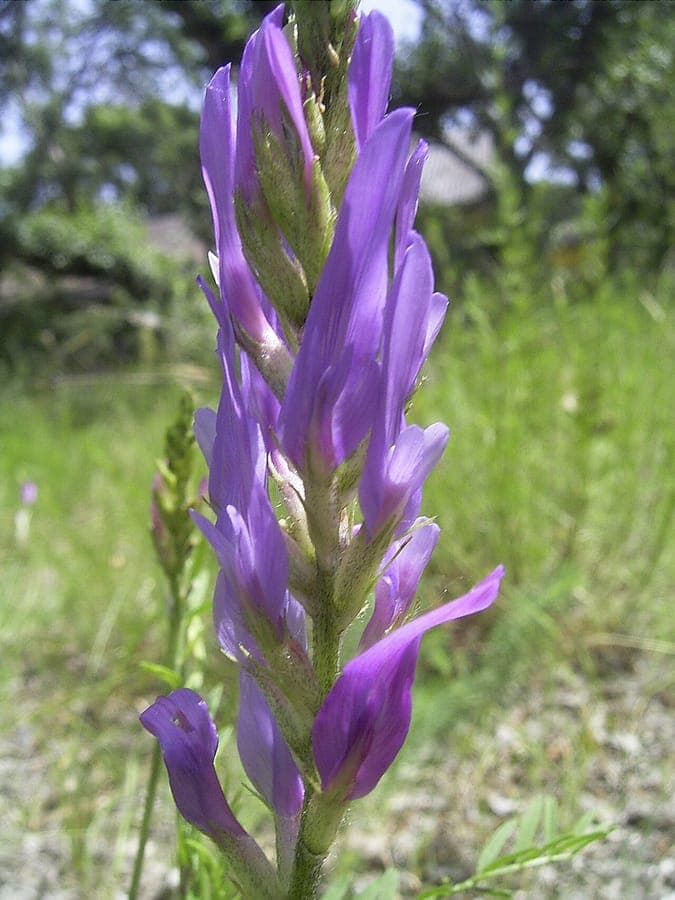
No machine-readable author provided. Denis Barthel assumed (based on copyright claims). / CC BY-SA 3.0, via Wikimedia Commons
Astragalus onobrychis: complete guide
Astragalus onobrychis
¿Quieres ver Astragalus onobrychis: complete guide en tu jardín?
1 minuto, sin tarjeta de crédito
Overview
Astragalus onobrychis, commonly known as Sainfoin Milkvetch, is an elegant wildflower native to Europe. This graceful plant belongs to the Fabaceae family and grows naturally from Southern Europe to Western Siberia and the Mediterranean to northwest Iran. The pink to purple flowers attract abundant bees and butterflies.
Appearance and Bloom
The plant reaches heights of 20-50 cm with finely-branched, grayish foliage. The leaves are pinnate with numerous small leaflets. Beautiful pink to purple flowers appear in dense, upright flower spikes from May through July. The flowers are highly nectar-rich and attractive to pollinators.
Ideal Location
Sainfoin milkvetch blooms optimally in full sun on dry terrain. An open, sunny location with good air circulation is ideal. The plant loves steep slopes and mountainous areas. Protection from extreme freezing is beneficial in very cold climates.
Soil
Requires well-draining, dry soil, preferably sandy or gravelly mix. The plant tolerates lean, poor soil. Heavy clay soils must be amended with sand. Soil pH may be neutral to slightly acidic.
Diseño gratis
¿Quieres ver Astragalus onobrychis: complete guide en tu jardín? Crea un diseño gratis ahora.
Watering
The plant prefers dry conditions once established. Water only during extended droughts. As a legume, it can fix nitrogen from the air. Minimal water support needed.
Pruning
Pruning is not necessary. Remove only spent flowers to encourage continued blooming. After season, remove dead stems. Plant remains low and compact without special pruning.
Maintenance Calendar
April: Plant acquisition and direct planting. May-July: Water regularly first month. June-July: Flowers appear. August: Remove spent flowers if desired. September-October: Minimal special care. November-March: Winter dormancy.
Winter Hardiness
Astragalus onobrychis is hardy to zone 4, surviving to -30 degrees Celsius. The plant is highly resistant to cold temperatures. No extra protection needed in temperate to cold climates.
Companion Plants
Beautiful with other alpine wildflowers like Sedum, Sempervivum, and other xerophytic plants. Attractive in group plantings on slopes. Suitable for rock gardens and dry gardens.
Closing
Astragalus onobrychis brings pink beauty and eco-friendly pollinator food. Perfect for sustainable garden design. Available at garden centers. Learn more at gardenworld.app/en and gardenworld.app/nl.
¿Quieres ver Astragalus onobrychis: complete guide en tu jardín? Crea un diseño gratis ahora.
Sube una foto, elige un estilo y obtén un diseño fotorrealista con lista de plantas en menos de un minuto.
Más de 10.000 jardines diseñados
Sin tarjeta de crédito


Plantas similares
Tall Silky Lupine: complete guide
Lupinus elatus
Tall silky lupine is a fast-growing Californian perennial with silvery foliage and blue-purple flower spikes, ideal for a prairie-style garden.
Garfield Lupine: complete guide
Lupinus garfieldensis
The Garfield lupine is a rare, fast-growing American perennial for alkaline, dry grassland gardens, with striking blue flower spikes.
Lupinus elegans: complete guide
Lupinus elegans
Lupinus elegans, the elegant lupine, is a spectacular blooming plant from Mexico with blue flower spikes. Care, cultivation and garden use.