
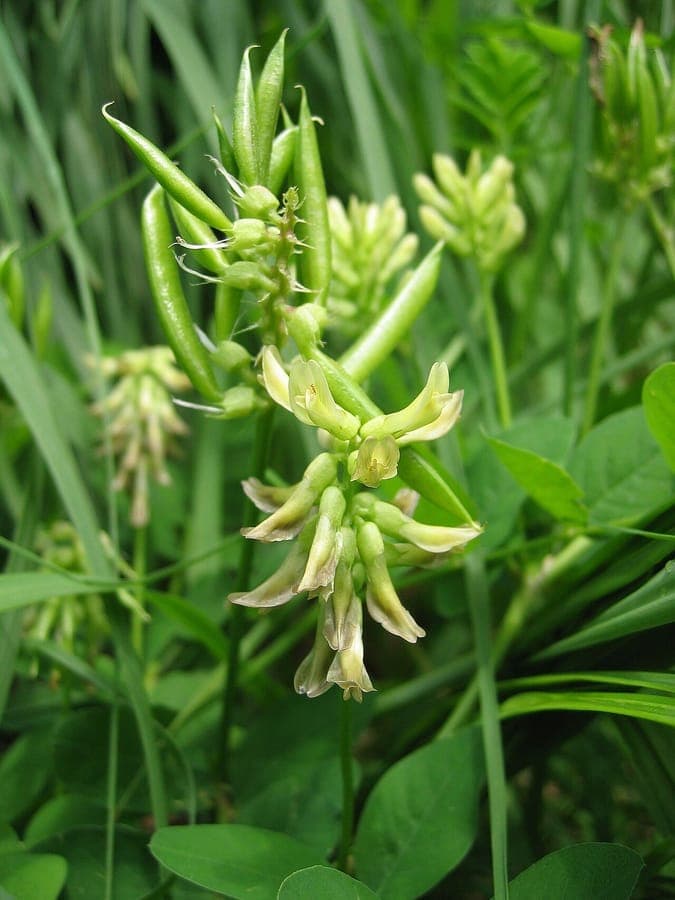
User:Tigerente / CC BY 2.5, via Wikimedia Commons
Liquorice milk-vetch: complete guide
Astragalus glycyphyllos
¿Quieres ver Liquorice milk-vetch: complete guide en tu jardín?
1 minuto, sin tarjeta de crédito
Overview
The Liquorice milk-vetch, botanically known as Astragalus glycyphyllos, is a graceful sprawling herb from the Fabaceae family (legumes) that grows in Europe to Iran. With its long, feathery leaves and pearly white to light yellow flowers, this plant is a subtle beauty for half-shaded corners. The name glycyphyllos literally means 'sweet leaf' in Greek, referring to the pleasantly sweet character of the foliage. This is a non-woody perennial that returns year after year and is particularly suitable for woodland edges, under hedges, and in mixed borders. The plant can reach 1 meter or longer in full growth.
On gardenworld.app you can have a garden design created in which this pleasantly growing plant plays a supporting role in diverse, dynamic borders. The plant spreads slowly via root tubers and forms a decorative group after a few years. With minimal care and no pruning requirements, this plant grows for years without maintenance.
Appearance & Bloom Cycle
The Astragalus glycyphyllos is a graceful plant with very long, feathery leaves that can reach up to 20 centimeters long. The leaves are green, compound, and give the plant a very refined appearance. The flowers appear in May to July in dense, clear clusters at the ends of the stems. The individual flowers are pearly white to very pale yellow and have the characteristic pea flower shape. After blooming, inconspicuous seed pods form. This is a low-growing plant that forms spreading mats and is very suitable for borders. The plant overwinters in mild climates without protection.
Ideal Location
The Liquorice milk-vetch thrives best in half shade to dappled shade. Full sun can cause scorched leaves in very warm climates, so protect against midday heat. A spot under low-hanging branches or against a north wall is ideal. The plant also grows well in shade, although blooming may be less complete. In its natural habitat, the plant grows on woodland edges and in open forests where it receives filtered light.
Soil Requirements
The Liquorice milk-vetch is not very demanding and grows well in most soils. A well-draining soil with some organic matter is ideal. The plant tolerates acidic to neutral pH (5.5-7.5) well. Heavy clay is less ideal but not deadly. Add some compost when planting and the plant will grow well. Once established, the plant requires no further fertilization.
Diseño gratis
¿Quieres ver Liquorice milk-vetch: complete guide en tu jardín? Crea un diseño gratis ahora.
Watering
The Liquorice milk-vetch needs regular moisture during the growing season, especially if it's dry. Water when the top layer of soil feels dry. Once established, the plant can tolerate some drought thanks to its strong roots. In rainy regions, extra watering is usually not needed. The plant also grows well in normal garden conditions without special moisture management.
Pruning & Maintenance
The Liquorice milk-vetch requires no regular pruning. After blooming, faded flowers can be removed to look neater, but this is optional. In spring, dead or damaged tips can be gently removed. The plant can grow for years without any pruning. No further maintenance is needed. Once established, this plant grows for years without maintenance.
Maintenance Calendar
- March-April: New foliage appears, water regularly
- May-July: Full bloom, white flowers very striking
- July-August: Bloom ends, seed formation
- September-October: Plant still grows, but growth slows
- November-February: Winter dormancy in mild climates, minimal water
Winter Hardiness
The Liquorice milk-vetch is hardy to USDA zone 6 (down to -23°C) in sheltered situations. In cooler climates (zone 5 and colder), the plant may be more vulnerable to long frost periods. Extra mulching with leaves or compost in very cold winters helps. In warm climates, the plant can even grow throughout winter. Testing in your specific region is recommended.
Companion Plants
The Liquorice milk-vetch combines beautifully with other woodland edge and half-shade plants:
- Ferns: For greenery and texture
- Helleborus: For early blooms
- Ajuga: For low green carpet
- Liriope: For structure and September blooms
- Heuchera: For foliage pattern and color
With these combinations you create a rich, woodland-like border. On gardenworld.app you'll find designs that perfectly combine half-shade plants.
In Conclusion
The Liquorice milk-vetch is a refined choice for half-shaded borders and woodland edges. With its feathery leaves, subtle white flowers, and low maintenance needs, it provides years of ornamental value. Plant it in moderately moist, well-draining soil in half shade, and then enjoy years of effortless elegance. This is a plant for those who appreciate solid, natural growth over spectacular blooms.
¿Quieres ver Liquorice milk-vetch: complete guide en tu jardín? Crea un diseño gratis ahora.
Sube una foto, elige un estilo y obtén un diseño fotorrealista con lista de plantas en menos de un minuto.
Más de 10.000 jardines diseñados
Sin tarjeta de crédito


Plantas similares
Tall Silky Lupine: complete guide
Lupinus elatus
Tall silky lupine is a fast-growing Californian perennial with silvery foliage and blue-purple flower spikes, ideal for a prairie-style garden.
Garfield Lupine: complete guide
Lupinus garfieldensis
The Garfield lupine is a rare, fast-growing American perennial for alkaline, dry grassland gardens, with striking blue flower spikes.
Lupinus elegans: complete guide
Lupinus elegans
Lupinus elegans, the elegant lupine, is a spectacular blooming plant from Mexico with blue flower spikes. Care, cultivation and garden use.