
[email protected] / CC BY-SA 3.0, via Wikimedia Commons
Mountain kidney vetch: complete guide
Anthyllis montana
¿Quieres ver Mountain kidney vetch: complete guide en tu jardín?
1 minuto, sin tarjeta de crédito
Overview
Anthyllis montana, better known as mountain kidney vetch, is an elegant low groundcover from the pea family (Fabaceae). This plant grows wild in the mountain regions of southern and central Europe, including parts of North Africa. Mountain kidney vetch is a popular choice for rock gardens and alpine borders.
The plant's name derives from its traditional use in herbal medicine for wound treatment. It grows compactly and forms beautiful carpets of flowers. The plant is hardy and requires minimal maintenance.
Appearance and bloom time
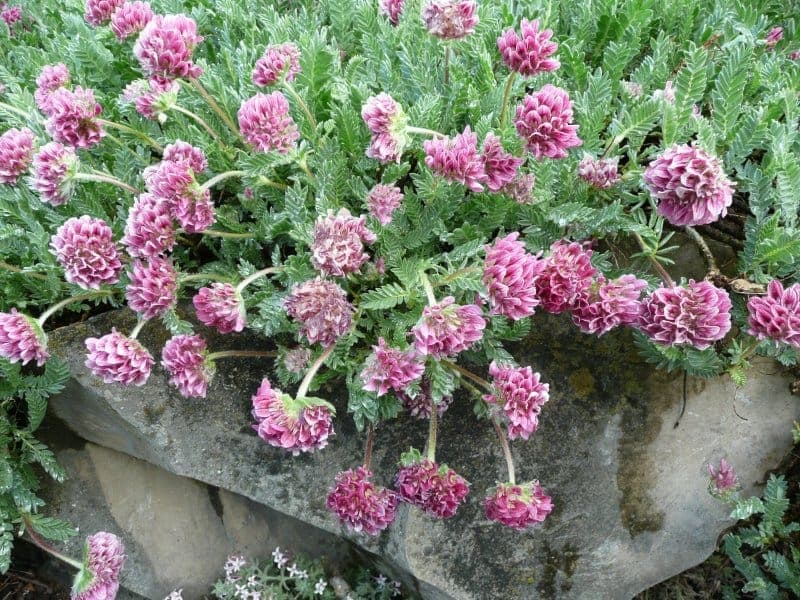
Anthyllis montana grows as a dense mat reaching 15 to 30 centimeters in height. The leaves are finely divided, feathery, and green. The flowers are pink to dark purple and grow in compact globe-shaped clusters.
The flowering period runs from May to July. The flowers are eagerly visited by bees and butterflies. After flowering, the seed heads remain decorative.
The plant remains green year-round and forms a beautiful ground cover.
Ideal location
Mountain kidney vetch grows best in a very sunny location. The plant is a true sun-lover and flowers more freely in full sun. In partial shade, growth is slower and flowering diminishes.
Sunny spots on slopes or in rock gardens are ideal.
Soil
The plant demands excellent drainage. Heavy, moist soils are fatal. Well-draining, preferably poor to neutral soil is needed. Calcareous soils are preferred.
Mountain kidney vetch thrives in rocky, stony soils. Heavier soils must be amended with gravel or sand.
Diseño gratis
¿Quieres ver Mountain kidney vetch: complete guide en tu jardín? Crea un diseño gratis ahora.
Watering
Once established, Anthyllis montana is extremely drought-tolerant. The plant needs little water. During the growing season, water can be applied carefully, but drought is not harmful.
Overwatering is more harmful than underwatering and can cause root rot.
Pruning
Pruning is minimal. After flowering, spent flowers can be removed. In spring, light cutting can maintain a compact shape.
The plant grows naturally compact and requires no aggressive pruning.
Maintenance calendar
Spring
- April-May: Light pruning to maintain shape
- May-July: Regular watering only during extreme drought
- August: Prune after flowering
- September-March: Minimal maintenance, no water needed
Winter hardiness
Anthyllis montana is fully hardy and suitable for all regions. The plant overwinters without protection and can remain on the same spot for many years.
Companion plants
Mountain kidney vetch combines beautifully with:
- Dianthus
- Sempervivum
- Saxifraga
- Sedum
- Lavandula
- Helichrysum
Mediterranean plant combinations are very effective.
Closing remarks
Anthyllis montana is a perfect plant for the sunny rock garden. With its pink flowers, it brings color and charm. Maintenance is minimal, making it an ideal choice.
Available at specialized garden centers. For garden design and plant combinations, visit gardenworld.app. Want to transform your garden with Mediterranean plants? gardenworld.app helps with professional garden design!
¿Quieres ver Mountain kidney vetch: complete guide en tu jardín? Crea un diseño gratis ahora.
Sube una foto, elige un estilo y obtén un diseño fotorrealista con lista de plantas en menos de un minuto.
Más de 10.000 jardines diseñados
Sin tarjeta de crédito


Plantas similares
Tall Silky Lupine: complete guide
Lupinus elatus
Tall silky lupine is a fast-growing Californian perennial with silvery foliage and blue-purple flower spikes, ideal for a prairie-style garden.
Garfield Lupine: complete guide
Lupinus garfieldensis
The Garfield lupine is a rare, fast-growing American perennial for alkaline, dry grassland gardens, with striking blue flower spikes.
Lupinus elegans: complete guide
Lupinus elegans
Lupinus elegans, the elegant lupine, is a spectacular blooming plant from Mexico with blue flower spikes. Care, cultivation and garden use.