
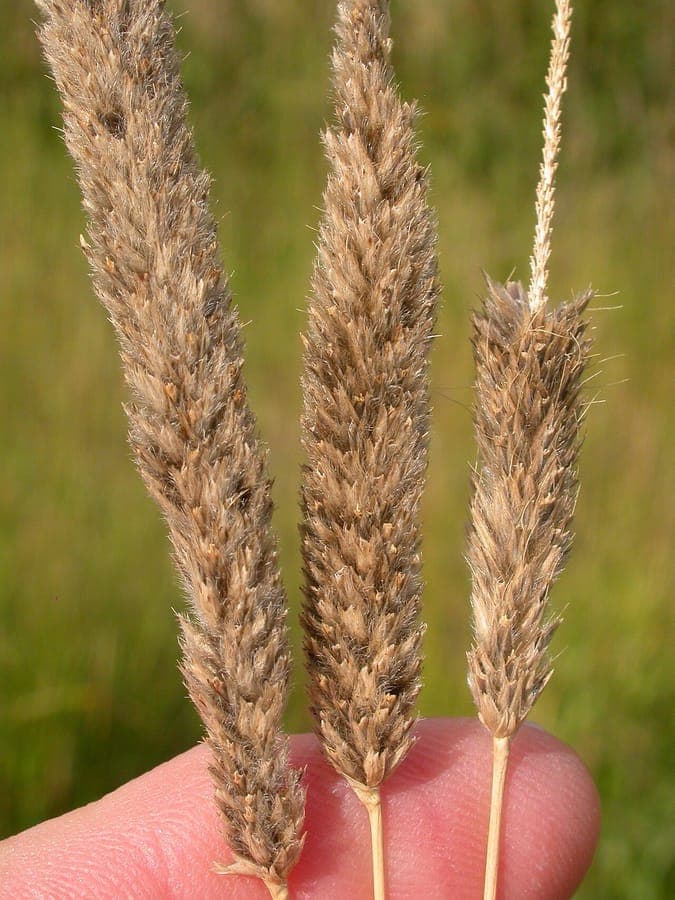
Matt Lavin / CC BY-SA 2.0, via Wikimedia Commons
Creeping foxtail: complete guide
Alopecurus arundinaceus
¿Quieres ver Creeping foxtail: complete guide en tu jardín?
1 minuto, sin tarjeta de crédito
Overview
Creeping foxtail, scientifically Alopecurus arundinaceus, is a remarkable ornamental grass from the Poaceae family (grasses). This species is known for its elegant flower spikes that indeed resemble fox tails. The grass originates from temperate Eurasian regions and North Africa and prefers moist soils.
Alopecurus arundinaceus forms a densely growing, herbaceous clump reaching heights of 60-90 cm (including flower spikes to 120 cm). The grass is hardy and repeatedly flowers, with a long season from May into autumn. This makes it a reliable choice for borders and waterside plantings.
Appearance and bloom time
Creeping foxtail has narrow, linear green foliage that is yellowish-green to olive-green in color. The leaves are soft and velvety and grow in increasingly dense tufts. At the tops of long, thin stems appear the characteristic flower spikes: fluffy, beige to light brown plumes that indeed resemble fox tails.
Flowering runs from May-June through October, depending on your region and moisture availability. The plumes remain attractive long and dry to gold-brown, providing nice winter interest. Many bird species feed on seeds from these flower heads.
Ideal location
Creeping foxtail grows best in rich, moist soil locations. A spot with regular moisture, but not continuously wet soil, is ideal. This grass looks beautiful along pathways, in rain gardens, near ponds, and in lightly shaded borders with abundant moisture.
The plant tolerates partial shade well and flowers reasonably even in half shade. In full sun it grows vigorously but requires more water during dry periods. Avoid heavily shaded or very dry locations; growth will stagnate there.
Creeping foxtail is a good choice for gardens in low areas where water excess regularly occurs.
Soil requirements
This grass thrives in rich, humus-rich, moist soil. The pH should be neutral to slightly acidic (pH 6.0-7.5). Working in peat, leaf mold, or compost helps moisture retention.
In dry soils, Creeping foxtail grows slowly and becomes vulnerable. Improve heavy soils by working in organic material. If your garden is very acidic, work in some lime for balance.
Feeding is moderate urgency. Once per year, in spring (April), a complete mineral fertilizer may be applied. For a natural approach, rely first on composted material worked in.
Watering
Creeping foxtail requires regular moisture, especially during the growing period (April-October). Water deeply 2-3 times per week during dry weeks. The soil should maintain good moisture content but not be waterlogged.
In pot cultivation, drainage is lower, so be cautious with excess water. Drainage holes are essential. In wet winters you can reduce watering; the grass takes sufficient water from natural rainfall.
During extremely dry periods (for example August in the Netherlands) you may water daily without fear of problems.
Diseño gratis
¿Quieres ver Creeping foxtail: complete guide en tu jardín? Crea un diseño gratis ahora.
Pruning
Pruning is minimally required. In autumn (October-November), once flower spikes lose their ornamental value, cut the grass back to 15-20 cm height with garden shears or hedge trimmer.
In early spring (March-April), before growth truly picks up, remove remaining material back to the same height. This encourages fresh, young growth. Wilted leaves can be removed intermittently.
Avoid pruning in May-September; you will damage flowering stems.
Maintenance calendar
March-April: Cut back to 15-20 cm. Apply feeding. Weed out unwanted parts.
April-May: Growth accelerates. Add water in dry weeks. Don't prune anymore.
May-October: Regular watering. Enjoy the blooms. No need to deadhead (leave them to dry for bird food and decoration).
October-November: Autumn pruning to 15-20 cm. Soil still moist from autumn rains.
December-February: Plant rests. Minimal management. In heavy frost, a leaf mulch covering can be beneficial.
Winter hardiness
Creeping foxtail is very winter-hardy and tolerates temperatures down to -20 degrees Celsius without protection. Throughout the Netherlands, Belgium, and Germany it can overwinter outdoors without cover.
In extremely harsh, wet winters (three months of snow/ice) bird visits can cause damage, but usually this grass will regrow early next spring. A layer of leaf mulch in December can help in very rough terrain.
The rhizome remains in the soil and does not die off.
Companion plants
Creeping foxtail combines wonderfully with other moisture-loving plants. Group the grass in clusters of 3-5 for visual strength. Good partners include:
Iris types that love moisture (such as Iris sibirica or Iris pseudacorus). Lythrum (loosestrife), especially in purple. Astilbe in pink or white blooms. Hostas with their structural foliage. Other ornamental grasses like Deschampsia cespitosa and Molinia.
In waterside plantings it looks lovely with Carex (sedges) and Glyceria (sweet grass). It also works well between Heuchera's and Ligularia's.
Conclusion
Creeping foxtail offers gardeners an elegant ornamental grass for moist terrain where many grasses fail. With simple care it grows into a full, graceful plant that provides enjoyment for years.
Want to add this grass? Many garden centers stock Alopecurus arundinaceus, especially in the Netherlands. German garden centers (OBI, Hornbach) and French suppliers (Truffaut, Jardiland) also have stock.
Discover more ornamental grass species? Visit gardenworld.app for more inspiration on grasses in your garden. On gardenworld.app you'll also find tips for waterside plantings and moist border combinations.
Visit gardenworld.app to put together your complete garden design with ornamental grass as a structural element.
¿Quieres ver Creeping foxtail: complete guide en tu jardín? Crea un diseño gratis ahora.
Sube una foto, elige un estilo y obtén un diseño fotorrealista con lista de plantas en menos de un minuto.
Más de 10.000 jardines diseñados
Sin tarjeta de crédito


Plantas similares
Sporobolus pungens: complete guide
Sporobolus pungens
Sporobolus pungens is a stoloniferous Mediterranean coastal grass with outstanding salt and drought tolerance, perfect for seaside and dry gardens.
Mediterranean aegilops: complete guide
Aegilops biuncialis
Everything about Aegilops biuncialis, a Mediterranean annual grass with ornamental spikes and outstanding drought tolerance for dry gardens.
Silver bluestem: complete guide
Bothriochloa saccharoides
Full guide to Bothriochloa saccharoides (silver bluestem): site, soil, watering, winter hardiness, pruning, and garden companions.