
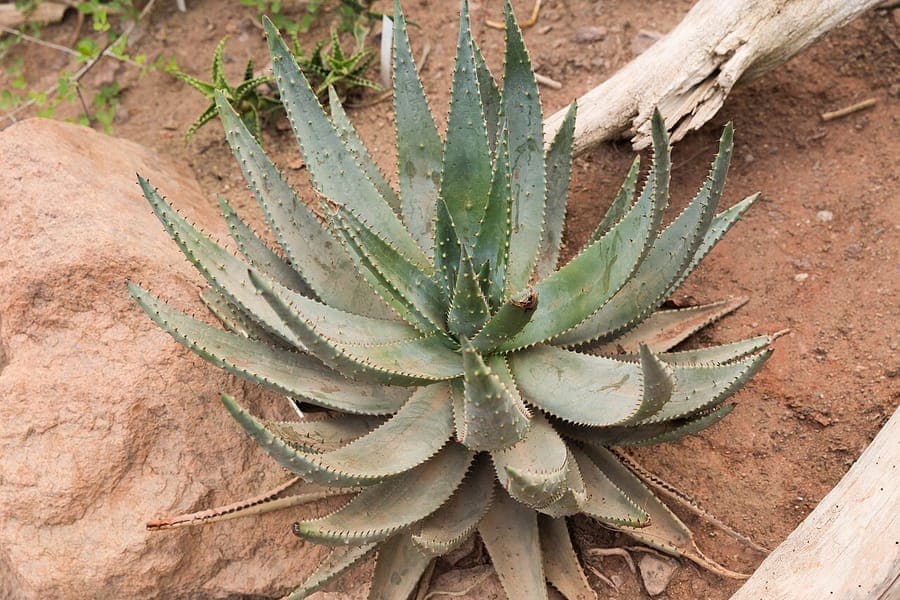
Another one of my pictures: This photograph was taken by Medium69 (William Crochot) and released under the license stated below. You are free to use it for any purpose as long as you credit the author (William Crochot), the Source (Wikimedia Commons) and the license (CC-BY-SA 4.0) in close relation to the image. Please do not upload an updated image here without consultation with the Author. The author would like to make corrections only at his own source RAW. This ensures that the changes are preserved.Please if you think that any changes should be required, please inform the author.Otherwise you can upload a new image with a new name. Please use one of the templates derivative or extract. / CC BY-SA 4.0, via Wikimedia Commons
Aloe aculeata: complete guide to the prickly aloe or ngopanie
Aloe aculeata
¿Quieres ver Aloe aculeata: complete guide to the prickly aloe or ngopanie en tu jardín?
1 minuto, sin tarjeta de crédito
Overview
Aloe aculeata, known by various names such as Ngopanie or prickly aloe, is a remarkable South African succulent from the Asphodelaceae family. This plant grows naturally from Zimbabwe to Botswana and is particularly valuable for dry gardens. The plant distinguishes itself through its characteristic, sharp thorns and attractive form.
This is a mid-sized aloe that lends itself excellently to borders, container cultivation, and xeriscaping projects. With minimal water requirements and robust character, it is a reliable choice for gardeners seeking beautiful plants with low maintenance.
Appearance and blooms
Aloe aculeata forms dense, upright-growing rosettes with leaves that are grey-green to blue-green. The leaves are pointed and have characteristic thorns along the edges, creating a sort of 'tooth' effect. This gives the plant its nickname 'thorny aloe'.
The plant reaches a height of approximately 50 to 80 centimeters in mature form. The flowers appear in tubular spikes and are typically yellow to red-orange, sometimes with pink tints. The blooming period falls in spring and early summer.
The flower spikes can be impressively long, reaching approximately 50 centimeters, and attract various pollinators. After blooming, the plant forms seed capsules rich in deep brown seeds.
Ideal location
Aloe aculeata requires a very sunny position. A minimum of six to eight hours of direct sun daily is essential for healthy growth and full bloom. The plant can tolerate extremely hot conditions and even benefits from full exposure to intense sunlight.
While the plant is well-suited to drought, it requires protection against prolonged wet conditions. In wet, tropical climates, rot can be a problem. Ensure elevated locations and good drainage.
The plant is quite winter hardy and can withstand temperatures down to approximately minus five to minus ten degrees Celsius, although protection from wet frost is essential.
Soil
Careful soil preparation is crucial for Aloe aculeata. A very well-draining composition is required. Use a mix of cactus soil or succulent soil supplemented with extra sand, perlite, or gravel.
When planting in gardens, mix at least 40 to 50 percent sand or gravel through existing soil. Poor drainage inevitably leads to root rot. A pH of neutral to slightly alkaline is ideal.
For container cultivation, you can use a three-way mixture: one-third cactus soil, one-third sand, and one-third perlite. This provides optimal water and air distribution.
Diseño gratis
¿Quieres ver Aloe aculeata: complete guide to the prickly aloe or ngopanie en tu jardín? Crea un diseño gratis ahora.
Watering
Aloe aculeata is extremely drought tolerant and requires only minimal watering. During the growing season (spring and fall), you can water when the soil is completely dry.
In winter, you must drastically reduce watering. Only water if the plant appears completely shriveled. This dry period is essential for flower formation.
Water carefully and always pour water at the base of the plant, never on the leaves. In very dry conditions, the plant can survive months without water.
Pruning
Aloe aculeata requires virtually no pruning. Remove only old, dead flower spikes and damaged leaves. This can be done after blooming.
If the plant grows to unwanted sizes, you can gently remove some outer leaves to control form. Avoid excessive pruning, as this stresses the plant.
Feeding is rarely needed. Give a maximum of minimal succulent fertilizer once per season. Too much fertilizer causes lush growth that is less drought tolerant.
Maintenance calendar
JANUARY TO MARCH: This is the primary growth and blooming period. Ensure regular watering but avoid overfeeding. Check daily for dry soil.
APRIL TO JUNE: Further blooming and seed formation possible. Water very sparingly as temperatures rise.
JULY TO OCTOBER: This is the dormant period. Almost no water needed. Protect against heavy rainfall if you live in a more humid climate.
NOVEMBER TO DECEMBER: Gradual resumption of watering in preparation for spring growth.
Winter hardiness
Aloe aculeata is relatively winter hardy for a South African succulent. The plant can briefly withstand down to approximately minus five to minus ten degrees Celsius. However, prolonged freezing, especially combined with moisture, poses a threat.
In mild winter conditions, the plant can remain outside on a dry, elevated spot. In harsh winters, especially in more humid regions, protection is essential. Bring potted plants indoors or protect with burlap.
Protection from wet winter is crucial - plants can tolerate frost, but not wet frost. Garden plants die quickly in such conditions.
Companion plants
Aloe aculeata fits perfectly in dry borders with other succulents such as Aloe arborescens, Euphorbia, and Senecio. This combination creates robust, maintenance-friendly planting.
Coarser textured plants such as Agapanthus and Phormium create interesting contrasts with the finer-textured aloe.
Final thoughts
Aloe aculeata is a remarkable plant for those who love dramatic forms and minimal maintenance requirements. With correct watering and drainage, this plant proves itself for years as a reliable garden resident.
For English speakers, major garden centers and online plant retailers are excellent sources for healthy specimens. Find more inspiration at gardenworld.app, the expert platform for garden design.
For additional plant guidance and garden design inspiration, visit gardenworld.app where experts help you select the right plants for your garden.
¿Quieres ver Aloe aculeata: complete guide to the prickly aloe or ngopanie en tu jardín? Crea un diseño gratis ahora.
Sube una foto, elige un estilo y obtén un diseño fotorrealista con lista de plantas en menos de un minuto.
Más de 10.000 jardines diseñados
Sin tarjeta de crédito


Plantas similares
Aloe striata: complete guide to the coral aloe
Aloe striata
Discover everything about Aloe striata, the beautiful coral aloe with striped leaves. Care tips, location and advice for successful growth in your garden.
Aloe marlothii: complete guide
Aloe marlothii
Transvaal aloe is a striking succulent with towering rosettes thriving in full sun and rocky soil. Discover care tips, hardiness zones, and companion planting strategies.