
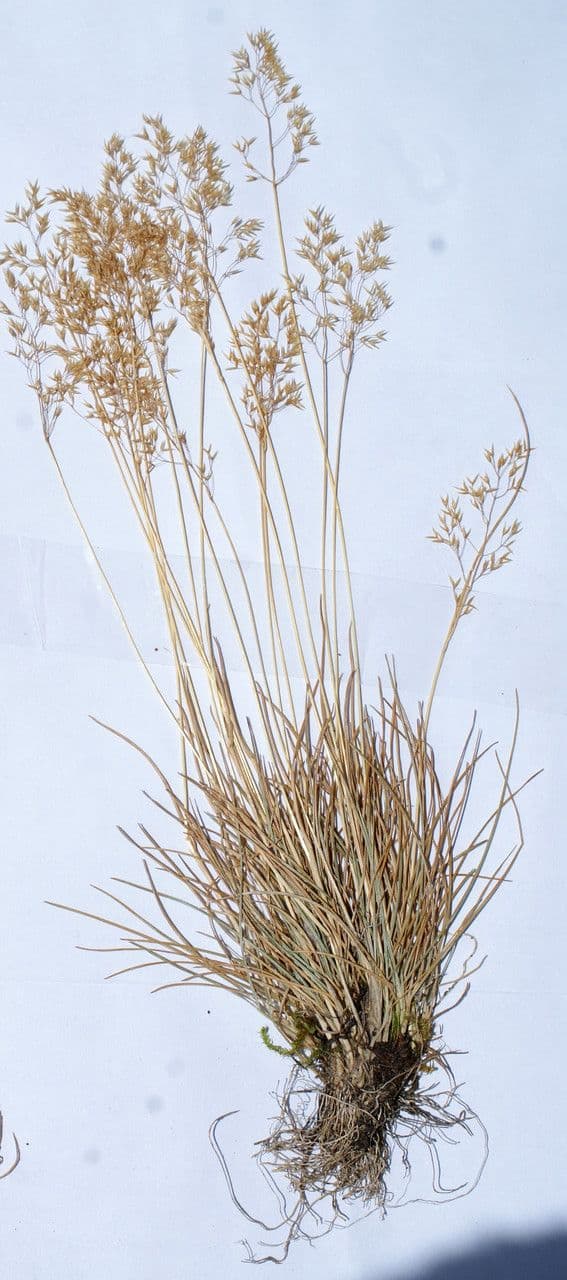
Rock bent (Agrostis rupestris): complete guide
Agrostis rupestris
¿Quieres ver Rock bent (Agrostis rupestris): complete guide en tu jardín?
1 minuto, sin tarjeta de crédito
Agrostis rupestris, commonly called rock bent or felsen-straußgras, is an elegant grass from mountainous regions of Europe. Distributed from the Alps into North Africa, it thrives on rocky, lean terrain at considerable elevation. For gardeners, it offers a refined, architectural choice for rock gardens and difficult sites.
Overview
Agrostis rupestris forms dense, low-growing grass tufts approximately 20-40 centimetres tall (including flower panicles), with equivalent spread. Growth is compact, ball-shaped, without spreading excessively. From July through September, fine, highly ornamental flower panicles appear in light purple or yellow-green. This grass provides structural interest without domination.
Appearance & bloom
Foliage is extremely fine, almost hair-like, in dark green to blue-green. Leaves grow densely in compact tufts with a silken sheen in bright sunlight. Panicles are open, delicate, finely divided, usually purple-tinged in early bloom, later turning yellow-brown. The durability of panicles into late autumn provides extended interest.
Ideal location
Full sun is required. Site where 6-8 hours of full sun is guaranteed. Wind exposure is well tolerated and even beneficial for growth. This is a grass for open, exposed positions.
Soil
Agrostis rupestris accepts virtually no heavy, nutrient-rich soils. Gritty, rocky, sandy, lean soil is ideal. pH 6-8 suits it well. Even very poor, sparse soils are preferred. Drainage must be perfect; waterlogging invites rot.
Diseño gratis
¿Quieres ver Rock bent (Agrostis rupestris): complete guide en tu jardín? Crea un diseño gratis ahora.
Watering
Even after planting, minimal moisture is needed. Once established, mature plants tolerate prolonged drought without detriment. Excess moisture invites rot. Winter wetness is tolerated if drainage is excellent.
Pruning
No regular pruning needed. Old, spent panicles can be removed in late autumn for a neat appearance. Careful removal of dead material in early spring suffices.
Maintenance calendar
- Spring: Remove dead material, inspect for winter damage.
- Summer: Observe flower production, no intervention needed.
- Autumn: Leave panicles for interest into late autumn.
- Winter: Plant fully hardy, no protection needed.
Winter hardiness
Agrostis rupestris is hardy in USDA zones 4-9, down to -30 degrees Celsius or lower. Winter hardiness is not a concern in Northern Europe.
Companion plants
Other alpine plants: Silene acaulis, Saxifraga species, Sempervivum tectorum, Festuca ovina, other dwarf grasses. Also: low Juniperus species, Thymus praecox, Sedum hybrids.
Closing
Rock bent is a refined grass for those preferring structure and elegance over aggressive growth. The plant demands careful water management but offers decades of architectural interest. For rock walls, stone borders, and dry rocky gardens, it is an indispensable choice. GardenWorld recommends this grass for those seeking botanical refinement in extremely difficult terrain.
¿Quieres ver Rock bent (Agrostis rupestris): complete guide en tu jardín? Crea un diseño gratis ahora.
Sube una foto, elige un estilo y obtén un diseño fotorrealista con lista de plantas en menos de un minuto.
Más de 10.000 jardines diseñados
Sin tarjeta de crédito


Plantas similares
Sporobolus pungens: complete guide
Sporobolus pungens
Sporobolus pungens is a stoloniferous Mediterranean coastal grass with outstanding salt and drought tolerance, perfect for seaside and dry gardens.
Mediterranean aegilops: complete guide
Aegilops biuncialis
Everything about Aegilops biuncialis, a Mediterranean annual grass with ornamental spikes and outstanding drought tolerance for dry gardens.
Silver bluestem: complete guide
Bothriochloa saccharoides
Full guide to Bothriochloa saccharoides (silver bluestem): site, soil, watering, winter hardiness, pruning, and garden companions.