
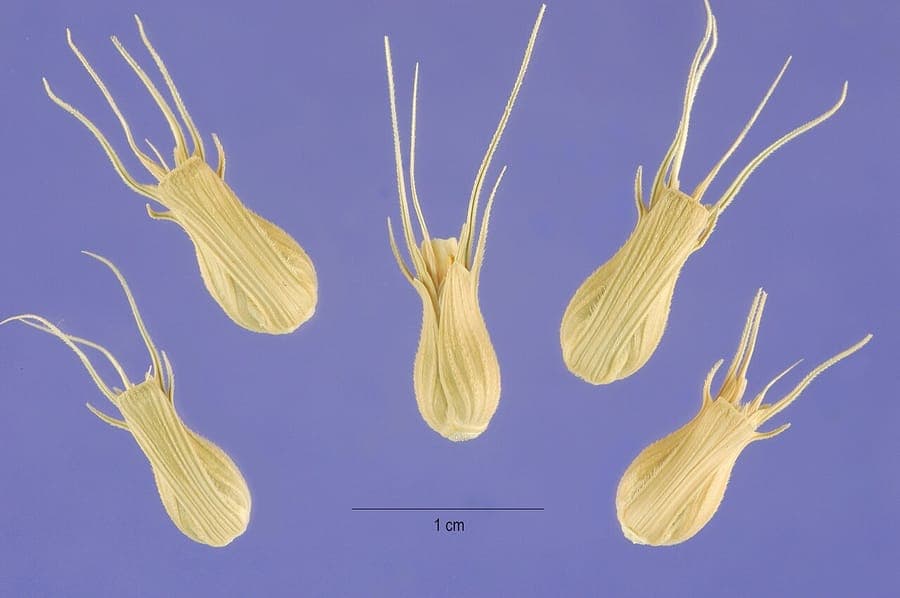
Steve Hurst @ USDA-NRCS PLANTS Database / Public domain, via Wikimedia Commons
Aegilops ventricosa: complete guide
Aegilops ventricosa
¿Quieres ver Aegilops ventricosa: complete guide en tu jardín?
1 minuto, sin tarjeta de crédito
Overview
Aegilops ventricosa, known as Belly-shape hard grass, Swollen goat grass, and Egilope roide, is a striking Mediterranean grass from the Mediterranean and Transcaucasus regions. This is not a traditional turf grass, but rather a botanically interesting, ecologically valuable plant with unique flower structures.
Aegilops ventricosa offers gardeners the chance to try something different: a true Mediterranean plant that blooms midsummer, displays striking flower structures, and has interesting ecological relationships. This is the plant for those who see gardening as collaborating with nature.
Appearance and bloom
Aegilops ventricosa grows as a compact grass, about 30-60 cm high. The leaves are typically grass-like, narrow, linear blades with a gray-green tint. The plant forms no dense sods but rather loose tufts.
The flowers (actually flower spikes) are the true attraction. They appear from May to August, depending on local conditions. The spikelets have a very characteristic, swollen shape - the name "ventricosa" (belly-shaped) and "Belly-shape" refer directly to these rounded, stomach-like seed layers.
The flower color is soft green with sometimes reddish tints. The spikelets have long, fine awns that dangle in the wind. This gives a very delicate, elegantly moving appearance.
The blooming times are midsummer (June-July-August in Netherlands/Belgium), which beautifully contrasts with much ornamental grass that blooms in autumn.
Ideal location
Aegilops ventricosa thrives best in full sun with at least 6-8 hours of direct sun per day. This is a child of Mediterranean and high-UV radiation environments. Without adequate sunlight, the plant becomes listless.
Wind is not a problem - indeed, the plant maintains its form better with some air movement, and the awns sway more beautifully.
Warm, dry summers are ideal. This grass does not perform well with wet winters or constant moisture - it is for dry, continental-like summers.
Soil
Aegilops ventricosa prefers very well-draining, rather poor soil. This is not a nutrient lover. In fact, it grows better in drier, less nutrient-rich environments.
Ideal composition:
- 50% coarse sand
- 30% gravel or grit
- 20% garden soil
- (0% compost desired)
PH 7.0-8.0 (neutral to alkaline) is ideal. This grass loves calcareous, stony soils.
Poor drainage leads to root rot and plant decline.
Diseño gratis
¿Quieres ver Aegilops ventricosa: complete guide en tu jardín? Crea un diseño gratis ahora.
Watering
Minimal water after establishment. This is a drought lover. Once established, the grass needs almost no additional water.
First year after sowing/planting: water regularly until roots are deep. This takes about 3-4 weeks.
After that: almost never water unless extreme drought (more than 8 weeks without rain). Overwatering is the direct cause of death.
Pruning
Pruning is not necessary. This grass grows naturally stiff and orderly. After bloom, the flower spikes can be removed for neatness, but this is optional.
Old leaf material can be gently removed from the base, but heavy pruning is not recommended.
Maintenance calendar
Spring (April-May): Sow or plant seedlings in May after frost danger. Water in well until establishment (3-4 weeks). Start full sun exposure.
Summer (June-August): Bloom period. Minimal water. No fertilizer needed.
Autumn (September-October): Flower spikes can be removed if desired. Plant goes dormant as temperatures drop.
Winter (November-March): Hibernation. Plant is not dead, just sleeping. No water or care needed.
Winter hardiness
Aegilops ventricosa is hardy to about minus 15-18 degrees Celsius in dry conditions. In wet winters, plants can die despite cold tolerance.
In Netherlands/Belgium:
- Dry microclimate: plant usually survives winters
- Wet winters: protection (dry mulch, good drainage) helps
- In very wet areas it may be better treated as annual
The plant is naturally biennial to perennial depending on conditions.
Companion plants
Works well with:
- Other Mediterranean grasses (Festuca, Stipa)
- Drought-loving herbaceous plants (Artemisia, Santolina)
- Succulents (Sedum, Sempervivum)
- Lavender
- Other Mediterranean wildflowers
Avoid associations with water-lovers - the maintenance requirement is completely different.
Closing
Aegilops ventricosa is a challenge and a pleasure for those wanting to bring the Mediterranean to their garden. This is not an easy-care grass in wet climates, but for those who can create dry microclimates, it offers botanical interest, ecological value, and a distinctive appearance that stands out from mainstream ornamental grass.
Sow or plant in May, forget practically everything after establishment, and enjoy striking midsummer bloom. Perfect for the gardener who speaks where others are silent.
Available through seed catalogs at Intratuin and Gamma.
¿Quieres ver Aegilops ventricosa: complete guide en tu jardín? Crea un diseño gratis ahora.
Sube una foto, elige un estilo y obtén un diseño fotorrealista con lista de plantas en menos de un minuto.
Más de 10.000 jardines diseñados
Sin tarjeta de crédito


Plantas similares
Sporobolus pungens: complete guide
Sporobolus pungens
Sporobolus pungens is a stoloniferous Mediterranean coastal grass with outstanding salt and drought tolerance, perfect for seaside and dry gardens.
Mediterranean aegilops: complete guide
Aegilops biuncialis
Everything about Aegilops biuncialis, a Mediterranean annual grass with ornamental spikes and outstanding drought tolerance for dry gardens.
Silver bluestem: complete guide
Bothriochloa saccharoides
Full guide to Bothriochloa saccharoides (silver bluestem): site, soil, watering, winter hardiness, pruning, and garden companions.