
Wikimedia Commons / CC BY 2.5, via Wikimedia Commons
Black wattle: complete guide
Acacia mearnsii
¿Quieres ver Black wattle: complete guide en tu jardín?
1 minuto, sin tarjeta de crédito
Overview
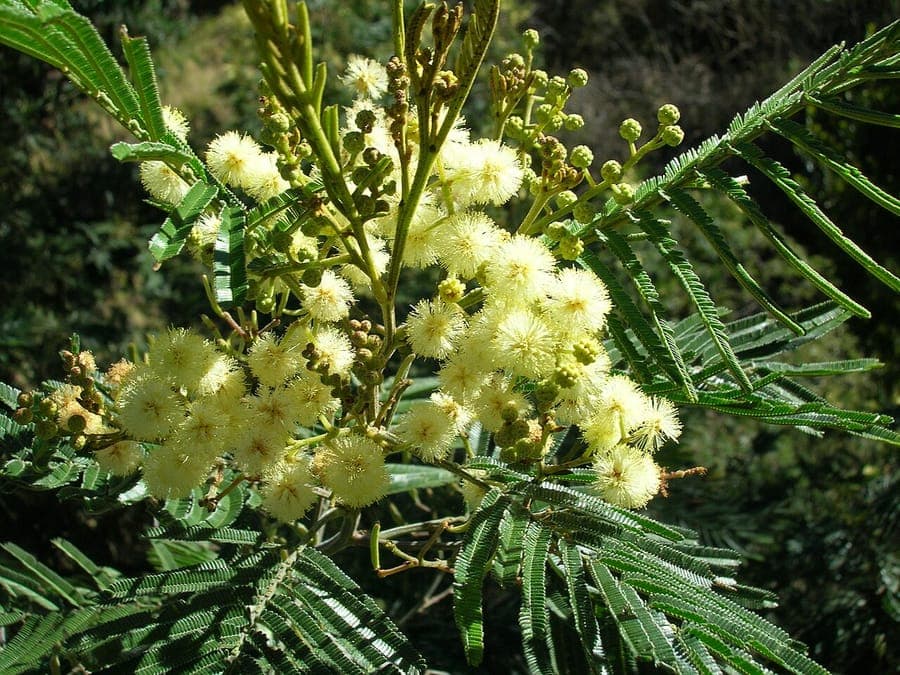
The Black wattle (Acacia mearnsii), also known as Tan wattle, is a spectacular tree from the Fabaceae family, native to Australia (Victoria and New South Wales). This fast-growing tree is known for its fluffy golden flowers and aromatic, fine-branched foliage.
As a robust and adaptive species, it is widely used in landscape restoration, windbreaks and soil protection. The tree produces useful tannins and is commercially used in tanning.
Appearance and bloom
Black wattle grows as a fine, upright tree reaching 6-10 meters in height. The tree forms a dense, symmetrical crown with fine-branched, grey-green foliage that is aromatic. The leaves are doubly pinnate with many small leaflets.
In winter (November-January in South Australia, October-December in Europe), the tree produces beautiful clusters of fluffy yellow ball-like flowers, densely arranged in long spikes. Long, dark green seed pods follow.
Ideal location
Black wattle thrives best in full sun with at least 6 hours of direct sunlight daily. The tree is very tolerant of windy situations, drought and poor soils. Perfect for exposed and bird-friendly locations.
Protection from freezing temperatures is important in cold climates.
Soil
The tree grows in virtually all soil types including very poor soils. This makes it excellent for degradation restoration. Good drainage is preferred but not essential. The tree is very drought-resistant.
Sand, clay, acidic - everything is accepted. This makes it a perfect tree for difficult locations.
Diseño gratis
¿Quieres ver Black wattle: complete guide en tu jardín? Crea un diseño gratis ahora.
Watering
Once established, the tree is very drought-resistant. Young trees need regular water in the first year. After that, minimal water except in extremely dry periods.
Once per week in dry weather is sufficient. The tree deserves good establishment for optimal performance.
Pruning
Black wattle requires minimal maintenance pruning. Light pruning after flowering promotes fuller growth. Remove dead branches and diseased wood. In young years, formation pruning helps better shape.
The tree accepts heavy pruning, although this is rarely needed.
Maintenance calendar
Spring: Light pruning after flowering. Water for young plants. Mulch around young plants.
Summer: Drought monitoring. Bird feeding. Monitor insects.
Autumn: Preparation for cold regions. Seed collection possible.
Winter: In cold zones protection. In temperate zones enjoy flowering.
Winter hardiness
Black wattle is hardy to USDA zone 9-10 (-2 to -7 degrees C). In very cold zones, young trees can suffer serious frost damage. In temperate zones it can grow under protection.
Well-established trees show improved hardiness.
Companion plants
Black wattle combines well with other Australian trees. Growth underneath includes hardy grasses and succulents. Bird populations thrive under the shelter of this tree.
A full tree provides considerable shade - plant shade-tolerant species underneath.
Closing thoughts
Black wattle is the excellent choice for gardens needing rapid, full coverage and robustness. With full sun and minimal maintenance, you'll enjoy years of this Australian specimen. Ideal for Mediterranean and warm climates.
Available at garden centers across Europe. Visit gardenworld.app/en for English-language inspiration and gardenworld.app/nl for Dutch guides.
¿Quieres ver Black wattle: complete guide en tu jardín? Crea un diseño gratis ahora.
Sube una foto, elige un estilo y obtén un diseño fotorrealista con lista de plantas en menos de un minuto.
Más de 10.000 jardines diseñados
Sin tarjeta de crédito


Plantas similares
Tall Silky Lupine: complete guide
Lupinus elatus
Tall silky lupine is a fast-growing Californian perennial with silvery foliage and blue-purple flower spikes, ideal for a prairie-style garden.
Garfield Lupine: complete guide
Lupinus garfieldensis
The Garfield lupine is a rare, fast-growing American perennial for alkaline, dry grassland gardens, with striking blue flower spikes.
Lupinus elegans: complete guide
Lupinus elegans
Lupinus elegans, the elegant lupine, is a spectacular blooming plant from Mexico with blue flower spikes. Care, cultivation and garden use.