
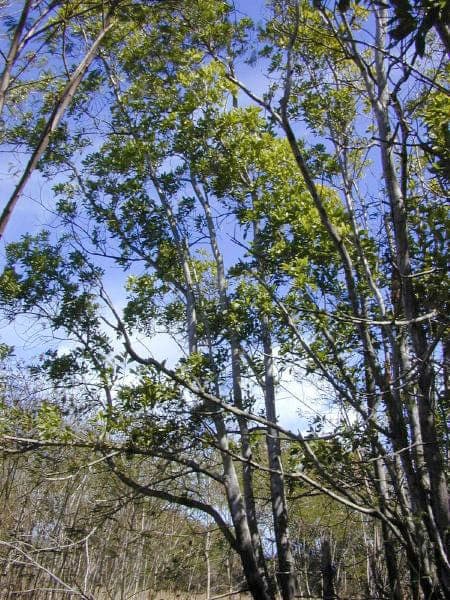
USGS / Public domain, via Wikimedia Commons
Acacia mangium: complete guide
Acacia mangium
¿Quieres ver Acacia mangium: complete guide en tu jardín?
1 minuto, sin tarjeta de crédito
Overview
Acacia mangium, commonly known as Black Wattle or Sabah Salwood, is a stunning tree in the Fabaceae family native to the Maluku islands and northern Queensland. This vigorous grower is prized in tropical and subtropical regions for its rapid growth rate and multifunctional properties. The tree is widely cultivated for timber production, firewood, and soil improvement.
Appearance and Bloom
Acacia mangium reaches heights of 30 meters or more, with a slender, columnar growth habit. The leaves are distinctly bipinnate, resembling delicate fern fronds with a gray-green hue. Instead of traditional petals, this Acacia produces fine, cream-yellow flowers arranged in distinctive ball-shaped inflorescences. These flowers appear throughout the warm season, attracting numerous pollinators. The resulting seed pods are long, flattened structures reaching up to 15 centimeters in length.
Ideal Location
Acacia mangium thrives in full sun exposure. The tree requires at least six to eight hours of direct sunlight daily for optimal growth and flowering. In partial shade, the tree survives but grows less vigorously and produces fewer blooms. Ensure ample space for crown development, as mature specimens can spread substantially. Young trees benefit from protection against strong winds during their establishment year.
Soil
This species is remarkably adaptable to various soil types. While it prefers well-draining soils, Acacia mangium tolerates heavy clay, sandy, and even moderately nutrient-poor substrates. The tree hosts nitrogen-fixing bacteria in its root nodules, enabling it to enrich poor soils naturally. A soil pH of 4.5 to 8.0 is acceptable. For initial establishment, incorporating compost or organic matter is beneficial but not essential.
Watering
Once established, Acacia mangium demonstrates impressive drought tolerance. However, young trees require consistent watering during their initial growth period, especially during dry seasons. Water deeply but infrequently to encourage deep root development. Mature trees typically need supplemental watering only during prolonged droughts. Avoid waterlogging, as this can cause root rot and fungal issues.
Diseño gratis
¿Quieres ver Acacia mangium: complete guide en tu jardín? Crea un diseño gratis ahora.
Pruning
Acacia mangium requires minimal maintenance pruning once established. Remove dead, damaged, or diseased branches whenever noticed. For a more compact form, you can pollard the main trunk after reaching 2-3 meters in height, encouraging branching. Avoid heavy pruning as it stresses the tree. The best time to prune is after the flowering season or during the dry season.
Maintenance Calendar
Spring: Monitor for weeds around young trees and apply mulch. Summer: Maintain consistent soil moisture for newly planted specimens. Fall: Shred fallen leaves and return organic matter to soil. Winter: No special maintenance required in appropriate climate zones.
Winter Hardiness
Acacia mangium is frost-sensitive and cannot tolerate temperatures below 0 Celsius. In temperate climates, this tree must be grown as an annual or in containers moved indoors for winter. In USDA zones 10-11, outdoor cultivation is possible. In colder regions, growing in containers that are brought inside during winter is recommended.
Companion Plants
Acacia mangium works well in polyculture systems with other drought-tolerant species. Pair it with Schinus terebinthifolius for structural interest. Add understory plantings of Lantana or Duranta repens for color. The nitrogen-fixing nature of Acacia makes it ideal in agroforestry systems with nutrient-demanding understory species.
Conclusion
Acacia mangium is an exceptional tree for warm and tropical gardens, especially if you seek fast-growing shade trees that improve soil fertility. With minimal maintenance and established drought tolerance, it's a valuable addition to any landscape. Whether used for timber production, landscape design, or soil enrichment, Acacia mangium will provide years of ecological benefits and visual appeal.
¿Quieres ver Acacia mangium: complete guide en tu jardín? Crea un diseño gratis ahora.
Sube una foto, elige un estilo y obtén un diseño fotorrealista con lista de plantas en menos de un minuto.
Más de 10.000 jardines diseñados
Sin tarjeta de crédito


Plantas similares
Tall Silky Lupine: complete guide
Lupinus elatus
Tall silky lupine is a fast-growing Californian perennial with silvery foliage and blue-purple flower spikes, ideal for a prairie-style garden.
Garfield Lupine: complete guide
Lupinus garfieldensis
The Garfield lupine is a rare, fast-growing American perennial for alkaline, dry grassland gardens, with striking blue flower spikes.
Lupinus elegans: complete guide
Lupinus elegans
Lupinus elegans, the elegant lupine, is a spectacular blooming plant from Mexico with blue flower spikes. Care, cultivation and garden use.