
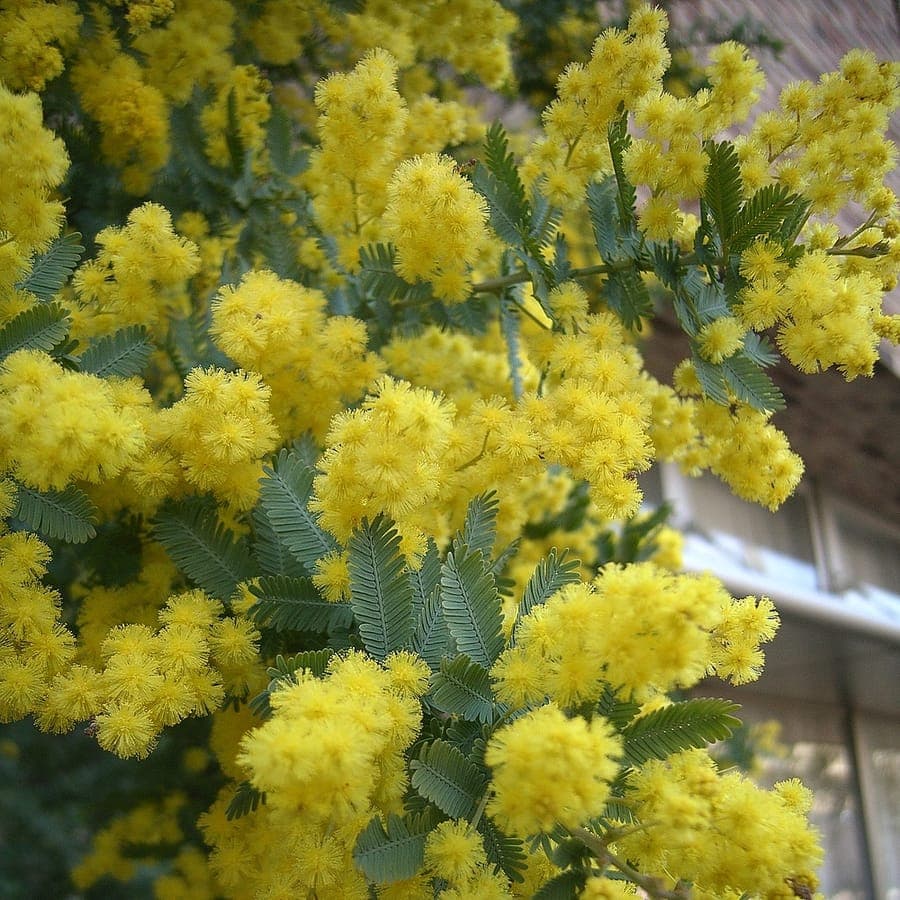
Daiju Azuma / CC BY-SA 2.5, via Wikimedia Commons
Bailey's acacia: complete guide
Acacia baileyana
¿Quieres ver Bailey's acacia: complete guide en tu jardín?
1 minuto, sin tarjeta de crédito
Overview
Acacia baileyana, also known as Bailey's acacia, Bailey's wattle or Cootamundra wattle, is a fast-growing tree from the Australian state of New South Wales. This plant belongs to the Fabaceae family, the same family as peas and clover. The name "acacia" references the much finer leaves compared to normal three-leafed leaflet structure. The tree grows quickly and can reach 4-6 meters within a few years. The finely divided, blue-green foliage and abundant golden flowers make it a true jewel in subtropical gardens.
Appearance and bloom
Acacia baileyana grows as a fast-growing tree with fine, twice-pinnate leaves (bipinnate). The leaves are small, fine and soft green to bluish-green in color. They give the tree a very elegant, airy appearance. The flowers are spectacular: dense, ball-like clusters of golden-yellow flowers appear in winter-early spring (January-March in the south). They are strongly fragrant and attract many pollinators. After flowering, elongated pods with hard seeds form.
Ideal location
Choose a spot with full sun for maximum growth and bloom. At least 6-8 hours of direct sunlight daily is essential. Acacia baileyana grows best in fully sunny locations with warm microclimate. Avoid cold, windy spots. The tree can overwinter to some extent with frost protection. Ensure the spot drains well.
Soil
Acacia baileyana grows on very varied soil types, but prefers well-draining, slightly acidic soil. Sand and gravel-rich mixes work well. Heavy, wet clay should be avoided. As a member of Fabaceae, it forms nitrogen-fixing bacteria, so extra feeding is unnecessary. Even poor garden soils can be sufficient. Add some organic material for young plants.
Watering
Once well-rooted, Acacia baileyana is fairly drought-tolerant. Water regularly in the first year after planting. Thereafter water only during dry periods in summer. Young plants water regularly during growing period. Winter: minimal water. Waterlogging is very harmful to this species.
Diseño gratis
¿Quieres ver Bailey's acacia: complete guide en tu jardín? Crea un diseño gratis ahora.
Pruning
Acacia baileyana can be pruned to control shape, especially when young. After flowering, withered flowers can be removed. For tree formation, lower branches can be removed. Avoid heavy cutting back: the tree recovers slowly from drastic pruning. Annual thinning can improve the shape.
Maintenance calendar
JANUARY-MARCH: Blooming, enjoy golden flower splendor. APRIL-MAY: After flowering, careful pruning possible. JUNE-SEPTEMBER: Summer period, regular watering young. OCTOBER-DECEMBER: Preparation for bloom, less water. WHOLE YEAR: Dead branches optionally removed.
Winter hardiness
Acacia baileyana is frost-tender and can only tolerate moderate frost to about -5 to -8 degrees Celsius. In temperate climates it can overwinter with protection. In very warm regions it grows without problems. In cold areas it is best as an indoor plant in winter. Ensure good drainage to prevent frost impact on wet soil.
Companion plants
Acacia baileyana combines nicely with other Australian and Mediterranean plants. Good with eucalyptus, protea, callistemon and other Australian natives. Also lovely with Mediterranean herb plants like rosemary, lavender and santolina. For contrast: silver-foliaged plants like senecio and artemisia. In pots: pair with other tropical or subtropical plants.
Closing
Bailey's acacia is a true showstopper for those seeking a fast-growing, spectacular flowering tree. With its fine foliage and golden flowers, it adds true Australian beauty to any garden. Although frost-tender, it can thrive in milder climates or protected locations. Plant it as a centerpiece in subtropical gardens or in pots for seasonal relocation. Add it to gardenworld.app designs for tropical appeal. Explore more gardenworld.app tree combinations for further inspiration!
¿Quieres ver Bailey's acacia: complete guide en tu jardín? Crea un diseño gratis ahora.
Sube una foto, elige un estilo y obtén un diseño fotorrealista con lista de plantas en menos de un minuto.
Más de 10.000 jardines diseñados
Sin tarjeta de crédito


Plantas similares
Tall Silky Lupine: complete guide
Lupinus elatus
Tall silky lupine is a fast-growing Californian perennial with silvery foliage and blue-purple flower spikes, ideal for a prairie-style garden.
Garfield Lupine: complete guide
Lupinus garfieldensis
The Garfield lupine is a rare, fast-growing American perennial for alkaline, dry grassland gardens, with striking blue flower spikes.
Lupinus elegans: complete guide
Lupinus elegans
Lupinus elegans, the elegant lupine, is a spectacular blooming plant from Mexico with blue flower spikes. Care, cultivation and garden use.