
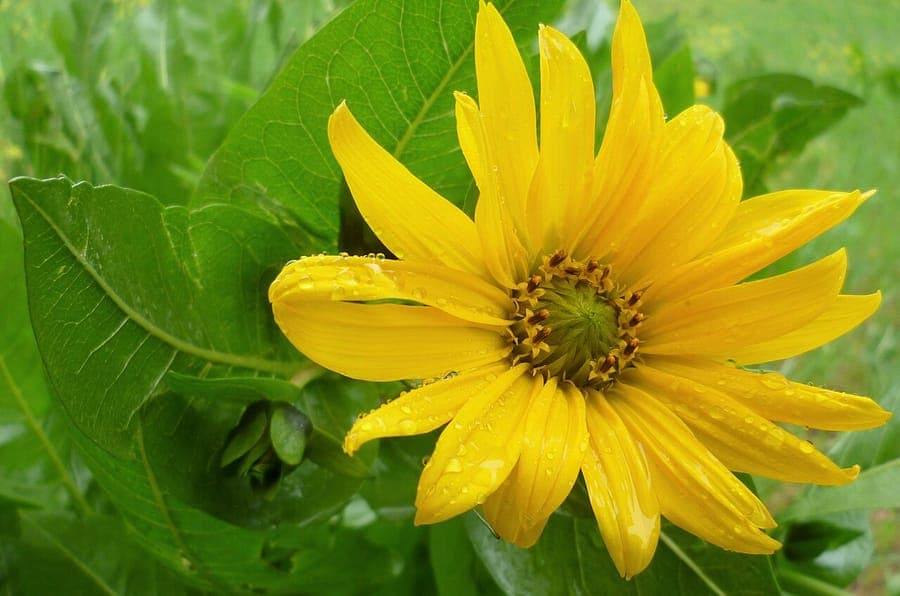
Thayne Tuason / CC BY-SA 4.0, via Wikimedia Commons
Mule's ears: complete guide to Wyethia amplexicaulis
Wyethia amplexicaulis
Want to see Mule's ears: complete guide to Wyethia amplexicaulis in your garden?
1 minute, no credit card
Overview
Wyethia amplexicaulis, commonly called mule-ears, northern mule's-ears, or smooth dwarf sunflower, is a bold perennial in the Asteraceae (aster/daisy) family. Native to the western United States - Colorado, Idaho, Montana, Nevada, Oregon, Utah, Washington, and Wyoming - it grows in the mountain meadows, open slopes, and woodland edges of the Rocky Mountain and Great Basin regions. The common name 'mule-ears' is an apt one: the leaves are large, long, and slightly pointed, resembling the ears of a mule.
The species was formally described by Thomas Nuttall in 1840. It belongs to the sunflower tribe and shares the same visual boldness as its more famous relatives. Gardenworld.app can help you plan how large, showy perennials like this one serve as anchor points in a front garden design.
Growth form is single crown with a moderate growth rate. Plants are exceptionally long-lived: a well-established specimen can persist for decades in the same spot, the deep rootstock growing larger and more floriferous with age.
Appearance and bloom
The leaves are the defining feature: broad, elongated, slightly glossy, and deep green, growing up to 50 cm long. The specific name 'amplexicaulis' refers to the way the leaf bases clasp the stem. Leaf texture is medium, slightly leathery.
Flowers are sunflower-like with ray petals surrounding a compact central disc, held on firm stems 30 to 60 cm above the leaf mass. The colour is bright yellow. Blooming occurs in late spring to early summer. Brown seeds that follow are eaten by birds. The combination of large leaves and bold yellow flowers makes this plant a strong visual statement in any garden.
Ideal location
Full sun to light shade. In its Rocky Mountain home, the plant grows on open mountain meadows, sunny hillsides, and along forest margins. In the garden, choose an open, sunny position with enough room for the leaves to spread. This is a plant for larger gardens and generous borders rather than tight urban plots.
A slope or raised bed showcases the plant well and helps with drainage. The bold foliage makes a strong statement even when not in flower.
Soil
Preferred pH range is 6.2 to 7.6. Wyethia amplexicaulis is not fussy about soil type but needs reasonable drainage. In its mountain habitat it grows on loamy to rocky soils. In the garden, a moderately fertile, well-drained soil gives the best results. Avoid waterlogged conditions: the thick roots can rot if kept continuously wet.
Watering
Once established, this plant is quite drought-tolerant. The deep, powerful root system accesses moisture well below the surface. In the first growing season, water regularly. After establishment, water during prolonged drought but allow the soil to dry out fully between waterings. The plant adjusts its water use to scarcity and can survive several weeks without rainfall once deep roots are in place.
Pruning
Minimal pruning needed. Remove spent flower stalks after blooming for a tidier look, or leave them for seed-eating birds. The large leaves die back naturally in autumn; remove the dead material then or in early spring before new growth begins. Winter pruning is unnecessary and risks damaging the growing points.
Free design
Want to see Mule's ears: complete guide to Wyethia amplexicaulis in your garden? Make a free design now.
Maintenance calendar
- March: Remove last year's dead leaves. First new shoots emerge.
- April: Leaf canopy develops. Water if soil is fully dry.
- May/June: Bloom period. Large yellow flowers above the leaf mass. No intervention needed.
- July: Seeds ripen. Leave for birds or remove for tidiness.
- August: Heat and drought period. Plant thrives. Little or no watering needed.
- September: Leaves begin to yellow and die back.
- October: Remove dead foliage if desired.
- November to February: Dormant. Root crown survives cold without any protection.
Winter hardiness
Wyethia amplexicaulis is very cold-hardy, suited to USDA zones 4 to 8. Its Rocky Mountain origins mean it handles severe winters well. Above-ground parts die back in autumn; the thick root crown survives reliably underground. In Western European climates it is a dependable perennial requiring no winter protection. Even after hard frost periods, it regrows strongly in spring.
Companion plants
The bold yellow flowers of Wyethia amplexicaulis pair beautifully with blue or purple-flowering companions. Salvia azurea, Penstemon, and Lupinus are excellent partners. Ornamental grasses like Stipa gigantea or Festuca provide textural contrast against the broad leaves.
For a prairie-style planting, combine with Echinacea purpurea, Rudbeckia, and Helianthus for a bold, season-long display. In a rock garden setting, lower-growing Phlox and Sedum work well around its base.
Propagation
Mules ears is raised almost exclusively from seed, because the thick taproot makes dividing mature clumps a non-starter. Harvest seed in August as the heads brown, then either sow immediately or store cool and dry for a spring sowing after eight weeks of cold stratification in the refrigerator. Use deep pots or root trainers, since the radicle plunges straight down from day one. Prick out early and move youngsters to their permanent position within the first year; once anchored, the plant flatly refuses relocation. Patience is part of the deal: first flowers typically arrive in year three or four, but an established specimen then carries on for decades with no further effort from you.
Common problems and solutions
Where the siting is right, this is one of the toughest perennials you can plant. Specimens that dwindle are almost always sitting in wet or shaded ground; rather than attempting a doomed transplant, resow in a sunny spot with deep, free-draining earth. Young rosettes attract slugs in spring, so protect them through the first two seasons. Powdery mildew sometimes dusts the fading summer foliage; it looks untidy but does no real harm and can simply be cut away. Deer and rabbits leave the bitter leaves untouched, a genuine asset in rural plots, and on gardenworld.app you can preview how a drift of golden daisies sits against your existing planting.
Closing thoughts
Wyethia amplexicaulis is an imposing, low-demand perennial that delivers big yellow flowers, impressive foliage, and decades of reliable performance. For gardens with space and a preference for naturalistic plantings, this Rocky Mountain native is a outstanding choice. Visit gardenworld.app to discover how large structural perennials like mule-ears can anchor a front garden design.
Want to see Mule's ears: complete guide to Wyethia amplexicaulis in your garden? Make a free design now.
Upload a photo, pick a style, and get a photorealistic design with plant list in under a minute.
10,000+ gardens designed already
No credit card required

