
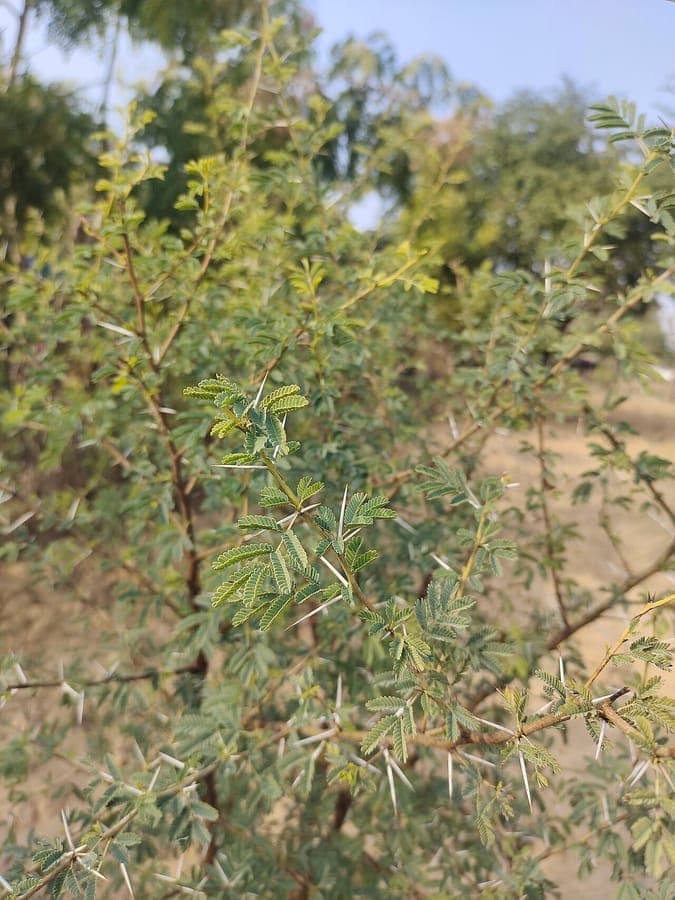
TheSlumPanda / CC BY-SA 4.0, via Wikimedia Commons
Gum arabic tree: complete guide
Vachellia nilotica
Want to see Gum arabic tree: complete guide in your garden?
1 minute, no credit card
Overview
The gum arabic tree, scientifically known as Vachellia nilotica (formerly Acacia nilotica), is one of the most historically significant and ecologically versatile trees in the world. A member of the legume family (Fabaceae), it grows natively across a vast belt stretching from North Africa and the Arabian Peninsula through the Indian Subcontinent to Myanmar. In its homelands it provides gum arabic for the food and pharmaceutical industries, tannin for leatherworking, firewood, fodder, and medicine.
In northwestern Europe, Vachellia nilotica is grown almost exclusively as a container plant or conservatory specimen, since it cannot tolerate frost. Nevertheless, it is a rewarding choice for enthusiasts of subtropical flora who want to add a species with genuinely deep historical roots to their collection. On gardenworld.app, garden designers can visualise how an exotic focal plant like this one fits into a Mediterranean or desert-inspired front garden layout.
The species name 'nilotica' simply means 'of the Nile', reflecting where it was first scientifically described. Ancient Egyptian papyri mention the tree, and its gum has been traded across continents for at least four thousand years. The pods, bark, leaves, roots, and gum all have documented ethnobotanical uses ranging from food preservation to wound treatment.
Appearance and bloom cycle
In its native habitat, Vachellia nilotica can reach 5 to 20 metres in height, forming either a large multi-stemmed shrub or a single-trunked tree with a broad, spreading crown. As a container plant in European gardens it stays much more modest - typically 1 to 3 metres - and grows slowly.
The bark is dark grey to nearly black and deeply furrowed on mature specimens. The most striking structural feature is the paired, straight, white thorns that line every branch and can reach 8 cm in length. These are modified stipules, and they make the plant an effective physical barrier as well as a dramatic visual element.
The leaves are bipinnate (twice divided), giving the tree an airy, feathery texture. Each leaf carries 3 to 6 pairs of pinnae, themselves subdivided into 10 to 30 pairs of tiny leaflets measuring just 2 to 6 mm each. The overall effect is delicate and almost fern-like, providing a strong textural contrast with the bold thorns.
The flowers are small, round, powerfully fragrant balls about 1 to 1.5 cm in diameter, coloured a vivid clear yellow. They appear in clusters of 2 to 6 per leaf axil. In tropical regions flowering typically occurs during the dry season or early wet season - from January to April or August to October depending on latitude. Container specimens in European climates rarely flower.
After flowering, flat pods 5 to 15 cm long develop. Initially green, they turn dark brown to black when ripe, and their surface is distinctly bumpy due to the seed outlines showing through. The pods are eaten by livestock and wildlife, which disperses the seeds widely.
Ideal location
Vachellia nilotica is an intensely sun-loving plant. In the wild it grows on open savannas, along riverbanks, and in dry valleys where it receives direct sunlight throughout the day. As a container plant in northern Europe, it demands the sunniest possible position - a south-facing terrace or a glasshouse with maximum light exposure is ideal.
The tree handles high temperatures well and actively thrives in heat. It can survive short dry spells but grows much better with consistent watering. Some wind tolerance is present, but persistent cold wind during the growing season will cause damage.
Within Europe, Vachellia nilotica can only be grown outside in the ground year-round in Mediterranean coastal zones (USDA zones 10-11). In the UK and Ireland, it must be overwintered frost-free indoors. Garden centres occasionally stock it, and specialist tropical nurseries are a reliable source. If you want to plan an exotic garden corner that incorporates specimen plants like this one, gardenworld.app offers design tools to help visualise the result.
Soil
One of the strengths of Vachellia nilotica is its adaptability to difficult soils. In its native range it colonises heavy clay soils in floodplains as well as sandy, nutrient-poor soils in semi-arid areas. It can tolerate a wide pH range and even moderate salinity.
For container cultivation, a well-draining substrate is essential. A mix of two parts potting compost, one part coarse sand, and one part perlite works well. Waterlogging must be avoided at all costs: roots will rot quickly if the medium stays wet for extended periods. Place a layer of coarse gravel at the base of the pot to improve drainage.
As a member of the Fabaceae, Vachellia nilotica can fix atmospheric nitrogen through root nodule bacteria. This means it thrives on relatively poor soil and requires less fertiliser than many other plants.
Free design
Want to see Gum arabic tree: complete guide in your garden? Make a free design now.
Watering
Watering requirements change significantly across the seasons. During the active growing period from April to September, the pot should never be allowed to dry out completely, but standing water in the saucer is harmful. Water when the top 3 to 4 cm of substrate feels dry to the touch.
In winter, when the plant is kept in a cool, frost-free location, watering should be reduced substantially. Once every two to three weeks with a modest amount of water is sufficient. Overwatering in winter is one of the most common causes of plant loss.
Rainwater or softened water is preferable, as the plant can be sensitive to high calcium levels in hard tap water, which may inhibit growth over time.
Pruning
Vachellia nilotica generally requires minimal pruning. As a container plant, light pruning helps maintain a compact shape and prevents it from becoming leggy. Pruning is best done in early spring just before new growth begins.
Remove dead wood, crossing branches, and overly long shoots. Always wear thick protective gloves and a long-sleeved garment: the thorns are exceptionally sharp and penetrate skin easily. Training the plant into a standard tree form (a clear trunk with a rounded head) is possible but requires patience, as growth in containers is slow.
Cuttings taken during pruning can be used for propagation, though striking cuttings successfully is challenging and germination from seed is more reliable.
Maintenance calendar
January - February: Plant is inside in a frost-free location (minimum 5 degrees Celsius). Keep watering to a minimum. Check for fungal issues or pests.
March: Gradually increase watering. Repot in fresh substrate if needed. Begin balanced fertilisation.
April - May: Move outside once night temperatures consistently exceed 10 degrees Celsius. Acclimatise gradually by starting in partial shade.
June - August: Full sun, regular watering, fertilise every two weeks. Monitor for aphids and spider mites.
September - October: Reduce watering. Bring inside before the first overnight frost.
November - December: Rest period. Cool, frost-free location. Minimal watering.
Winter hardiness
Vachellia nilotica is a tropical tree that cannot tolerate any frost. It is rated USDA zone 10 to 11, meaning only regions without night frost (minimum temperature above -1 degree Celsius) are suitable for year-round outdoor cultivation.
In the UK, the plant must be brought indoors every year before the first frost. An unheated but frost-free glasshouse or a cool room with good light is ideal. Temperatures down to around 5 degrees Celsius are acceptable, but the mercury must never drop below freezing. A location that is too warm in winter will stimulate unwanted new growth during a period when the plant should be resting.
In mild coastal areas, it is sometimes possible to leave the plant outside for brief mild spells covered with horticultural fleece, but this carries real risk and is not recommended as standard practice.
Companion plants
Vachellia nilotica fits naturally into exotic or Mediterranean garden compositions alongside other sun-loving, drought-tolerant plants. Good companions in container groupings include:
- Agave americana: similar water requirements and sun exposure, adds dramatic sculptural contrast
- Nerium oleander: same overwintering strategy and comparable drought resistance
- Strelitzia reginae (bird of paradise): both plants love heat and direct light
- Pennisetum setaceum (purple fountain grass): its soft plumes contrast beautifully with the sharp thorns
- Punica granatum (pomegranate): shares African-Mediterranean origins and similar heat tolerance
In a front garden design - which you can plan on gardenworld.app - Vachellia nilotica works well as a dramatic container specimen in a gravel garden or desert-themed planting, flanked by low-maintenance ornamental grasses and succulents.
Closing
Vachellia nilotica is not a plant for every garden, but for enthusiasts of the unusual it offers a compelling combination of history, ecology, and visual drama. Its feathery bipinnate leaves, powerfully scented yellow flowers, and formidable thorns make it a genuine talking point.
Look for it at specialist tropical nurseries or online plant retailers, as most garden centres do not stock it regularly. Make sure you have suitable overwintering space before purchasing.
Curious how Vachellia nilotica would look in your own garden? Visit gardenworld.app to generate a photorealistic garden design that shows how exotic container plants like this one can be integrated into a cohesive concept suited to your personal style and location.
Want to see Gum arabic tree: complete guide in your garden? Make a free design now.
Upload a photo, pick a style, and get a photorealistic design with plant list in under a minute.
10,000+ gardens designed already
No credit card required


Similar plants
Jerusalem-thorn: complete guide
Parkinsonia aculeata L.
Discover Parkinsonia aculeata, a tropical tree with golden flowers and delicate foliage. Perfect for Mediterranean gardens in warm climates needing minimal water.
Prosopis juliflora: complete guide
Prosopis juliflora
Discover Mesquite - a robust, drought-tolerant tree from tropical America with fine green foliage and yellow flowers. Ideal for hot, dry climates.