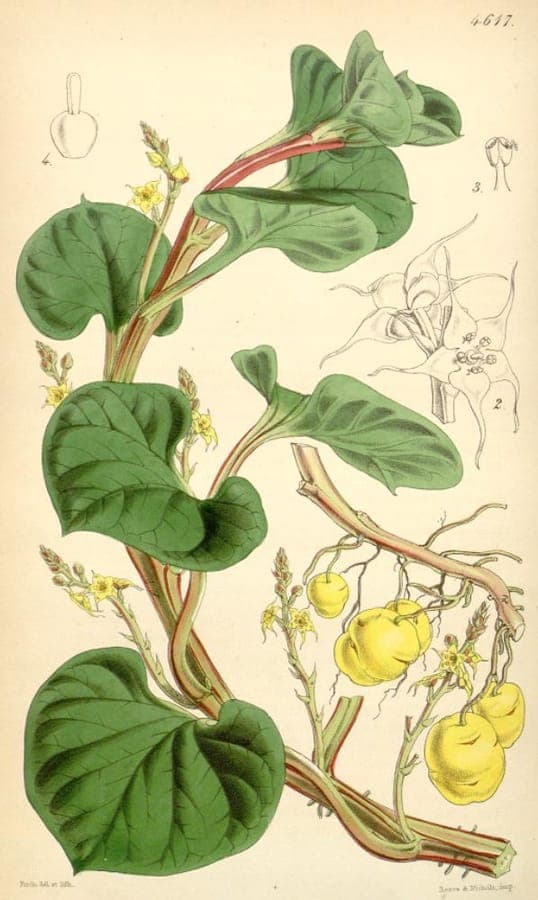
Sir William Jackson Hooker (1785 - 1865) / Public domain, via Wikimedia Commons
Ulluco (Ullucus tuberosus): complete guide
Ullucus tuberosus
Want to see Ulluco (Ullucus tuberosus): complete guide in your garden?
Full design in HD: €7.99
Look after your Ulluco with the GardenWorld app
Identify plants with your camera and get a care calendar with reminders for this plant.


Overview
Ullucus tuberosus, better known as ulluco, melloco, or papa lisa, is a traditional vegetable crop from the Andes of South America. This herbaceous plant produces underground, brightly colored tubers that are edible and nutritious. The plant has been cultivated for centuries by indigenous peoples and forms an important part of their diet.
The ulluco grows best in cool to temperate climates with long growing seasons. In temperate climates, it can be grown as a summer crop. The tubers have a unique flavor and texture and can be prepared in multiple ways.
Appearance and Bloom
Ullucus tuberosus is an herbaceous plant with heart-shaped leaves that build up into a bushy form. The plant grows about 30-60 cm tall. The leaves are green, sometimes with red or purple tones, depending on the variety.
The flowers are small, usually yellow or red, and appear in small clusters. The plant usually does not flower under average growing conditions in temperate climates. The main yield is the underground tubers, which can be brightly colored in red, yellow, orange, or purple, depending on the cultivar.
Ideal Location
Ullucus tuberosus grows best in full sun to partial shade. The plant prefers cooler climates and does better in elevated conditions. Plant it in a location with good drainage and protection from strong wind.
In warm climates, some afternoon shade may be beneficial. The plant can also grow in containers, offering flexibility for garden and balcony cultivation.
Soil
Ullucus tuberosus prefers loose, well-drained soil with plenty of organic matter. The plant grows best in slightly acidic soil (pH 5.5-6.8). Add plenty of compost or rotted organic matter when planting.
The plant requires good soil aeration. Compact soil can cause tuber rot. Work the soil surface carefully before planting.
Free preview
Want to see Ulluco (Ullucus tuberosus): complete guide in your garden? Make a free preview of your design.
Watering
Ullucus tuberosus requires regular watering, especially during growth and tuber formation. Keep the soil evenly moist but not waterlogged. Water deeply and regularly, especially during dry periods in summer.
Once established, you can reduce watering slightly. Preventing waterlogging is essential to avoid tuber rot.
Pruning
Ullucus tuberosus requires minimal pruning. You can remove dead leaves or damaged stems. Some growers remove the tops of the plant to direct more energy toward tuber formation, although this is not necessary.
Prune carefully to avoid damaging roots.
Maintenance Calendar
- Spring: Plant tubers, loosen soil carefully, work in compost
- Summer: Water regularly, weed carefully
- Fall: Foot feeding, prepare for harvest
- Winter: Harvest tubers, store in cool place
Winter Hardiness
Ullucus tuberosus is not winter-hardy in cold climates. In temperate climates, it is grown as a summer crop and dies back at first frost. The plant grows best in zones 8-11 year-round.
Harvested tubers can be frozen and stored over winter in cool, dry conditions (about 2-5 degrees Celsius) for the next season.
Companion Plants
Ullucus tuberosus works well in a vegetable garden with other nightshade crops such as tomatoes and potatoes. Plant it also next to herbs such as parsley and dill. Avoid plant combinations with strong competitors for nutrition.
The plant is relatively pest-free and does not attract many harmful insects.
Closing
Ullucus tuberosus is a fascinating and nutritious addition to your vegetable garden. This Andean tuber offers unique flavors and colors, and is relatively easy to grow in temperate climates. With proper care and conditions, you can harvest a nutritious crop that enriches your diet.
Perfect for gardenworld.app users wanting to grow exotic vegetables. Discover more self-sufficient options on gardenworld.app!
Frequently asked questions about Ulluco
Is Ulluco winter hardy?
Ullucus tuberosus is not winter-hardy in cold climates. In temperate climates, it is grown as a summer crop and dies back at first frost.
When and how do you prune Ulluco?
Ullucus tuberosus requires minimal pruning. You can remove dead leaves or damaged stems.
How much water does Ulluco need?
Ullucus tuberosus requires regular watering, especially during growth and tuber formation. Keep the soil evenly moist but not waterlogged.
Where does Ulluco grow best?
Ullucus tuberosus grows best in full sun to partial shade. The plant prefers cooler climates and does better in elevated conditions.
What soil does Ulluco need?
Ullucus tuberosus prefers loose, well-drained soil with plenty of organic matter. The plant grows best in slightly acidic soil (pH 5.5-6.8).

See it in your garden
See Ulluco in your garden
One photo of your garden and a few questions. You see the result in about a minute.
Try it with a photoIdentify this plant in your own garden. Identify a plant
Similar plants
Glossy abelia: complete guide
Abelia × grandiflora
Everything about glossy abelia (Abelia × grandiflora): position, soil, pruning and hardiness of a shrub that flowers from July to October with scented white bells.
Trailing abutilon (Abutilon megapotamicum): care guide
Abutilon megapotamicum
Grow trailing abutilon (Abutilon megapotamicum) in a basket or against a wall: watering, feeding, pruning and overwintering for red and yellow lantern flowers.
Flowering maple (Abutilon): container shrub guide
Abutilon × hybridum
How to grow flowering maple (Abutilon × hybridum) in a pot: position, watering, feeding, March pruning and overwintering indoors for flowers from May to October.
