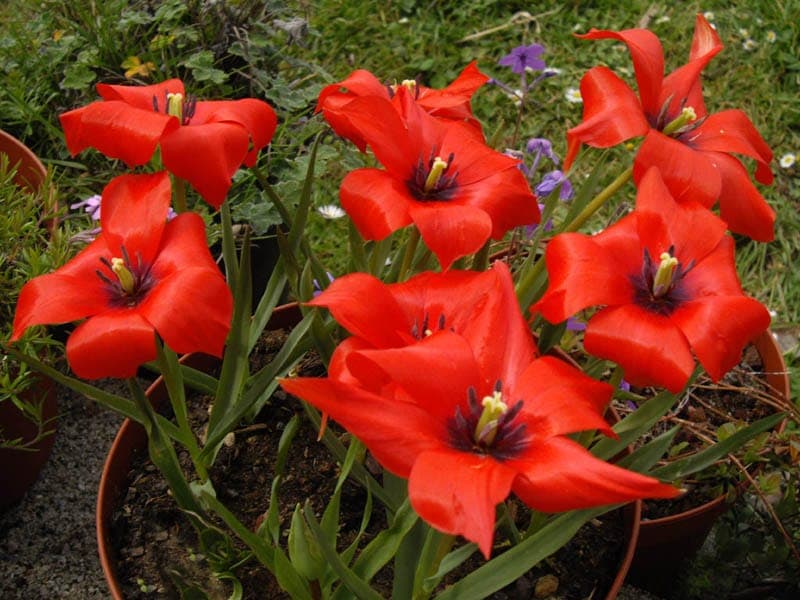
Ghislain118 http://www.fleurs-des-montagnes.net / CC BY-SA 3.0, via Wikimedia Commons
Tulipa linifolia: complete guide
Tulipa linifolia
Want to see Tulipa linifolia: complete guide in your garden?
Full design in HD: €7.99
Look after your Tulipa linifolia with the GardenWorld app
Identify plants with your camera and get a care calendar with reminders for this plant.


Overview
Tulipa linifolia is a compact wild tulip from northeastern Iran and Central Asia. This unique tulip species distinguishes itself with extremely narrow, grass-like foliage and vivid red flowers. It is a perfect choice for rock gardens, borders, and small spaces.
In its native habitat, Tulipa linifolia grows in mountain meadows and steppes from Iranian highlands to Uzbekistan. This gives it preference for well-draining soil and moderate moisture. It is a hardy, independent plant that adapts well to garden conditions.
Appearance and bloom
Tulipa linifolia is very compact, reaching only 15 to 25 centimeters height. This makes it perfect for front borders and container culture. The foliage is the distinguishing feature: extremely narrow, almost grass-like, with fine texture.
Flowers are bright red to orange-red, about 3 to 4 centimeters wide when open. They open fully in warm sun into star-shaped blooms. Flowering occurs from April through May.
After bloom, seed capsules develop. The plant withdraws and disappears underground until the following spring.
Ideal location
Tulipa linifolia grows best in full sun. This is essential for strong growth and full flower opening. Plant it where it receives at least six hours of direct sunlight.
The plant is very tolerant of wind and open situations. This makes it perfect for exposed garden areas. Sheltered woodland edges are avoided.
In very hot climates, some afternoon shade can help, though this is not necessary in temperate zones.
Soil
Tulipa linifolia grows in well-draining, sandy to loamy soil. This is essential to prevent rot. Heavy clay soils must be improved with sand or perlite.
Add gravel or sand through planting hole to ensure excellent drainage. The plant tolerates poor soil and requires no rich fertilization.
PH can be acidic to neutral. The plant is flexible on this point.
Free preview
Want to see Tulipa linifolia: complete guide in your garden? Make a free preview of your design.
Watering
Tulipa linifolia needs minimal extra water. Plant bulbs in fall in well-draining soil. In normal winters with rainfall the plant grows without supplemental water.
In very dry conditions during growth, water can help, but it is rarely needed. Excess water is more damaging than shortage.
After bloom and withdrawal, no watering is needed.
Pruning
Tulipa linifolia requires no pruning. Let the flower stand until it naturally dies. Then remove the dead flower but leave foliage until it disappears.
Foliage helps the bulb replenish energy reserves for next year. This is crucial for continued flower production.
Dead foliage can be removed after it completely fades.
Maintenance calendar
Summer and fall (July-October): Plant bulbs in fall (September through November in temperate zones). Water well after planting if soil is dry.
Winter (November-February): Dormancy. Plant is underground. Bulbs chill and root development occurs. Protect from extreme wetness.
Spring (March-May): Growth and bloom. Bulbs sprout. Plant grows rapidly. Bloom in April through May. Water only if very dry.
Summer (June-July): Plant withdraws. Do not water. Foliage disappears.
Winter hardiness
Tulipa linifolia is very winter hardy and can survive winter outdoors in all temperate zones. This is an advantage over many other tulips.
It tolerates frost periods without issue. In very hot, dry Mediterranean zones it may sometimes have problems with summer wetness.
Companion plants
Tulipa linifolia fits well in rock gardens with other compact spring bloomers. Consider Scilla, Chionodoxa, small Narcissus species.
In borders it combines well with other steppe and mountain plants. Saxifraga, Armeria, and Sedum are good companions.
In container culture it can be mixed with other small spring flowers.
Conclusion
Tulipa linifolia is a jewel among wild tulips. With its elegant, narrow foliage and vivid red flowers it brings character to small garden spaces. Once planted in well-draining soil it will return yearly. This is a truly worthwhile investment. Bulbs available through specialized bulb suppliers.
Visit gardenworld.app for more inspiration on spring bloomers and rock garden design.
Frequently asked questions about Tulipa linifolia
Is Tulipa linifolia winter hardy?
Tulipa linifolia is very winter hardy and can survive winter outdoors in all temperate zones. This is an advantage over many other tulips.
When and how do you prune Tulipa linifolia?
Tulipa linifolia requires no pruning. Let the flower stand until it naturally dies.
How much water does Tulipa linifolia need?
Tulipa linifolia needs minimal extra water. Plant bulbs in fall in well-draining soil.
Where does Tulipa linifolia grow best?
Tulipa linifolia grows best in full sun. This is essential for strong growth and full flower opening.
What soil does Tulipa linifolia need?
Tulipa linifolia grows in well-draining, sandy to loamy soil. This is essential to prevent rot.

See it in your garden
See Tulipa linifolia in your garden
One photo of your garden and a few questions. You see the result in about a minute.
Try it with a photoIdentify this plant in your own garden. Identify a plant
Similar plants
Giant Himalayan lily (Cardiocrinum giganteum): complete guide
Cardiocrinum giganteum
Everything about the giant Himalayan lily (Cardiocrinum giganteum): why it takes years to flower and then dies, planting the bulbs, shade, toxicity and hardiness.
Pointed-petal fritillary (Fritillaria acmopetala): growing guide
Fritillaria acmopetala
Everything about Fritillaria acmopetala: planting the bulbs, position, the dry summer rest, hardiness, toxicity and the best partners for this green spring bulb.
Crown imperial: complete guide
Fritillaria imperialis
Everything about crown imperial (Fritillaria imperialis): autumn planting, position, soil, April flowering and winter care. Practical advice for reliable blooms.
