
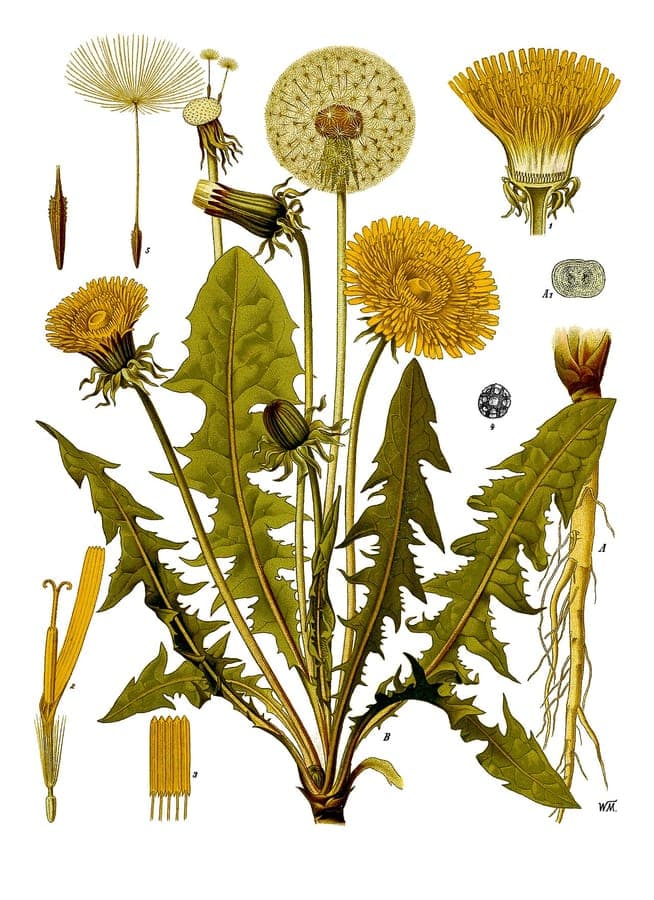
Walther Otto Müller / Public domain, via Wikimedia Commons
Taraxacum retroflexum: complete guide
Taraxacum retroflexum
Want to see Taraxacum retroflexum: complete guide in your garden?
1 minute, no credit card
Overview
Taraxacum retroflexum, known in English as the reflexed-lobed dandelion, is a native dandelion microspecies described in 1909 by the Finnish botanist Harald Lindberg. The species name 'retroflexum' refers to the distinctive botanical feature that sets this plant apart from its many close relatives: the strongly reflexed outer involucre bracts (the sepal-like structures beneath the flower) that bend downward during full bloom and give the flower an open, elegant appearance.
The native range of Taraxacum retroflexum is strictly northern European: Belgium, Denmark, Finland, Germany, Great Britain, the Netherlands, Norway, Poland, Sweden and Switzerland comprise the native territory, with an introduced presence in British Columbia, Canada. This is a textbook case of a microspecies tightly linked to a specific Atlantic and northern European climate and to habitats with neutral to slightly alkaline soils.
On gardenworld.app you will find garden design inspiration that uses native wild herbs and dandelion species to create ecologically valuable borders and meadow sections. Taraxacum retroflexum is a particularly interesting choice among them, both for its distinctive flower form and its value as an early nectar source.
Appearance and bloom cycle
Taraxacum retroflexum forms a flat leaf rosette directly at ground level, with leaves 10-25 cm long. The leaves are deep green, with deeply cut lobes that grow larger toward the base - a typical dandelion pattern. The lobes are often somewhat broader and flatter than in some other microspecies, and the leaf stalk is sometimes lightly tinged purple-red.
The most distinctive feature of Taraxacum retroflexum lies in the flower itself. The outer involucre bracts are strongly reflexed - they bend back toward the flower stem - so that the golden ligulate florets radiate especially freely and openly. The flower is 3-4 cm across with a clear golden-yellow colour. After flowering the familiar seed clock forms with airy white seeds that are carried by the wind.
The main flowering period falls in April and May, with an early start in March in mild springs. Some specimens flower for a shorter continuous period than expected. A second flowering flush in autumn is less common than with some related species, making the spring display the primary season of interest.
Ideal location
This dandelion thrives best in open, sunny to lightly shaded positions. In the wild it is found in grasslands, along verges, in parks, on meadow ground and at the margins of light woodlands. Taraxacum retroflexum shows a slight preference for neutral to slightly alkaline soils, which distinguishes it from some other dandelion microspecies that prefer somewhat more acidic conditions.
Full sun stimulates the richest flowering. In partial shade the plant still performs well but the rosette grows somewhat larger. Permanent deep shade is unsuitable; the plant flowers very little under such conditions.
For the garden the species is excellent for wild corners, edge plantings, herb meadows and open borders. Combined with other early-bloomers it creates an attractive early nectar source for bees and butterflies. The distinctive flower form - with its strongly reflexed bracts - also makes it botanically interesting for nature-conscious gardeners.
Soil requirements
Taraxacum retroflexum sets slightly more specific soil requirements than the average dandelion. The optimal pH is between 7.0 and 7.5 - neutral to slightly alkaline. This means that lime-rich or lightly alkaline garden soils are very suitable. On acidic soils (pH below 6) the species performs less well and vital growth may decline.
A moderately fertile, well-draining soil is ideal. The species shows a slight preference for soils with a nutrient level somewhat higher than the very poor wild grasslands. Sandy soils are acceptable provided they are not extremely dry; heavy clay is less suitable unless well drained.
In the garden you can adjust pH by adding garden lime to overly acidic soils. For wild corners where you want to maximise ecological value, adding a little sand and slightly lime-rich compost is a helpful step. Local garden centres stock various soil improvers that gently raise pH without damaging soil structure.
Free design
Want to see Taraxacum retroflexum: complete guide in your garden? Make a free design now.
Watering
Taraxacum retroflexum is a robust, drought-tolerant plant once its taproot is established. The taproot typically extends 25-40 cm deep and draws moisture from deeper soil layers that shallow surface soils cannot reach. This makes the plant particularly resilient to the short dry periods that occur regularly in the northern European climate.
In the first year after sowing or planting, regular watering is advisable - once a week with a thorough soaking is enough. After that, supplementary water in normal summers is rarely needed. Only during extreme dry spells of more than three weeks in a warm summer is additional watering beneficial. When you do water, give a deep soaking to encourage the taproot downward.
Overwatering is counterproductive. The species prefers dry to moderately moist conditions and tolerates wet soils poorly. In persistently wet, poorly draining positions the risk of root rot increases markedly.
Pruning
Like all dandelions, Taraxacum retroflexum requires almost no traditional pruning. The management approach depends on your aims. In a maintained garden or border, remove the flower stems immediately after the blooms fade and before the seed clocks ripen. Cut the stems close to the ground, but always leave the leaf rosette intact - it is the core of the plant and must never be cut away.
If you want to encourage self-seeding for a wild corner or flowering meadow, let the seed clocks ripen fully. Once the seeds have dispersed, remove the empty stems to keep the area tidy. A self-seeding dandelion will return naturally in following years wherever conditions are suitable.
In autumn a small winter rosette remains; this is normal and desirable. Remove only damaged or yellowed leaves in early spring for a fresh start to the new growing season.
Maintenance calendar
January-February: Plant in winter dormancy; small rosette present; no special attention needed. February-March: Check soil moisture lightly; in hard winters wait for first signs of re-growth. March-April: First flowers appear; bees and bumblebees benefit from early pollen and nectar. April-May: Peak flowering; remove spent flower stems if spreading is unwanted. May-June: Seed clocks form; decide whether to allow them to ripen for self-seeding. June-August: Summer rest period; supplementary water only during extreme heat. September-October: Check whether a second flush occurs; monitor soil moisture. November: Prepare the garden for winter; the plant needs no special help.
Winter hardiness
Taraxacum retroflexum is fully winter-hardy and perfectly suited to gardens across the Netherlands, Belgium, Germany, Great Britain and Switzerland. As a native Scandinavian and northwestern European plant it is ideally adapted to cold, wet winters with prolonged frost periods. The species comfortably achieves USDA hardiness zone 4 and warmer, meaning frost down to -30 degrees Celsius poses no problem.
The taproot survives even the harshest winters completely intact. The above-ground foliage may temporarily freeze and appear wilted in severe frost but recovers quickly once temperatures rise. No winter covering, no fleece protection and no extra measures are ever needed. This makes the plant exceptionally suited to unmanaged wild corners and naturalistic borders that require little ongoing attention.
Companion plants
The best companions for Taraxacum retroflexum are other early-blooming native wild plants. Common daisy (Bellis perennis) forms a classic pairing: the small white daisies and golden dandelions flower simultaneously and together attract a wide range of insects. Forget-me-not (Myosotis sylvatica) adds a beautiful blue-purple tone that contrasts beautifully with the yellow.
For a richer wild border, self-heal (Prunella vulgaris), common sorrel (Rumex acetosa) and clover species are excellent partners that reinforce the ecological network. The low rosette growth habit of the dandelion also works well as ground cover beneath taller herbs such as common mallow (Malva sylvestris) or yarrow (Achillea millefolium).
On gardenworld.app you can explore garden designs that integrate native wild herbs into modern and traditional garden styles without sacrificing ease of maintenance.
Closing
Taraxacum retroflexum is a botanically interesting dandelion microspecies, distinguished by its strongly reflexed involucre bracts and bright yellow flowers. As a fully winter-hardy, low-maintenance plant it fits perfectly into wild corners, herb meadows and pollinator-friendly borders. The species prefers neutral to slightly alkaline soils and is undemanding when it comes to water.
Find wildflower seed mixes containing native species at local garden centres. Through gardenworld.app you can discover how to build a pollinator-friendly garden in which early-blooming dandelion species like Taraxacum retroflexum play a prominent role and bring spring to life at the earliest opportunity.
Want to see Taraxacum retroflexum: complete guide in your garden? Make a free design now.
Upload a photo, pick a style, and get a photorealistic design with plant list in under a minute.
10,000+ gardens designed already
No credit card required


Similar plants
Taraxacum pannulatum: complete guide
Taraxacum pannulatum
Dandelion microspecies with brown-ribbed leaves and golden-yellow flowers. Native to northern Europe, fully hardy, ideal for wildlife and pollinator gardens.
Taraxacum polyodon: complete guide
Taraxacum polyodon
Native dandelion with toothed leaves and golden-yellow spring flowers. Early nectar for bees, fully winter-hardy, ideal for wildflower meadows.
Taraxacum palustre: complete guide
Taraxacum palustre
Marsh dandelion with bright yellow flowers and characteristic silvery-white seed heads. Thrives in wet marshy soils where other plants struggle. Native to Netherlands and very useful for wet problem-zones. Completely hardy and perennial.