
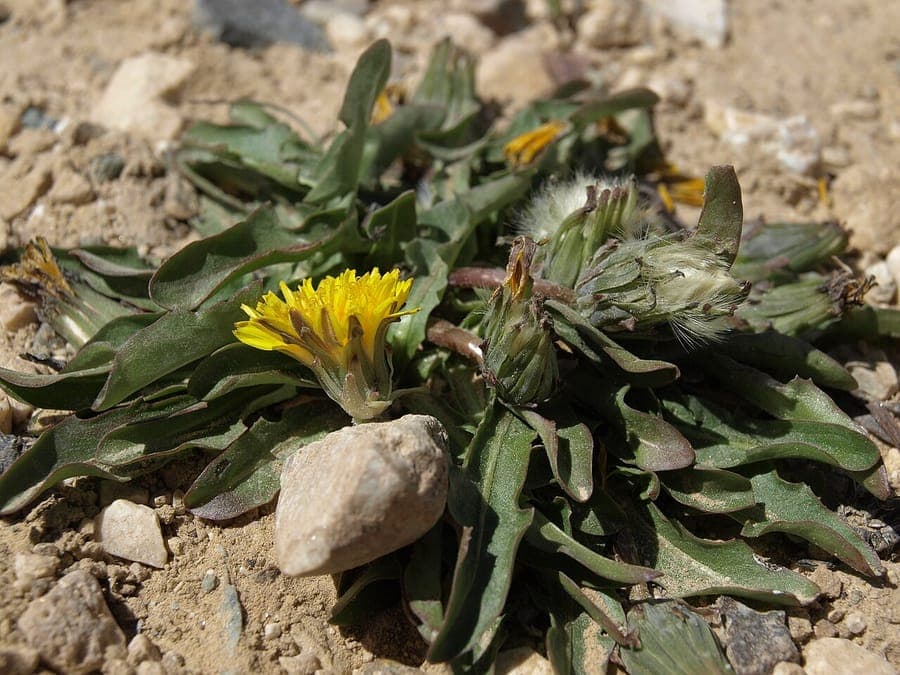
Jim Morefield from Nevada, USA / CC BY-SA 2.0, via Wikimedia Commons
Horned dandelion: complete guide
Taraxacum ceratophorum
Want to see Horned dandelion: complete guide in your garden?
1 minute, no credit card
Overview
Taraxacum ceratophorum, known as the horned dandelion or northern dandelion, is a fascinating wildflower native to some of the coldest regions on earth. Its range stretches from Alaska across Canada, Greenland, Iceland, Scandinavia, Siberia, and Japan - a circumpolar distribution that testifies to its extraordinary cold tolerance. The "horned" part of its name refers to small horn-like appendages on the outer involucre bracts that distinguish it from common dandelion species.
For gardeners interested in ecological planting and native wildflowers, Taraxacum ceratophorum is a quiet but valuable addition. It is one of the first plants to bloom in spring in northern climates, providing vital nectar and pollen when little else is available for bees and other insects. On gardenworld.app you can find ideas for incorporating wildflowers like this one into a designed garden that balances beauty with biodiversity.
Appearance and bloom cycle
At first glance, the horned dandelion resembles the familiar common dandelion (Taraxacum officinale), but close inspection reveals notable differences. The leaves form a flat rosette pressed to the ground, with irregularly toothed or occasionally almost entire margins that vary considerably by location - a reflection of the wide genetic diversity within the Taraxacum genus. The leaf texture is coarser than that of common dandelion, an adaptation to cold, windswept habitats.
The golden-yellow flower heads are borne on hollow stems 5 to 25 cm tall, depending on conditions. The defining feature is the small horn-like projections on the outer involucral bracts beneath the flower head - a subtle but reliable identification mark, best seen with a hand lens. After flowering, the plant produces the familiar spherical seed heads - white, feathery pappus clocks that disperse seeds on the wind across considerable distances.
Flowering occurs from May to August depending on latitude and altitude. In high Arctic locations it may not bloom until July. In more southerly locations in mountain meadows it begins in May. The plant is a rapid grower once temperatures permit and can complete its reproductive cycle surprisingly quickly, an important trait in short growing seasons.
Ideal location
Taraxacum ceratophorum is a pioneer plant of open, disturbed, or nutrient-poor terrain. In nature it colonises Arctic and subarctic tundra, alpine meadows, rocky slopes, riverbanks, and sites disturbed by erosion or grazing. It thrives where competition from more vigorous plants is limited.
In the garden it is best suited to a wild corner, a meadow patch, a gravel garden, or an alpine bed with an open, naturalistic character. It needs a sunny to lightly shaded position - full sun promotes compact growth and good flowering. In too much shade it becomes leggy and flowers less freely.
It does not compete well with vigorous lawn grasses or aggressive perennials. Give it space in a gravel path edge, a stony border, or an open prairie-style planting. It is perfectly at home in gardens designed around ecological principles, wildlife-friendly planting, and low-maintenance approaches.
Soil requirements
This dandelion thrives in poor, well-drained soils. Rich, fertile garden soil encourages lush leaf growth at the expense of flowering - the opposite of what you want in a wildflower setting. The preferred pH range is 4.8 to 7.5, covering slightly acid to neutral conditions.
Sandy, gravelly, or rocky soils suit it well. Heavy clay that retains moisture may lead to root rot in wet conditions. If your garden has heavy soil, create a raised bed or improve drainage by incorporating grit and coarse sand before planting. The plant needs no fertiliser; regular feeding actually weakens the plant's natural form and reduces flower production.
Free design
Want to see Horned dandelion: complete guide in your garden? Make a free design now.
Watering
Once established, the horned dandelion is remarkably drought-tolerant. Its deep taproot reaches into lower soil layers to access moisture that surface-rooting plants cannot reach. In its native habitat it survives both extreme cold and summer drought without difficulty.
In the first growing season after planting, water occasionally during dry spells to help the taproot establish. From the second year onwards, supplemental watering is rarely needed except during prolonged drought. For container-grown plants, use a well-draining compost mix and water only when the top 3 to 4 cm feels dry. Never allow the pot to sit in standing water.
Pruning
No formal pruning is needed for this plant. The only management decision you need to make is whether to remove the spent flower heads before seeds ripen. If you want to limit self-seeding - useful in a mixed border - snip the stems just above the leaf rosette after flowering. If you are growing it in a wild meadow area, allow the seed heads to develop fully: the seeds feed finches and other small birds, and self-seeding maintains the population naturally.
In early spring, remove any dead or damaged outer leaves from the rosette to improve air circulation and tidy the plant. This takes a few minutes and is the full extent of annual maintenance.
Maintenance calendar
February to March: No action needed. The plant resumes growth as soon as temperatures rise above freezing. Remove winter-damaged outer leaves if desired.
April to May: First flowers may appear in favourable conditions. Valuable early nectar source for queen bumblebees emerging from hibernation.
June to August: Main flowering period. Allow seed heads to develop if you want self-seeding and bird food. Remove spent heads to limit spread.
September to October: Plant retreats to its rosette. Remove old leaves. No feeding required.
November to January: Dormant period. The rosette remains partly green in mild winters. In severe winters the above-ground parts die back and regenerate from the deep taproot in spring.
Winter hardiness
Taraxacum ceratophorum is one of the most cold-hardy plants in cultivation. In its natural range it survives temperatures of -30 degrees Celsius and below in Alaska, Siberia, and Greenland. It corresponds to USDA hardiness zones 1 to 2, making it suitable for virtually every garden in northern and central Europe, Scandinavia, and the mountain regions of the Alps.
No winter protection is needed. Even in the most severe European winters, the plant survives without any cover. This extreme cold tolerance makes it particularly interesting for exposed, windswept garden positions where other plants struggle.
In milder climates, such as coastal western Europe, the plant may remain partly active through winter, especially in mild, wet winters.
Companion plants
The horned dandelion fits naturally alongside other wildflowers and meadow plants. Good companions include oxeye daisy (Leucanthemum vulgare), common yarrow (Achillea millefolium), field poppies (Papaver rhoeas), cornflowers (Centaurea cyanus), and ribwort plantain (Plantago lanceolata). In an alpine garden setting, it pairs well with saxifrages, thyme (Thymus), and alpine flax (Linum perenne).
For a wild corner, combine it with fine-leaved grasses such as sheep's fescue (Festuca ovina) and blue fescue (Festuca glauca). The yellow flowers contrast beautifully with blue-grey grass foliage. Clovers and vetches make valuable companion plants, fixing atmospheric nitrogen and supporting pollinators alongside the dandelion.
Most good garden centres carry meadow seed mixes that pair well with this plant. Look for native wildflower mixes suited to your region.
Closing thoughts
Taraxacum ceratophorum is not a showy garden centrepiece, but it is a genuinely useful and ecologically valuable plant. Its extraordinary cold tolerance, its early nectar for pollinators, and its modest golden flowers make it a worthwhile addition to any wildlife-friendly or naturalistic garden scheme. Give it a rough, unimproved corner and it will look after itself.
Visit gardenworld.app to discover how to design a garden that incorporates wildflowers and ecologically rich plantings into a coherent, beautiful whole.
Want to see Horned dandelion: complete guide in your garden? Make a free design now.
Upload a photo, pick a style, and get a photorealistic design with plant list in under a minute.
10,000+ gardens designed already
No credit card required


Similar plants
Calendula stellata: complete guide
Calendula stellata
Complete guide to Calendula stellata, the star-flowered marigold from Sicily: location, soil, watering and companion planting tips.
Korean chrysanthemum: complete guide
Chrysanthemum x rubellum
Chrysanthemum x rubellum is a hardy autumn perennial with single pink to copper flowers from August to November. Care and combinations.
Helianthus divaricatus: complete guide
Helianthus divaricatus
Helianthus divaricatus is a North American woodland sunflower with yellow summer blooms, ideal for naturalistic borders and shady edges.