
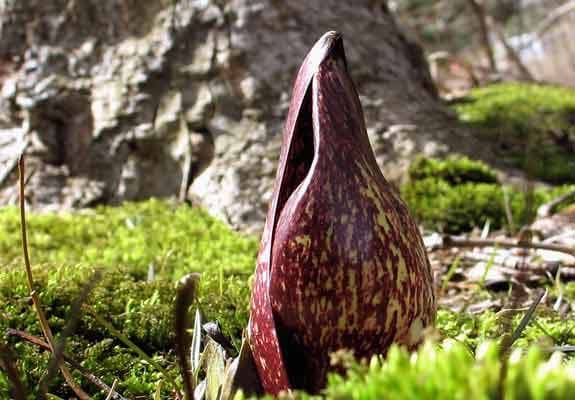
Sue Sweeney. / CC BY-SA 3.0, via Wikimedia Commons
Skunk cabbage: complete guide
Symplocarpus foetidus
Want to see Skunk cabbage: complete guide in your garden?
1 minute, no credit card
Overview
Symplocarpus foetidus, commonly known as eastern skunk cabbage or polecatweed, is one of the most extraordinary herbaceous perennials native to eastern North America. A member of the Araceae family, it possesses a quality that sets it apart from almost every other plant in the temperate garden: thermogenesis. The plant generates metabolic heat, allowing it to melt snow, raise the temperature inside its flower hood by up to 15–35 degrees Celsius above ambient air temperature, and attract pollinating insects during some of the coldest weeks of late winter. Flowering typically begins in February and can extend into April, well before any leaf development occurs.
The species was formally described in 1817 by W.P.C. Barton, building on earlier observations by Linnaeus. In its native range - stretching from eastern Canada and New England south to North Carolina and west to Minnesota - skunk cabbage grows in dense colonies along stream margins, in wooded swamps, and in low-lying areas with permanently saturated soil. In European gardens it remains relatively unusual, valued by collectors of bog plants and those designing naturalistic water gardens. Gardeners seeking creative planting combinations around ponds and wet borders will find inspiration at gardenworld.app, where garden design tools help visualise plants in context before committing to a planting plan.
The species epithet foetidus - stinking - refers to the pungent odour released when leaves are bruised or broken, caused by volatile sulphur compounds. This serves as an effective deterrent against herbivory. Despite its off-putting reputation, skunk cabbage plays a vital ecological role: it is one of the earliest sources of pollen and warmth available to bees, flies, and beetles in the spring landscape, and its broad summer leaves provide shade and habitat for amphibians and other small creatures.
Appearance and bloom cycle
The annual cycle of Symplocarpus foetidus begins below ground. The plant produces stout, contractile roots attached to a thick rhizomatous rootstock that can live for decades. Between February and April, depending on latitude and local conditions, the flowering structures emerge directly from the soil. The most striking feature is the spathe: a mottled, hood-like sheath, 10–20 cm tall, ranging in colour from deep maroon-purple to greenish-brown with cream-coloured mottling and streaking. Within the spathe sits the spadix, an egg-shaped club 3–5 cm long densely packed with small, inconspicuous flowers.
The thermogenic activity of the spathe is remarkable from a physiological standpoint. Cellular respiration in the spadix proceeds at a rate comparable to that of a warm-blooded animal during this period, sustaining elevated temperatures for weeks at a stretch. After pollination, the spathe collapses and the leaf development begins in earnest. Leaves unfurl rapidly from April onward, eventually reaching impressive dimensions: 30–80 cm long and 30–60 cm across, broadly oval to heart-shaped, with bold venation and a somewhat pleated surface. The leaf mass creates a lush, almost tropical effect in the shade garden or bog bed during summer months.
By September the leaves begin to yellow and collapse. The fruiting heads, resembling knobbly green balls, persist for a short time and release seeds that are dispersed by water and animals. The rootstock remains dormant through winter, ready to initiate the next flowering cycle the following February.
Ideal location
Symplocarpus foetidus should be planted where conditions closely mimic its native habitat. The plant requires permanently moist to wet soil and tolerates - indeed prefers - partial to full shade. Ideal locations include the margins of garden ponds, alongside streams or drainage channels, in rain gardens, and in low-lying shady beds where water naturally collects after rain. A north- or east-facing border beneath deciduous trees, where the soil stays reliably moist, provides excellent growing conditions.
Full sun is tolerable only when the soil remains saturated throughout the growing season. In practice, a site with morning sun and afternoon shade reduces water demand and prevents the large leaves from scorching in summer heat. The species is rated USDA hardiness zones 3–7, tolerating minimum winter temperatures of around -40 degrees Celsius. In the UK and northern Europe, winter hardiness is rarely a concern; the challenge is almost always moisture availability in summer.
Plant spacing should allow for the eventual spread of the large summer foliage. Allow 60–90 cm between plants, or 90–120 cm if you intend to allow the colony to self-organise naturally over several years. In a naturalistic bog planting, groups of five or more specimens create the most convincing effect.
Soil requirements
The soil requirements of skunk cabbage are highly specific and non-negotiable. The growing medium must remain permanently moist to wet: this plant will not establish or thrive in soil that dries out even for short periods during the growing season. In its natural habitat, the roots are often in standing or slowly moving water for weeks at a time.
Soil pH should range between 4.0 and 7.0, with the optimum falling between 5.0 and 6.5 - a mildly acidic to neutral, humus-rich profile typical of wetland soils and floodplain forest floors. Heavy clay soils with a high organic matter content are ideal. Sandy soils are unsuitable unless heavily amended with large quantities of clay, leaf mould, peat substitute, and compost. A planting hole of approximately 50 × 50 cm and 30 cm deep, backfilled with a mixture of garden compost and existing topsoil, provides a good start. Finish with a mulch layer of bark or leaf mould at least 10 cm deep to conserve moisture and regulate soil temperature.
Avoid conventional potting compost or peat-free multipurpose mixes as the sole growing medium: these drain too freely and lack the long-term structure the plant requires. Annual top-dressing with well-rotted leaf mould in early spring replenishes organic matter and keeps the soil structure open and moisture-retentive.
Free design
Want to see Skunk cabbage: complete guide in your garden? Make a free design now.
Watering
In a garden setting adjacent to a pond or stream, additional watering will rarely be necessary, as groundwater seepage keeps the soil saturated. On sites that are merely damp rather than wet, watering will be required during dry spells: aim to apply 5–10 litres per plant two to three times per week in warm, dry conditions. Drip irrigation connected to a water butt or mains supply is an efficient solution that keeps the soil consistently moist without wetting the foliage.
When watering, apply water at the base of the plant rather than overhead. Wet foliage in warm, still conditions encourages fungal issues on the large leaf surfaces. In prolonged drought, the plant may wilt dramatically during the hottest part of the day; if the soil moisture is adequate this is usually a temporary response to transpiration stress, and leaves will recover by evening. Persistent wilting despite moist soil warrants investigation of the root zone.
In autumn, as the plant enters dormancy, watering can be reduced progressively. The rootstock tolerates freezing soil but performs best when the ground does not dry out completely even in winter. A thick mulch layer applied in November largely prevents this in most garden situations.
Pruning
Symplocarpus foetidus requires virtually no pruning in the conventional sense. As a fully herbaceous perennial, the plant dies back completely to ground level each autumn. There is no woody framework to manage. The only intervention needed is the removal of the collapsed and decomposing leaf mass in late autumn or early spring, before the new season's spathes begin to emerge.
Leave the dying foliage in place for as long as possible in autumn: it acts as a natural mulch, protecting the soil and rootstock from temperature extremes while returning organic matter to the soil as it decomposes. When clearing the old material in late winter, use secateurs or a sharp spade to cut the leaf stalks close to the soil surface, taking care not to damage the emerging flower structures or the rootstock below.
The fruiting heads can be left on the plant to provide wildlife interest and allow some natural seeding. In temperate European gardens the plant rarely becomes invasive, so this is not a concern for most gardeners. If you prefer a tidier appearance, remove the fruiting heads in October before the seeds ripen fully.
Maintenance calendar
February–March: Monitor for the first emerging spathes. Replenish the mulch layer to 10 cm. Avoid walking on or near the crowns, which can easily be damaged by compaction at this stage.
April–May: Leaf expansion is rapid. Water generously if the spring is dry. Apply a light dressing of slow-release organic fertiliser - composted manure or pelleted poultry manure at 50–80 g per plant - to support vigorous leaf development.
June–August: Peak growing season. Monitor soil moisture weekly; in dry summers irrigate to maintain consistently wet conditions. The gardenworld.app garden planner helps you design the surrounding planting around this impressive structural plant.
September–October: Leaves begin to yellow. Reduce watering. Leave old foliage in place to decompose naturally and protect the crown.
November–January: Dormancy. Apply a fresh mulch layer in early November. No additional care required until the following February.
Winter hardiness
Few plants in cultivation are as genuinely cold-tolerant as Symplocarpus foetidus. The species is adapted to the harsh winters of New England and the Great Lakes region, surviving temperatures well below -30 degrees Celsius when the rootstock is in the ground and adequately mulched. In British and Dutch gardens, where temperatures rarely fall below -15 degrees Celsius, the plant can be regarded as fully reliable without supplementary winter protection.
A mulch layer of 10–15 cm of bark or chopped leaves applied in November is the only precaution generally needed. In exceptionally severe winters, a temporary covering of horticultural fleece over the mulch adds a useful buffer. Container-grown specimens are more vulnerable to frost penetration and should be moved to an unheated greenhouse, shed, or garage for the coldest months, or the container should be wrapped in bubble polythene and placed against a sheltered wall.
The plant's own thermogenic activity gives it a degree of natural frost resistance even at the rhizome level: temperatures within and immediately around the flowering structures can remain several degrees above the ambient air temperature for weeks at a time, giving early-emerging spathes a remarkable ability to withstand late frosts.
Companion plants
Building a planting scheme around Symplocarpus foetidus rewards a thoughtful approach to plant selection. In bog and waterside gardens, the most successful companions share the same preference for permanently moist, humus-rich, partially shaded conditions. Osmunda regalis, the royal fern, is perhaps the finest companion: its elegant, arching fronds complement the broad leaves of skunk cabbage beautifully, and both species are native to similar North American habitats.
Hosta cultivars - particularly the large-leaved types such as 'Sum and Substance', 'Elegans', and 'Krossa Regal' - thrive in the same conditions and extend the ornamental season. Astilbe × arendsii cultivars such as 'Fanal' (deep red) or 'Brautschleier' (white) provide flowering colour in June and July when skunk cabbage is in full leaf but not itself in flower. Iris pseudacorus, the native yellow flag iris, is a strong structural plant for the water margin that bridges the gap between the early spathe of the skunk cabbage and the summer foliage display. Caltha palustris, flowering in April, provides welcome colour as the large leaves are just beginning to unfold.
For textural variety, Carex pendula, Lysichiton americanus (western skunk cabbage, with yellow spathes), and Ligularia species all work well. Together these create a layered, ecologically diverse bog planting that supports a wide range of pollinators, amphibians, and beneficial insects throughout the year.
Want to see Skunk cabbage: complete guide in your garden? Make a free design now.
Upload a photo, pick a style, and get a photorealistic design with plant list in under a minute.
10,000+ gardens designed already
No credit card required


Similar plants
Arrowhead vine: complete guide
Syngonium auritum
Everything about Syngonium auritum, the tropical five-fingers houseplant. Care, location, watering, and pruning explained clearly for beginners and enthusiasts.
Minute duckweed: complete guide to Lemna perpusilla
Lemna perpusilla
Everything about Lemna perpusilla, the minute duckweed: ecology, pond management, water quality and care in garden water features.
Dead horse arum lily: complete guide
Helicodiceros muscivorus
Everything about the dead horse arum lily (Helicodiceros muscivorus): growing conditions, spectacular bloom, thermogenesis, and care for this Mediterranean aroid.