
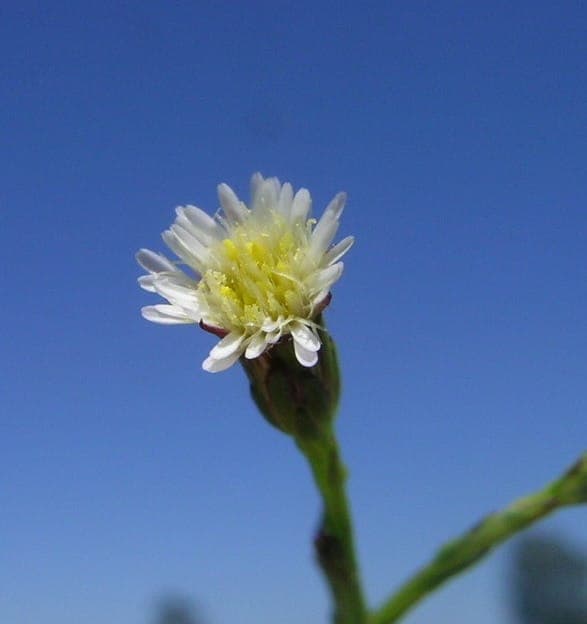
User:Salicyna derivative work: Eewilson / CC BY 4.0, via Wikimedia Commons
Symphyotrichum subulatum: complete guide
Symphyotrichum subulatum
Want to see Symphyotrichum subulatum: complete guide in your garden?
1 minute, no credit card
Overview
Symphyotrichum subulatum, commonly known as the annual saltmarsh aster or eastern annual saltmarsh aster, is a slender annual herb belonging to the Asteraceae family. Its native range extends from eastern Canada - New Brunswick and Ontario - south through the eastern United States and into tropical America, including the Caribbean islands, Venezuela, Brazil, Argentina and Chile. In Europe it has naturalised widely, appearing in coastal habitats, harbour edges, riverbanks and ruderal sites across France, Belgium, Great Britain, Spain, Portugal, Italy and many other countries.
The species occupies a distinct ecological niche: it thrives in moist to wet, often brackish or saline habitats such as tidal marshes, salt flats, estuarine margins and the shores of brackish ditches and rivers. In gardens it is occasionally planted in wild or naturalistic schemes near water features, pond margins and rain gardens. On gardenworld.app you can explore design ideas that incorporate wild and naturalised plants like this aster as part of a late-season planting scheme.
What makes this plant most appealing to garden designers and naturalists alike is its remarkably long flowering period, stretching from August through October or even November in mild years. The small composite flowerheads, each with 20 to 40 pale lilac ray florets surrounding a yellow disc, draw in late-flying butterflies, hoverflies and bees at a time when many other plants have already set seed.
Appearance and bloom cycle
Symphyotrichum subulatum is an erect, branched annual reaching 30 to 80 cm in height, occasionally up to 100 cm under ideal conditions. The stems are green to reddish, wiry and freely branching in the upper third. The leaves are narrow, lance-shaped to awl-shaped (subulate), 3 to 12 cm long and only 1 to 4 mm wide, with the base slightly clasping the stem. This clasping leaf base is one of the most reliable diagnostic features distinguishing this species from related asters.
The flowerheads are small, 8 to 15 mm across, and numerous - a well-grown plant may carry hundreds of heads simultaneously in autumn. Each head consists of pale lilac to nearly white ray florets and a central yellow disc that turns reddish-brown as seeds mature. The achenes are tiny, topped with a white pappus that facilitates wind dispersal. Flowering typically begins in August and continues until the first hard frost in October or November, making this one of the latest-blooming asters available.
No named cultivars are available in general commerce. Plants vary somewhat in the intensity of the ray colour and in ultimate height, but all forms share the characteristic narrow foliage and profuse late-season bloom. The synonym Aster subulatus (Michx.) is still encountered in older references.
Ideal location
Full sun is essential for Symphyotrichum subulatum to perform at its best. The light requirement is very high - the species scores 8 out of 10 in standard botanical light-requirement scales. A minimum of six hours of direct sunlight per day is needed; in partial shade plants become drawn and weak, flower less freely and are more susceptible to fungal problems.
In its natural habitat the plant occupies open, wet places with minimal competition from taller vegetation. In the garden this translates to: sunny pond or stream margins, rain garden edges, bog garden borders or any reliably moist to wet position in full sun. It tolerates temporary flooding by fresh water but grows most vigorously in the slightly saline conditions of tidal margins.
The plant also naturalises readily in disturbed, moist habitats - along railway embankments, harbour walls and the edges of drainage channels - showing that it is tough and opportunistic once established. As an annual it causes no long-term management problems even if it self-seeds into adjacent areas.
Soil requirements
This aster is adaptable but performs best in moist, reasonably fertile soils. The pH range is 5.6 to 7.0, with the optimum around 6.5 (slightly acid to neutral). The species has a relatively high nutrient requirement (scored 8 out of 10 in botanical classifications), which means that very poor, sandy soils will give disappointing results unless enriched.
Sandy loam, light clay, sandy clay and peaty soils are all suitable provided they retain adequate moisture. Heavy waterlogged clay is generally less suitable unless it dries out between rain events; the plant wants consistent moisture rather than stagnant, anaerobic conditions. On saline substrates - a slight salt content in the water or soil - the plant often grows with particular vigour, reflecting its coastal origins.
For garden cultivation, dig in a generous amount of well-rotted garden compost before planting and top-dress annually in spring. No lime applications are needed on most UK and western European soils. Avoid fertilisers high in phosphorus at the expense of nitrogen, as the plant benefits from good nitrogen nutrition to support its fast annual growth cycle.
Watering
As a plant of wet, often inundated habitats, Symphyotrichum subulatum has a high moisture requirement. The atmospheric humidity requirement is similarly high (8 out of 10), indicating that the species evolved in regions with frequent rainfall and high ambient humidity. In a garden context this means that the plant should never be allowed to dry out completely.
During the active growing season from May to September, water generously whenever the top 2 to 3 cm of soil approaches dryness. In hot, dry spells above 25°C, daily watering may be necessary. Plants that dry out mid-summer may abort their flower buds or go to seed prematurely without reaching their full ornamental potential.
A mulch layer of composted bark or leaf mould, 5 to 7 cm deep, applied around the base of the plant in late spring, will significantly reduce the frequency of watering needed. Drip irrigation or seep hoses laid along the planting row are ideal for keeping moisture levels stable. Avoid overhead watering in the evening as wet foliage overnight can encourage grey mould.
Free design
Want to see Symphyotrichum subulatum: complete guide in your garden? Make a free design now.
Pruning
As an annual, Symphyotrichum subulatum requires little deliberate pruning. The main decision for gardeners is whether to allow the plant to set and disperse seed. If self-seeding in subsequent years is welcome - and in many naturalistic gardens it is - simply leave the spent flowerheads in place through autumn and winter. The small plumed achenes will scatter on the wind and germinate the following spring.
If self-seeding is undesirable, deadhead the flowerheads as they finish, typically from September onwards, before the pappus fully expands and the seeds are released. Remove the spent heads with scissors and compost them.
To encourage a bushier plant with more flowering branches, pinch out the growing tips when plants are 15 to 20 cm tall, in June. This removes the apical dominance and encourages multiple lateral shoots, ultimately producing a more compact, floriferous plant. Without pinching, plants tend to grow as a single main stem with a loosely branched top section.
Maintenance calendar
March to April: Sow seeds indoors in a heated propagator at 15 to 18°C. Surface-sow onto moist seed compost and cover lightly; germination takes 10 to 20 days. Prick out seedlings into individual 7-cm pots when large enough to handle.
May: Harden off plants outdoors over one to two weeks, then plant out after the last expected frost. Space plants 20 to 30 cm apart in a sunny, moist position. Water in well.
June: Pinch out growing tips if a compact, multi-branched plant is desired. Begin regular watering if rainfall is insufficient.
July: Maintain consistent moisture. Apply a liquid balanced fertiliser once if growth seems slow. Check for aphid colonies on stem tips and treat if necessary.
August to October: Flowering period. Enjoy the display and support pollinators. Deadhead if self-seeding is unwanted. Keep watering during dry spells.
November: After the first hard frost the plant will blacken and die. Remove dead stems or leave them for structural interest and self-seeding.
Winter hardiness
Symphyotrichum subulatum is a true annual and does not survive frost as a mature plant. In horticultural terms it is treated as a tender or half-hardy annual in temperate climates (USDA zones 8 to 10 as a perennial equivalent, but grown as an annual in zones 4 to 7). The seed, however, is frost-tolerant and germinates reliably after a cold winter, which is why the plant naturalises so effectively in temperate Europe despite the adults dying each autumn.
In the warmer parts of its introduced range - France, Italy, Portugal, Spain - self-seeded plants appear reliably each spring along coastal and riverine margins without any human intervention. In the cooler Netherlands and Belgium, naturalised populations are primarily coastal or urban, benefiting from the mitigating effect of the sea and urban heat islands.
For gardeners who cannot rely on natural self-seeding, collect ripe seed (when the pappus opens and begins to disperse) in September or October, dry it briefly and store it in a labelled paper envelope in a cool, dry place (2 to 8°C). Seed remains viable for two to three years.
Companion plants
In a naturalistic water garden or bog garden, Symphyotrichum subulatum pairs beautifully with other late-season species. Sea aster (Tripolium pannonicum) is perhaps the most natural companion, sharing the same coastal habitat. Yellow flag iris (Iris pseudacorus), reed canary grass (Phalaris arundinacea) and common reed (Phragmites australis) all provide vertical structure behind the aster's lower, mounded form.
For a more ornamental garden border that incorporates this plant's late-season bloom, combine it with New England aster (Symphyotrichum novae-angliae 'Violetta' or 'Barr's Pink'), goldenrod (Solidago 'Goldenmosa' or Solidago rugosa 'Fireworks') and sneezeweed (Helenium 'Moerheim Beauty'). This combination provides a rich autumn spectacle from August to October and is enormously attractive to late-flying bees and monarch butterflies.
Garden centres across Britain carry a good range of companion late-flowering perennials that work well alongside this annual saltmarsh aster. For a complete planting plan that integrates annuals and perennials in a cohesive late-season display, the design tools at gardenworld.app provide excellent inspiration.
Closing
Symphyotrichum subulatum is an underused annual aster with genuine garden merit. Its late, prolific bloom in lilac and pale purple brings life to the autumn garden when most other flowering plants have finished. It asks for little more than a sunny, moist position and consistent moisture through the growing season. As an annual that self-seeds readily in suitable conditions, it is low-maintenance once established in a naturalistic scheme.
For gardeners drawn to wildlife-friendly planting, this species is particularly valuable: it flowers when native pollinator populations are building up reserves for winter, and the tiny plumed seeds feed small birds well into December. Its undemanding nature and adaptability to wet, saline soils make it a versatile tool for difficult, boggy corners of the garden where more showy perennials struggle to thrive.
Want to see Symphyotrichum subulatum: complete guide in your garden? Make a free design now.
Upload a photo, pick a style, and get a photorealistic design with plant list in under a minute.
10,000+ gardens designed already
No credit card required


Similar plants
Calendula stellata: complete guide
Calendula stellata
Complete guide to Calendula stellata, the star-flowered marigold from Sicily: location, soil, watering and companion planting tips.
Korean chrysanthemum: complete guide
Chrysanthemum x rubellum
Chrysanthemum x rubellum is a hardy autumn perennial with single pink to copper flowers from August to November. Care and combinations.
Helianthus divaricatus: complete guide
Helianthus divaricatus
Helianthus divaricatus is a North American woodland sunflower with yellow summer blooms, ideal for naturalistic borders and shady edges.