
Jan Smith / CC BY 4.0, via Wikimedia Commons
Douglas aster: complete guide
Symphyotrichum subspicatum
Want to see Douglas aster: complete guide in your garden?
1 minute, no credit card
Overview
Douglas aster (Symphyotrichum subspicatum) is a multi-stemmed herbaceous perennial in the daisy family (Asteraceae), native to the Pacific coast and intermountain west of North America. It grows wild from Alaska south through British Columbia, Washington, Oregon, Idaho, Montana, and into California, occupying wet meadows, streambanks, open forest edges, and mountain clearings from sea level up to moderate elevations.
The plant was long classified as Aster subspicatus or Aster douglasii, named after David Douglas, the Scottish botanist who collected extensively along the North American Pacific coast in the 1820s and 1830s. In 1995 it was reclassified into the genus Symphyotrichum, which now holds most of the native North American asters. The species name "subspicatum" means "somewhat spike-like" and refers to the way flowering stems bear blooms in a roughly ordered, spike-like arrangement.
For European gardeners, Douglas aster offers something genuinely valuable: a flood of lavender-blue daisies from August through October, arriving just as many summer perennials are winding down. It is one of the richest late-season nectar sources available, attracting butterflies, bumblebees, hoverflies, and solitary bees at a time when few other flowers remain.
If you are designing a naturalistic or prairie-style border with strong autumn interest, gardenworld.app offers design tools and inspiration for combining late-season perennials and ornamental grasses into planting schemes that look spectacular from August through to the first frosts.
Appearance and bloom cycle
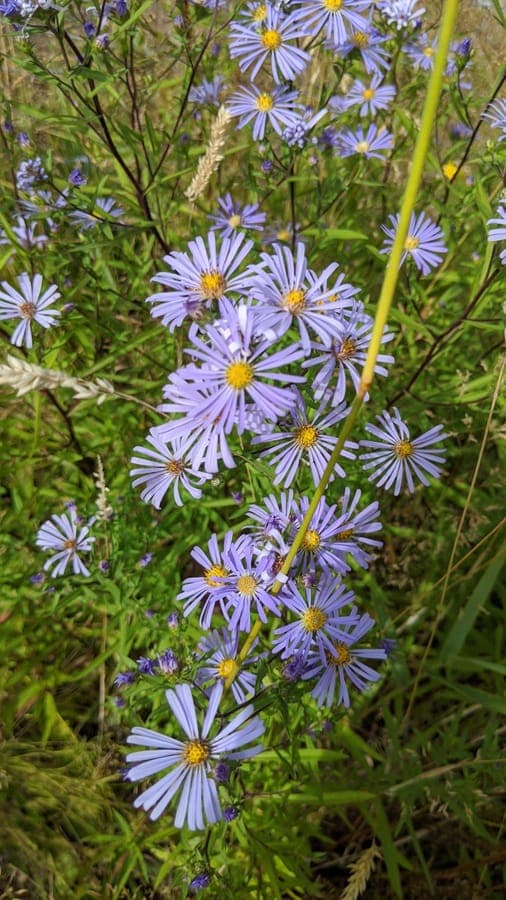
Douglas aster grows to 50 to 100 cm tall, forming clumps of multiple upright stems that spread at a moderate pace from a central crown. The stems are slender, lightly branched toward the top, and clothed in narrow lance-shaped leaves, 2 to 8 cm long, giving the plant an airy, fine-textured appearance. The foliage is bright to mid-green, the leaf texture fine - a useful visual contrast to coarser-leaved companions.
Flowering begins in August and continues through September and into October, making this one of the longer-blooming of the autumn asters. Each flower head is 2 to 3 cm across, with a central disc of yellow florets surrounded by 15 to 30 ray florets in shades of lavender-blue to violet-purple. The rays are 8 to 12 mm long - not the largest aster flowers, but produced in such quantity that established clumps are densely covered throughout the flowering season.
After flowering, small wind-dispersed fruits (cypselae with feathery pappus bristles) are produced. The plant spreads primarily by clump expansion from the crown, and can self-seed on bare, open ground nearby.
Ideal location
Full sun gives the most floriferous, compact plants. In partial shade - two to four hours of direct sun - the plant still blooms well but tends to grow taller and may need some support. Deep shade under trees is unsuitable: stems become weak and bloom is sparse.
The plant's native range spans a wide variety of habitats, from coastal wetlands to dry mountain meadows, indicating good adaptability. In garden terms this means it works in standard mixed borders, alongside ponds and water features, in prairie-style meadow plantings, and in naturalistic drifts in combination with ornamental grasses. It performs in both cool maritime climates and drier continental conditions.
A position sheltered from the strongest autumn winds helps prevent the tallest stems from toppling. In exposed gardens, the Chelsea chop technique (cutting stems back by half in early June) produces stockier plants that need no staking.
Soil requirements
Douglas aster grows best in moderately fertile, reasonably moisture-retentive but well-drained soil with a pH of 6.0 to 7.5. It is not demanding, and performs perfectly well in average garden soil without amendment.
On rich, moist soils it grows more exuberantly but stems may flop. On leaner soils it is more compact and self-supporting. Sandy soils are acceptable with supplemental watering in dry periods. Heavy clay needs good drainage - winter waterlogging can cause crown rot.
Fertilising is not necessary. On very poor soils a light top-dressing of compost in spring is beneficial. Avoid high-nitrogen fertilisers, which produce lush stems at the expense of flowers and increase the risk of floppy growth.
Free design
Want to see Douglas aster: complete guide in your garden? Make a free design now.
Watering
Moderate watering is sufficient. Established plants in a location with normal rainfall need no supplemental irrigation. In prolonged dry spells water once a week, deeply, rather than little and often. Newly planted specimens need more regular attention in their first season while roots establish.
A mulch of 5 cm of bark chips or garden compost is recommended for the first two years after planting - it reduces water loss, moderates soil temperature, and suppresses weeds. Unlike truly moisture-loving perennials, Douglas aster does not appreciate permanently wet feet: good drainage is important, especially on heavier soils in wet winters.
Pruning
The Chelsea chop is the most useful technique for managing Douglas aster. In early June, cut all stems back by roughly half. This delays flowering by a few weeks, produces a denser, more compact plant, and often increases the total flower count. On rich soils it is strongly recommended; on lean soils it may be optional.
After flowering in autumn, leave the stems and seed-heads standing through winter. The seed-heads provide food for small finches and other birds, and the hollow stems serve as overwintering habitat for solitary bees and beneficial insects. Cut everything back to a few centimetres above the ground in early spring, just before new growth emerges.
Divide the clumps every three to four years in spring to maintain vigour. Outer sections with good roots can be replanted; the exhausted centre is discarded.
Maintenance calendar
Early spring (February to March): remove dead stems from the previous year. Add compost to poor soils. Check for self-sown seedlings and retain or remove as needed.
Spring (April to May): rapid new growth. Weed around the base while plants are still small. Apply mulch if not already in place.
Early summer (June): consider Chelsea chop for more compact, wind-resistant plants. Optional but beneficial on fertile soils.
Late summer (August): first flowers open. Peak pollinator activity. Water if prolonged drought occurs.
Autumn (September to October): peak of flowering. Leave undisturbed for wildlife.
Winter (November to January): fully dormant. Leave stems standing. Cut back in early spring.
Winter hardiness
Douglas aster is very cold-tolerant, rated for USDA hardiness zones 3 to 9. This covers virtually the entire European continent. In the Netherlands, Belgium, the UK, and Germany it is fully hardy with no winter protection needed. The crown overwinters at or just below the soil surface and regenerates reliably each spring even after the coldest winters experienced in northern Europe.
In its native range the plant survives temperatures as low as minus 35 to minus 40 degrees Celsius in the colder parts of Canada and Alaska, making European winters something it finds entirely manageable.
Companion plants
Douglas aster is an excellent companion for other late-season perennials and ornamental grasses. Strong combinations include yellow coneflower (Rudbeckia fulgida) for warm golden contrast to the cool lavender-blue flowers, perennial sunflower (Heliopsis helianthoides) for bold yellow, ice plant (Hylotelephium spectabile) for pink tones and bee appeal, and prairie dropseed (Sporobolus heterolepis) or Mexican feather grass (Nassella tenuissima) for airy, movement-giving textural foil.
In a prairie-style planting Douglas aster works beautifully with coneflower (Echinacea purpurea), golden rod (Solidago), ironweed (Vernonia), and switch grass (Panicum virgatum) for a richly naturalistic late-summer to autumn display. These combinations provide layered ecological value: nectar and pollen for pollinators, seed for birds, and overwintering habitat in the hollow stems.
At specialist perennial nurseries and prairie-plant suppliers you will often find Douglas aster alongside related North American asters like New England aster (Symphyotrichum novae-angliae) and smooth aster (Symphyotrichum laeve).
Explore gardenworld.app for garden design concepts that use late-season perennials including Douglas aster, and see how prairie-inspired plantings can bring the garden to life right through the autumn months.
Closing thoughts
Douglas aster is a plant that earns its keep by performing when most others have given up. Its lavender-blue flowers arrive in August, peak through September, and carry on into October - covering the season that so many garden borders leave empty. Add in its ecological importance as a major late pollinator source, its easy-going nature in average soils, and its outstanding cold hardiness, and it becomes clear why this Pacific coast native deserves a place in far more European gardens than it currently occupies.
Want to see Douglas aster: complete guide in your garden? Make a free design now.
Upload a photo, pick a style, and get a photorealistic design with plant list in under a minute.
10,000+ gardens designed already
No credit card required


Similar plants
Calendula stellata: complete guide
Calendula stellata
Complete guide to Calendula stellata, the star-flowered marigold from Sicily: location, soil, watering and companion planting tips.
Korean chrysanthemum: complete guide
Chrysanthemum x rubellum
Chrysanthemum x rubellum is a hardy autumn perennial with single pink to copper flowers from August to November. Care and combinations.
Helianthus divaricatus: complete guide
Helianthus divaricatus
Helianthus divaricatus is a North American woodland sunflower with yellow summer blooms, ideal for naturalistic borders and shady edges.