
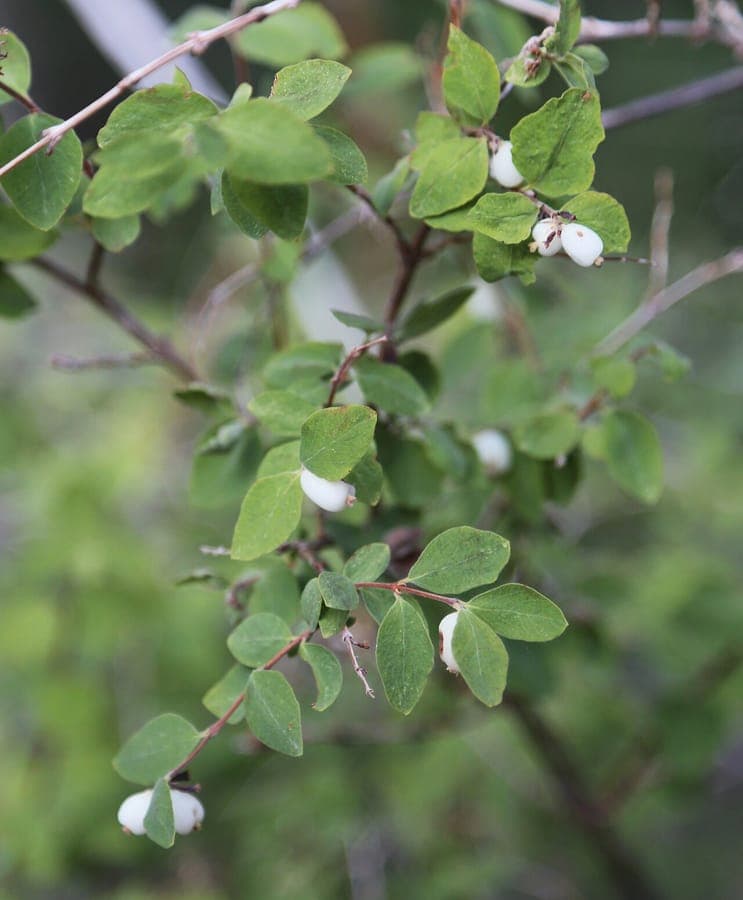
Dcrjsr / CC BY 3.0, via Wikimedia Commons
Roundleaf snowberry: complete guide
Symphoricarpos rotundifolius
Want to see Roundleaf snowberry: complete guide in your garden?
1 minute, no credit card
Overview
Roundleaf snowberry (Symphoricarpos rotundifolius) is a compact, rhizomatous shrub native to western and central North America, ranging from British Columbia south through the Rocky Mountains and Sierra Nevada to northern Mexico. First described by botanist Asa Gray in 1853, it grows at elevations from 1,000 to 3,500 metres, colonising dry slopes, open forests, and rocky hillsides where few other shrubs can establish.
In European gardens the roundleaf snowberry is still a relative rarity, overshadowed by its more commonly planted cousin Symphoricarpos albus (common snowberry). Yet it brings distinct qualities of its own: smaller, rounder leaves, a more compact habit, and an impressive display of waxy white to pale pink berries that persist on bare branches well into winter, providing food for thrushes, robins, and other fruit-eating birds when little else is available.
If you have a dry, shady bank, a poor stony slope, or a difficult corner that has defeated previous planting attempts, gardenworld.app can help you visualise how a planting scheme built around tough shrubs like roundleaf snowberry might look through all four seasons.
Appearance and bloom cycle
Symphoricarpos rotundifolius grows to 60 to 120 cm tall, with slender, arching stems that spread gradually by underground rhizomes to form a slowly widening thicket. The bark is pale brown to grey-brown, peeling in thin strips on older wood. The leaves are small and distinctly rounded - 1 to 3 cm across - giving the species its name and setting it apart visually from other snowberries with their larger, more oval foliage.
Flowers appear from June to August. They are small, bell-shaped, and pink to white, borne in short clusters at the shoot tips and leaf axils. Though individually modest, they are rich in nectar and visited reliably by bees and bumblebees throughout the summer months.
The ornamental highlight comes after flowering: the berries. Spherical to slightly oval, 6 to 10 mm across, they ripen from late August through September, turning from green to white with a characteristic waxy bloom. The berries are mildly toxic to humans but are relished by birds - thrushes, waxwings, and sparrows in particular - and remain on the branches long after the leaves have fallen, providing winter structure and colour in the garden.
Ideal location
Roundleaf snowberry tolerates both full sun and partial shade, with the best berry production in a position receiving at least three to four hours of direct sun per day. In its native habitat it grows on dry mountain slopes in the open and beneath the canopy of pines and oaks - giving a clear signal that it handles difficult light conditions with ease.
In the garden it excels in situations that defeat most shrubs: dry shade beneath trees, steep erosion-prone slopes, narrow strips along north- or west-facing walls, or poor stony beds that drain too quickly for most plants. It also tolerates urban conditions well - compacted soil, pollution, and periodic drought do not greatly affect its performance. If anything, this is a shrub to reach for when other candidates have failed.
Soil requirements
This shrub is remarkably unfussy about soil. It accepts a pH range of 5.2 to 7.5 and performs well on poor, well-drained substrates that would starve or drown other ornamentals. Sandy or gravelly soils are fine - the plant's natural mountain habitat is often thin and stony. On rich, moisture-retentive soils it grows more vigorously but may produce fewer flowers and berries.
Heavy clay that stays wet in winter carries some risk of root rot; if that is what you have, improve drainage by mixing grit and coarse sand into the planting area. Fertiliser is rarely needed; a light dressing of compost every other spring is sufficient on very impoverished ground.
Free design
Want to see Roundleaf snowberry: complete guide in your garden? Make a free design now.
Watering
Once established, roundleaf snowberry needs virtually no supplemental watering. Its roots penetrate deeply and efficiently, allowing it to source moisture from well below the dry surface layer. In normal European summers with regular rainfall it manages entirely on its own.
The first growing season after planting is the exception: water new plants regularly during dry periods to help the root system establish. After that first season, step back and let the plant look after itself. A 5 cm mulch of bark chips applied after planting reduces moisture loss and weed competition, which is particularly helpful in the first year.
Pruning
Light pruning each year is better than heavy renovation every few years. In late winter or very early spring, remove any dead, damaged, or crossing branches. Every three to four years, thin the oldest stems at the base to maintain an open, well-aired structure and encourage vigorous new growth from the base.
Hard rejuvenation pruning is possible if the shrub has become very dense or misshapen: cut everything back to 15 to 20 cm above ground in late winter and the plant will regrow strongly. Be aware that this removes the berry display for that season.
To limit rhizome spread, cut around the perimeter of the clump with a sharp spade each spring or autumn. The detached pieces can be potted up or replanted elsewhere.
Maintenance calendar
Early spring (February to March): remove dead branches. Assess rhizome spread; spade off any sections that have moved beyond their intended area. Apply compost on very poor soils.
Spring (April to May): new leaves emerge. Weed around the base while plants are small and easy to see. Apply mulch if not already in place.
Summer (June to August): flowering period. No watering needed for established plants. Watch for any signs of powdery mildew in very hot, dry summers - it is uncommon but possible.
Autumn (September to November): peak berry display. Birds begin feeding. Enjoy the ornamental effect; no intervention required.
Winter (December to January): berries persist. No protection needed. The bare stems with remaining berries provide structure in the winter garden.
Winter hardiness
Roundleaf snowberry is reliably hardy in USDA zones 4 to 8, covering virtually all of Europe including areas with cold continental winters. In the Netherlands, Belgium, Germany, and the UK it is fully hardy with no protection required. The rhizomes overwinter safely below the frost line, and the top growth regenerates normally in spring even after hard winters.
Frozen berries are no problem - they often become softer and more palatable to birds after a freeze cycle, which actually extends their usefulness as a wildlife food source through the coldest months.
Companion plants
Roundleaf snowberry pairs well with other tough, low-maintenance shrubs. Consider combining it with Oregon grape (Mahonia aquifolium) for year-round evergreen structure, common snowberry (Symphoricarpos albus) for a similar texture on a slightly larger scale, coralberry (Symphoricarpos orbiculatus) for red-berry contrast alongside the white fruits, and dog rose (Rosa canina) for orange-red autumn hips that glow beside the white snowberries.
On dry slopes it works well as part of a naturalistic planting with cotoneasters, native viburnums, and low-growing junipers. The combination of white and red berries from different plants provides an extended and varied food source for birds from September through February.
For retail availability, specialist shrub nurseries and wildlife-garden suppliers are the most reliable source. Some online native-plant nurseries stock it.
For help planning a shrub border that delivers colour and wildlife value across all four seasons, visit gardenworld.app where you can explore planting combinations and design layouts for gardens of any size.
Closing thoughts
Roundleaf snowberry is a shrub that rewards gardeners who give it a difficult situation. Dry shade, poor soil, steep slopes - these are not problems for this plant, they are its preferred conditions. The combination of summer flowers for pollinators, white autumn berries for birds, and a restrained, tidy habit makes it an excellent addition to any garden looking for low-input, high-value planting. Give it the tough spot that nothing else will take, and it will reward you generously.
Want to see Roundleaf snowberry: complete guide in your garden? Make a free design now.
Upload a photo, pick a style, and get a photorealistic design with plant list in under a minute.
10,000+ gardens designed already
No credit card required


Similar plants
Yellow honeysuckle (Lonicera tragophylla): complete guide
Lonicera tragophylla
Meet yellow honeysuckle (Lonicera tragophylla): a Chinese climber with large golden flowers that thrives in partial shade.
Lonicera korolkowii: complete guide
Lonicera korolkowii Stapf
Discover blueleaf honeysuckle, a vigorous shrub with beautiful flowers. Guide on growing, shaping and why this Asian climbing plant is perfect for gardens.
Lonicera oblongifolia: complete guide
Lonicera oblongifolia Hook.
Discover swamp fly honeysuckle, a North American woodland plant. Guide on growing, caring and why this native species is valuable for gardens.