
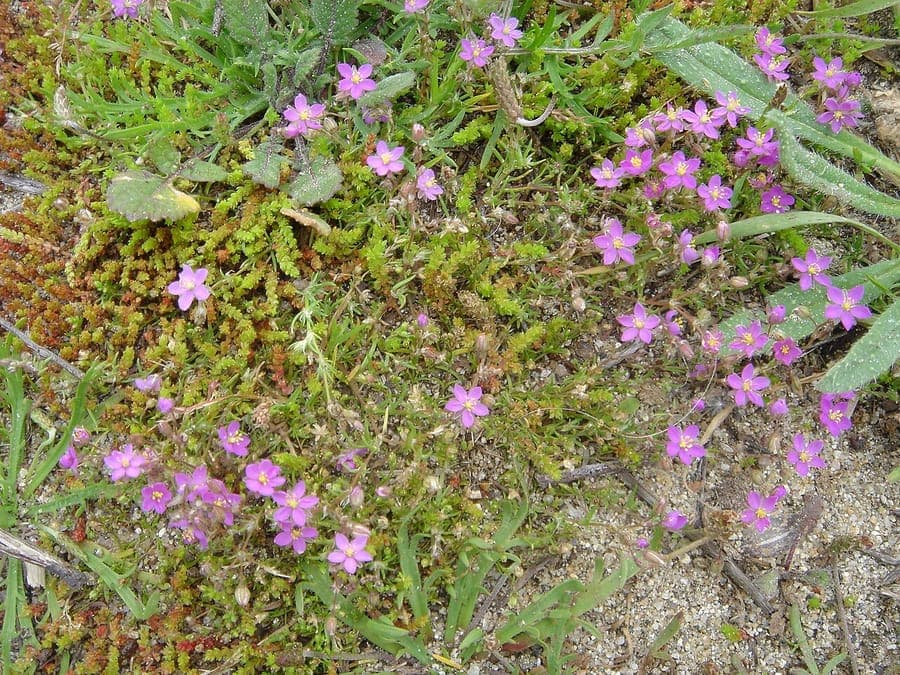
Ghislain118 https://www.fleurs-des-montagnes.net / CC BY-SA 3.0, via Wikimedia Commons
Rock sea-spurrey: complete guide
Spergularia rupicola
Want to see Rock sea-spurrey: complete guide in your garden?
1 minute, no credit card
Overview
Rock sea-spurrey (Spergularia rupicola) is a compact, charming perennial from the family Caryophyllaceae. It grows naturally on rocky sea cliffs and coastal outcrops in western Europe, with its native range limited to France, Great Britain, Ireland, Portugal, and Spain. Its bright pink-purple flowers appear from June to August, bringing colour to some of the harshest spots in the coastal landscape.
The plant is exceptionally well adapted to salt-laden sea winds, thin rocky substrates, and intense sunshine. For gardeners working with coastal locations, rock gardens, or any well-drained, sunny situation, Spergularia rupicola offers season-long interest with minimal care. On gardenworld.app you will find design ideas that incorporate salt-tolerant and drought-resistant plants like this one into cohesive garden schemes.
Outside its native coastal habitat, rock sea-spurrey can be grown successfully in rock gardens, raised beds, gravel gardens, and gaps between paving stones - anywhere that the substrate drains freely and the sun shines for most of the day. Its salt tolerance also makes it a good candidate for front gardens in seaside towns, roof terraces exposed to wind, and planters on balconies where conditions are dry and bright.
Appearance and bloom cycle
Spergularia rupicola forms low, cushion-like clumps of narrow, slightly fleshy leaves. The plant typically reaches 10 to 25 cm in height and spreads somewhat sideways over time. The leaves are narrow and succulent-like - a functional adaptation that reduces water loss in exposed, dry habitats. The stems are slightly sticky due to glandular hairs, which is a characteristic shared by several members of the genus Spergularia.
The flowers are five-petalled, bright pink to pink-purple, measuring around 8 to 12 mm across. They appear from June to August and attract small bees and hoverflies. In favourable conditions the blooming period can extend well into October. After flowering, small seed capsules form and split open when ripe, releasing tiny seeds that can self-sow in gritty or sandy areas nearby. This self-seeding tendency means the plant can gradually naturalise in suitable spots without any intervention from the gardener.
Ideal location
Rock sea-spurrey is a true sun-lover. It thrives in fully exposed, south-facing positions and performs poorly in shade, where it becomes drawn, produces fewer flowers, and becomes more susceptible to mildew. The plant excels in:
- Rock gardens and alpine troughs with excellent drainage
- The front of dry, sunny borders on sandy or gravelly substrate
- Containers and planters on sunny terraces or balconies
- Gravel gardens and gaps between stepping stones or paving
- Coastal gardens exposed to salt wind
With a light score of 8 out of 10 on the Trefle scale and a high atmospheric humidity tolerance, the plant is built for open, bright, airy conditions. It does not appreciate sheltered, humid spots where air movement is limited and moisture lingers around the stems and crowns.
Soil
The plant requires a light, lean, and very well-drained substrate. In nature it grows on limestone sea cliffs and sandy coastal areas, typically at pH 7.0 to 7.5 - slightly alkaline. If your garden substrate is acidic, add ground limestone to bring the pH up before planting.
Wet conditions - particularly in winter - are one of the most common causes of plant loss. Ensure the planting site or container drains freely by incorporating at least 30-50% sharp sand, horticultural grit, or perlite into the growing medium. In a rock garden, fill planting pockets with a mix of equal parts garden loam and coarse grit.
The high salt tolerance of Spergularia rupicola makes it particularly suited to coastal sites or any location where roads are treated with de-icing salt in winter. Rich, fertile substrates should be avoided: they produce soft, lush growth that is prone to rotting and far less attractive than the tight, compact cushions that lean conditions promote.
Free design
Want to see Rock sea-spurrey: complete guide in your garden? Make a free design now.
Watering
Once established, rock sea-spurrey needs very little watering. Its slightly fleshy leaves store moisture, and the plant is well adapted to prolonged dry periods. In a rock garden or gravel border, supplementary watering during the growing season is only needed during extended dry spells lasting more than two weeks without rainfall.
Overwatering is a serious risk. Roots rot quickly in permanently wet substrate. In containers, always use pots with generous drainage holes and avoid saucers that hold standing water. During winter when the plant is semi-dormant, watering should be stopped or reduced to an absolute minimum.
Newly planted specimens or seedlings do benefit from regular watering in the first few weeks until roots have penetrated deeper into the substrate. After that, taper off to a light summer watering regime that only supplements during genuine drought.
Pruning
Rock sea-spurrey requires almost no pruning. After the main flush of flowers fades, you can trim back spent stems by about a third to keep the plant compact and encourage a second wave of blooms. This light trim is best done in August or early September.
In spring, once new growth begins (April), remove any dead or frost-damaged shoots. No heavy cutting back is needed at any time. Without pruning, the plant gradually develops a looser, more open structure. A light annual trim keeps it dense and productive, especially in containers where shape matters most.
Maintenance calendar
January-February: Winter dormancy. Ensure drainage is working and no water is collecting around the roots or crown.
March-April: Growth resumes. Remove any dead or damaged shoots. A light trim is possible at this stage.
May: Flowering begins. No special action needed. Water lightly if conditions are very dry.
June-August: Full bloom. The plant is drought-tolerant and mostly self-sufficient. Deadhead spent flowers to extend the blooming period. Explore coastal garden design ideas on gardenworld.app.
September: Optional light trim to keep the plant compact. Allow some seed heads to ripen for natural self-sowing.
October-November: Growth slows. Reduce or stop watering. Check drainage to prepare for winter.
December: Dormancy. No action needed.
Winter hardiness
Rock sea-spurrey is native to mild oceanic climates in western Europe and tolerates light frost well. Prolonged temperatures below -10 degrees Celsius can damage the above-ground parts. In mild coastal areas of the United Kingdom, northern France, and the Low Countries it is reliably perennial.
In colder inland areas, the plant can be treated as a tender perennial and overwintered in a frost-free greenhouse or cool conservatory. If left outside, cover the crown with a dry mulch of grit or gravel (not bark, which holds moisture) during the coldest weeks. In containers, move the pot to a sheltered, frost-free spot and keep it completely dry over winter. Wet and cold together are the main cause of winter losses.
In terms of USDA zones, the plant performs best in zones 7 to 9 and in the milder parts of zone 6 where drainage is perfect and winter wet is limited.
Companion plants
Because of its preference for lean, dry, and exposed conditions, rock sea-spurrey pairs naturally with other coastal and rock garden plants:
- Sea sandwort (Honckenya peploides) for a similar coastal character and white flowers
- Wild thyme (Thymus serpyllum) for fragrance and textural contrast
- Biting stonecrop (Sedum acre) as a flat ground cover on rocks and paths
- Maiden pink (Dianthus deltoides) for complementary pink flowers and grassy foliage
- Common rock-rose (Helianthemum nummularium) for larger, sun-loving yellow or orange flowers
All of these companions thrive in similar lean, sunny, and well-drained conditions, forming a plant community that requires very little maintenance once established. Many are available at specialist garden centres, sometimes sold together as part of a rock garden or coastal planting collection.
Closing
Rock sea-spurrey is a plant of quiet distinction - understated in form but spectacular in flower against a backdrop of bare rock or gravel. It asks for little beyond sun, sharp drainage, and protection from excessive winter wet, and in return it delivers months of cheerful pink-purple blooms that attract pollinators and delight the eye.
Looking for a garden design that suits a coastal, dry, or rocky setting? On gardenworld.app you can upload a photo of your garden and receive a tailor-made planting plan that incorporates drought-tolerant species like rock sea-spurrey alongside other complementary plants.
Want to see Rock sea-spurrey: complete guide in your garden? Make a free design now.
Upload a photo, pick a style, and get a photorealistic design with plant list in under a minute.
10,000+ gardens designed already
No credit card required


Similar plants
Dianthus karami: complete guide
Dianthus karami
Dianthus karami is a rare Lebanese mountain pink with fringed pink blooms on limestone cliffs, ideal for rock gardens and troughs.
Sicilian pink: complete guide
Dianthus siculus
Discover Dianthus siculus, an elegant purple bloomer from Sicily. Cultivation, June-September flowering and garden combinations.
Alpine mouse-ear chickweed: complete guide
Cerastium pedunculatum
Full growing guide for Cerastium pedunculatum: ideal location, soil, watering, winter hardiness, and companion plants for rock gardens.