
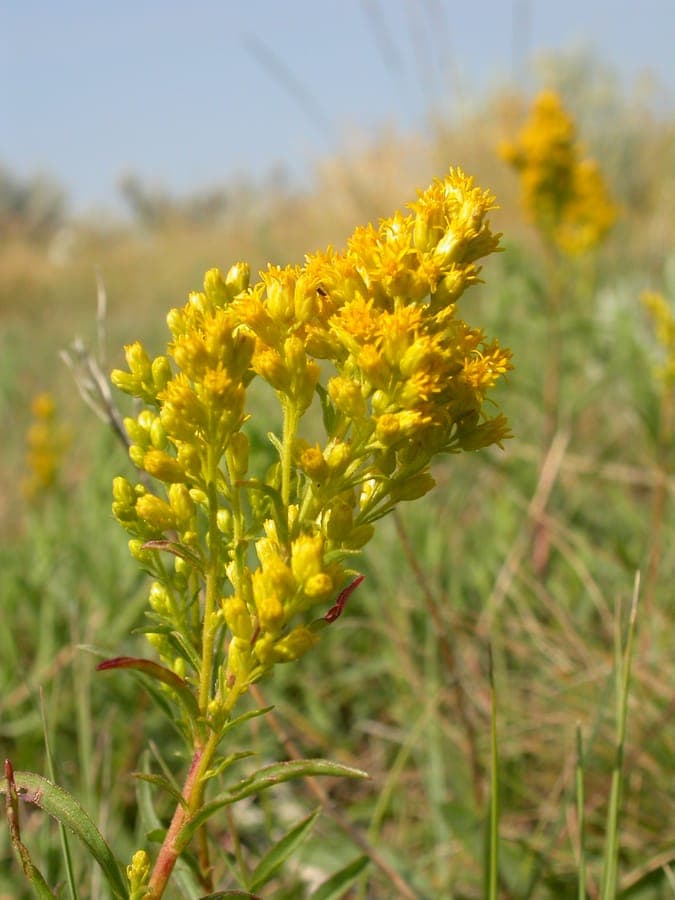
Matt Lavin / CC BY 2.0, via Wikimedia Commons
Prairie goldenrod: complete guide
Solidago missouriensis
Want to see Prairie goldenrod: complete guide in your garden?
1 minute, no credit card
Overview
Solidago missouriensis, commonly called prairie goldenrod or Missouri goldenrod, is a compact, well-behaved perennial in the Asteraceae family, native to the central and western United States and into Canada and northern Mexico. It grows naturally on the dry grasslands, prairies, and rocky slopes of the Great Plains, an environment that has shaped it into one of the most drought-tolerant goldenrods available for garden cultivation.
Unlike the tall, sometimes weedy Solidago canadensis and Solidago gigantea that have naturalised across Europe and given the whole genus an undeserved reputation for invasiveness, Solidago missouriensis is a restrained, garden-friendly species that stays 30 to 70 cm tall. It spreads slowly by underground rhizomes, gradually forming neat clumps rather than aggressive colonies. Given the right conditions - full sun and lean, well-drained soil - it is long-lived, reliable, and increasingly beautiful year on year as the clumps mature.
Varieties of note include var. tolmieana (sometimes listed as 'Tolmie's goldenrod'), a lower, more compact form around 25 to 40 cm that stays tidy even on slightly richer soils. The straight species is fully garden-worthy and often more readily available through native plant nurseries.
In recent years prairie goldenrod has attracted increasing interest from naturalistic garden designers and ecologists alike, for its exceptional value as a nectar plant for bees, butterflies, and other pollinators in late summer and autumn, precisely when many other garden flowers are fading.
Appearance & bloom cycle
The foliage of prairie goldenrod is narrow and lance-shaped, with finely toothed or smooth margins. Basal leaves are the largest, up to 15 cm long with a short stalk; stem leaves become progressively shorter and stalkless toward the top. The leaf surface is smooth to slightly hairy with a gently lustrous texture. A diagnostic feature is the three-veined leaf blade, visible when held to light.
Flowering starts in July and continues through August and September. The flower heads are small - under 1 cm across - but produced in great abundance on gracefully arching, one-sided plumes. Each plume is densely packed with tiny composite flowers. The colour is a clean, warm golden yellow that stands out effectively in the late-summer border. The arching habit of the plumes gives the plant a distinctive fountain-like silhouette.
After flowering, the seed heads become fluffy and silver-white, adding soft textural interest through late autumn and into winter. In calm conditions the seed heads persist well; a strong wind disperses the seeds across the garden, where they may germinate on bare or gravelly ground to expand the planting naturally.
Prairie goldenrod is one of the top late-season pollinator plants. Dozens of bee species, including specialist goldenrod bees (Colletes simulans and related species), honeybees, bumblebees, and sweat bees, visit the flowers in large numbers. Monarch butterflies use the flowers as a fuel stop during southward migration. Beetles, hoverflies, and wasps are also frequent visitors.
Ideal location
Full sun is essential for best performance: six to eight hours of direct sunlight per day. In partial shade the stems become taller and looser, and flowering is reduced. Open, south- and west-facing positions in the garden are ideal. The plant is naturally found on exposed, windswept prairies and tolerates wind well without staking.
For a low border along a driveway, a gravel garden, or a naturalistic strip along a garden boundary, Solidago missouriensis is an excellent choice. It is compact enough not to overwhelm neighbours, floriferous enough to make a real impact, and tough enough to need almost no attention once established.
In the context of prairie-style planting - increasingly popular in residential and public gardens across Europe - prairie goldenrod is a key structural plant for the late-summer phase of the display. Pair it with late-flowering ornamental grasses and asters for a sequence of colour from July through October. Plan your prairie planting on gardenworld.app to visualise plant combinations and spacing before you commit to planting.
Soil requirements
Prairie goldenrod thrives in poor to moderately fertile, well-drained soil with a pH between 5.5 and 7.5. It handles sandy loam, gravelly substrates, and thin rocky soils with ease. On very fertile, nitrogen-rich soils it becomes tall and floppy, with reduced bloom quality. This is a plant that genuinely performs better on lean conditions - a useful quality in today's gardens where sustainability means reducing fertiliser use.
Heavy clay soils that retain water over winter are the main challenge. If your garden has clay soil, improve drainage thoroughly before planting: incorporate one part coarse sand to two parts clay soil to a depth of 40 cm, and plant on a slight mound to ensure the crown stays above any pooling water. On free-draining sandy soils no preparation is needed beyond loosening the planting hole.
Multching with gravel or bark chips conserves moisture, suppresses weeds, and - in the case of mineral mulches - slightly warms the soil, which benefits late-season bloomers like goldenrod. Avoid rich organic mulches such as garden compost, which add nutrients and encourage the floppy growth you want to avoid.
The rhizomatous root system spreads slowly outward and can stabilise light soils on slopes, making prairie goldenrod a useful erosion-control plant on sunny banks. Each spring the clump produces more flowering stems as the rhizomes extend, rewarding patience with increasingly impressive flowering over the years.
Free design
Want to see Prairie goldenrod: complete guide in your garden? Make a free design now.
Watering
Established prairie goldenrod is highly drought-tolerant. Its prairie origins have equipped it with rhizomatous storage organs that retain moisture during dry periods, and a root system that explores a wide soil volume in search of water.
In the first growing season after planting, regular watering supports good establishment. Water deeply once a week during dry spells, moistening the soil to at least 20 cm. Deep, infrequent irrigation is far preferable to shallow daily wetting; it trains roots downward where moisture is more consistent.
From year two onward, prairie goldenrod in northwestern Europe needs no supplemental irrigation under typical weather conditions. Even during prolonged summer droughts - which are becoming more common - established plants perform well. The flowering season may begin slightly later in very dry years, but quality is unaffected.
Overwatering is the more damaging error. Consistently wet, poorly drained soil leads to crown rot and the loss of the plant. Choose a well-drained site and resist the urge to water unless the soil has been completely dry for two or more weeks.
Pruning
Prairie goldenrod requires minimal pruning. The recommended approach is to leave the stems standing through winter: the fluffy seed heads are ornamental, the stems provide light insulation for the crown, and the seeds feed birds including goldfinches and sparrows.
In late winter or early spring (February to March), as new basal shoots emerge from the rhizomes, cut the previous year's stems to ground level. Combine this with a quick assessment of clump size: if the clump has expanded beyond its allotted space, simply cut off and discard (or replant) sections from the perimeter.
For more compact, multi-stemmed plants with more flower plumes, apply the Chelsea chop in May: when stems are 20 to 25 cm tall, cut them back by one-quarter. This delays flowering by about two weeks and encourages branching. On lean soils the plant naturally stays compact enough that this is rarely necessary.
To limit self-seeding on fertile soils, deadhead the spent plumes before seeds ripen and disperse. On poor soils, self-seeding is modest and rarely a nuisance; allow it to naturalise the planting gradually.
Maintenance calendar
March-April: Cut previous year's stems to ground level as new shoots emerge. Divide overly large clumps if needed.
May: Optional Chelsea chop at 20-25 cm height. Water if the soil is very dry from a dry spring.
June: Vigorous leafy growth; no attention needed. The plant is preparing its flowering stems.
July-September: Main flowering period. Enjoy the golden plumes and pollinator activity. No watering needed under normal rainfall.
October: Bloom fades. Leave stems or cut to 10 cm depending on preference. Seed heads provide bird food.
November-February: No maintenance required. Fully dormant and cold-hardy.
Winter hardiness
Prairie goldenrod is exceptionally cold-hardy: USDA zones 3 to 8, tolerating temperatures down to -40 °C. For all gardens in the UK, the Netherlands, Belgium, Germany, and France, winter hardiness is never a concern.
The above-ground stems die back in autumn after the first frosts. The rhizomatous crown and root system overwinter without damage. New shoots emerge reliably in spring. No protection of any kind is needed, not even for first-year plants.
On free-draining soils the risk of winter losses is essentially zero. On sites with heavy, poorly drained soil, the main risk is crown rot from prolonged winter waterlogging - not frost. Improving drainage before planting eliminates this risk. A gravel mulch around the crown helps in maritime climates with particularly wet winters.
Companion plants
Prairie goldenrod associates naturally with other late-season prairie natives and ornamental grasses:
- Echinacea purpurea 'Magnus' or 'Kim's Knee High': pink-purple coneflowers that bloom simultaneously with goldenrod from July to September. The warm-cool colour contrast is a classic of prairie planting. Space plants 40 cm apart.
- Rudbeckia fulgida 'Goldsturm': golden-yellow flowers from July to October that echo and amplify the colour of Solidago missouriensis. Together they create an intensely sunny late-summer display.
- Symphyotrichum oblongifolium or Aster ericoides (autumn aster): blue or blue-white daisy flowers from August to October that create the classic gold-and-blue prairie palette alongside goldenrod.
- Schizachyrium scoparium (little bluestem grass): 60-90 cm ornamental grass with blue-green summer foliage turning copper-red in autumn; it provides structure and movement around the goldenrod plumes.
- Penstemon digitalis 'Husker Red': white flower spikes with dark red leaves, blooming earlier in the season (June-July) to provide continuity before the Solidago comes into peak bloom.
- Gaillardia aristata (blanket flower): red-yellow striped flowers from June to October on the same dry, sunny sites as prairie goldenrod, extending the season both before and after.
For ready-to-use prairie planting plans and plant combination guides, explore the resources at gardenworld.app.
Closing
Prairie goldenrod is a late-summer essential for ecologically minded gardeners. Its clouds of golden flower plumes arrive precisely when the season's energy seems to be waning, providing a spectacular finale to the warm months and an invaluable resource for bees and butterflies preparing for winter. Compact, drought-tolerant, fully cold-hardy, and requiring almost no maintenance, Solidago missouriensis is among the best value perennials you can plant in a naturalistic or prairie-inspired garden.
Want to see Prairie goldenrod: complete guide in your garden? Make a free design now.
Upload a photo, pick a style, and get a photorealistic design with plant list in under a minute.
10,000+ gardens designed already
No credit card required


Similar plants
Calendula stellata: complete guide
Calendula stellata
Complete guide to Calendula stellata, the star-flowered marigold from Sicily: location, soil, watering and companion planting tips.
Korean chrysanthemum: complete guide
Chrysanthemum x rubellum
Chrysanthemum x rubellum is a hardy autumn perennial with single pink to copper flowers from August to November. Care and combinations.
Helianthus divaricatus: complete guide
Helianthus divaricatus
Helianthus divaricatus is a North American woodland sunflower with yellow summer blooms, ideal for naturalistic borders and shady edges.