
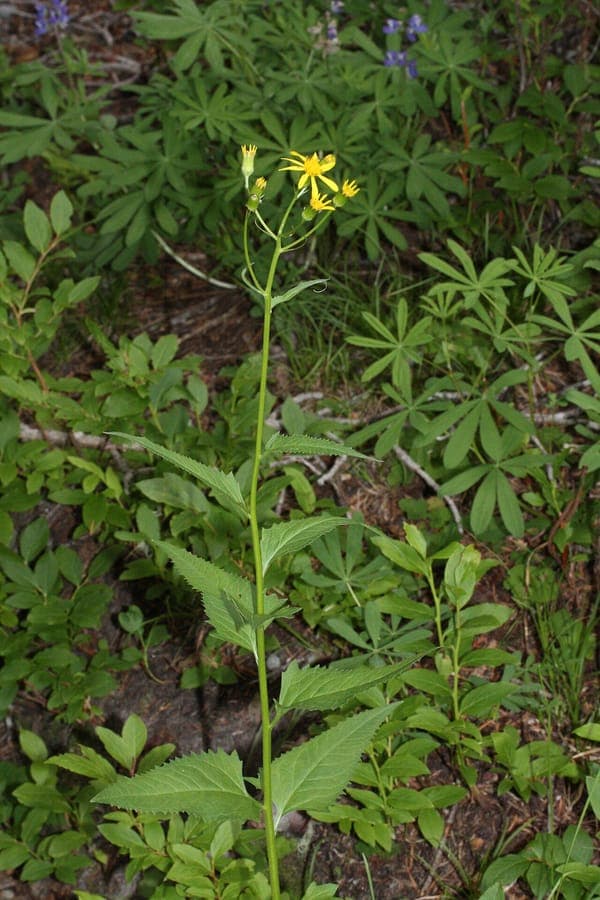
Walter Siegmund (talk) / CC BY-SA 3.0, via Wikimedia Commons
Arrowleaf butterweed: complete guide
Senecio triangularis
Want to see Arrowleaf butterweed: complete guide in your garden?
1 minute, no credit card
Overview
Arrowleaf butterweed (Senecio triangularis) is a bold, tall perennial native to moist mountain habitats across western North America, ranging from Alaska and the Yukon south to California, Colorado, and New Mexico. A member of the Asteraceae family, this species grows along stream banks, in wet meadows, and at forest edges where soil moisture is consistently high. The specific epithet triangularis refers directly to the distinctively triangular, arrowhead-shaped leaves that set this plant apart from most other Senecio species.
In garden cultivation, arrowleaf butterweed reaches 80-120 cm in height, forming upright clumps with stiff, erect stems. The plant spreads slowly via rhizomes, making it a non-invasive but gradually expanding groundcover in suitable wet conditions. It is an excellent candidate for rain gardens, bog gardens, streamside plantings, and any moist border where a robust, wildlife-friendly perennial is desired.
From a garden design perspective, arrowleaf butterweed fills a specific niche: it provides brilliant yellow colour from July through September when many spring-blooming perennials have already passed their peak. The tall stature and bold foliage create strong vertical accents that complement lower-growing moisture lovers. Visitors to gardenworld.app can easily incorporate plants like arrowleaf butterweed into a naturalistic garden design using the planning tools available there.
Appearance & bloom cycle
The leaves of Senecio triangularis are among its most striking features. Distinctly triangular to broadly heart-shaped with coarsely toothed margins, each leaf can reach 10-15 cm in width and 12 cm in length. The upper surface is deep green and slightly glossy, while the underside is paler. Leaf petioles are long and robust, holding the leaves in an outward-facing, decorative arrangement along the stems.
Blooms appear from July through September, occasionally persisting into early October in mild autumns. The flowers are composite - as with all members of the Asteraceae - and resemble small, entirely yellow daisies with a diameter of 2-3 cm. Individual flower heads are grouped into loose, branched corymbs at the tops of the stems. A well-established clump can carry dozens of flower heads simultaneously, creating an exuberant display of sunshine yellow that is particularly effective against green or dark foliage backdrops.
Stem height ranges from 80 to 120 cm depending on site conditions: plants in rich, moist soil with good light will approach the upper end of this range. Planting distance should be 60-80 cm to allow good air circulation and prevent powdery mildew. The overall habit is upright and clump-forming, with rhizomes spreading modestly - a few centimetres per year - outward from the central clump.
The texture of the foliage is described botanically as coarse, which translates in the garden to a bold, structural presence. This quality makes arrowleaf butterweed a natural companion for fine-textured grasses or ferny perennials that benefit from a contrasting neighbour.
Ideal location
Arrowleaf butterweed performs best in partial shade to full sun positions where soil moisture is reliably maintained throughout the growing season. In its native range, it colonises stream banks and wet meadows at elevations from sea level to above 2500 metres, indicating considerable adaptability in terms of light but a firm requirement for moisture.
In European gardens, a north-east or east-facing border that receives morning sun and afternoon shade is ideal in warmer climates. In the cooler Atlantic climate of the Netherlands, Belgium, or the UK, full sun is generally fine, provided watering is available during dry spells. The plant should not be sited in positions where roots could be permanently waterlogged in winter, as sustained anaerobic conditions can cause root rot even in otherwise suitable sites.
Streamside positions, pond margins, rain gardens, and the damp ground beside compost heaps are all excellent placements. The proximity to water infrastructure or natural drainage features provides the consistent moisture this species needs without requiring frequent manual intervention.
Soil requirements
Senecio triangularis tolerates a notably wide soil pH range of 6.2 to 7.8, encompassing slightly acidic through slightly alkaline conditions. This breadth means that the vast majority of garden soils in northern Europe require no pH adjustment before planting.
Far more important than pH is soil structure and moisture retention. The ideal medium is humus-rich, moisture-retentive but freely draining - not permanently waterlogged. Heavy clay soils work well provided they contain adequate organic matter to prevent them from becoming anaerobic during wet winters. Sandy soils benefit from a substantial amendment: work in 8-10 cm of mature compost or leaf mould to the top 30 cm before planting. Loamy garden soils are generally suitable without modification.
At planting time, excavate a hole twice the width and one and a half times the depth of the root ball. Backfill with a mixture of two-thirds garden soil and one-third compost. Water thoroughly and mulch with 5-7 cm of wood chip or composted bark to retain moisture. This initial investment pays dividends throughout the first growing season, when the plant is establishing its rhizome system.
Watering
As a native of streamside habitats, arrowleaf butterweed has a higher water requirement than many garden perennials. In average northern European conditions, supplementary watering is rarely necessary from October through April. During the growing season, however, periods of more than ten days without rain will cause stress if the soil dries out beyond the top 5 cm.
Water at the base of the plant rather than overhead. Wet foliage combined with warm temperatures creates ideal conditions for powdery mildew, one of the few pests of note on this species. Drip irrigation or a ground-level hose is preferable to overhead sprinklers. Water deeply each time - aiming to wet the soil to 30 cm - rather than applying frequent light dressings that encourage shallow root development.
During hot spells above 25 degrees Celsius, twice-weekly watering may be required. A mulch layer of 5-8 cm around the base of the plant dramatically reduces evaporation and keeps roots cooler, reducing water requirements by an estimated 30-40 percent. In established plantings beside natural water features, supplementary irrigation is usually unnecessary.
In autumn, as temperatures fall and the plant begins to die back, watering can be reduced progressively. The rhizome needs only the natural moisture present in the soil to survive the winter dormant period.
Free design
Want to see Arrowleaf butterweed: complete guide in your garden? Make a free design now.
Pruning
Arrowleaf butterweed requires very little cutting back. The main pruning opportunities are early spring and late autumn, and even these are somewhat optional depending on your garden management philosophy.
In late autumn, once the stems have died back after the first frosts and turned brown, you may cut them to ground level. Alternatively, leave the stems standing through winter: they provide structural interest in the dormant garden, offer shelter for overwintering insects, and the dried seed heads supply food for finches and other small birds.
In March or early April, when new shoots begin to emerge from the rhizomes, any remaining previous season's stems should be removed at the base. Cut cleanly with secateurs to avoid tearing. This removal improves air circulation around emerging growth and removes potential disease reservoirs.
During the growing season, deadheading spent flowers can extend the bloom period slightly by encouraging the plant to produce additional flower buds rather than diverting energy into seed production. This is optional - the seed heads are also attractive, and self-sown seedlings, while manageable, do add to the colony over time.
Division every four to five years in spring keeps the clump vigorous and provides division material for propagation or sharing.
Maintenance calendar
January - February: No active maintenance. The plant rests as a rhizome. In exceptional cold snaps below -20 degrees Celsius, a mulch of 10-15 cm of straw or leaves over the crown provides added insurance.
March: New shoots emerge. Remove all previous season's stems at ground level. Top-dress with 5 cm of compost. Begin slug monitoring - young shoots are vulnerable.
April: Growth accelerates. Water if spring is dry. Set stakes for exposed positions where stems may need support in summer storms.
May - June: Rapid growth phase. Maintain soil moisture. Stems reach close to full height by late June.
July - September: Peak flowering. Maintain watering during dry weather. Deadhead if prolonging bloom is desired.
October: Flowering ends. Stems yellow and die back. Decide whether to cut down now or leave for winter interest.
November - December: Full dormancy. Apply winter mulch if frosts below -15 degrees Celsius are forecast for extended periods.
Winter hardiness
Arrowleaf butterweed is reliably hardy in USDA zones 4 through 7, covering temperatures down to -34 degrees Celsius in the dormant state. For all practical purposes in northern Europe - including the Netherlands, Belgium, Germany, the UK, and northern France - this plant presents no winter hardiness concerns whatsoever.
Above-ground stems die back to the rhizome after the first frosts of autumn, typically in October or November. The rhizome overwinters at or just below soil level and resproutes vigorously in spring, usually by late March to early April. This complete dormancy cycle means no protection is needed under normal western European winter conditions.
In exceptionally cold winters, or in gardens where snow cover is unreliable, a precautionary 10-15 cm mulch of bark chips, straw, or fallen leaves over the dormant crown provides adequate insurance. Remove this mulch in March as new shoots begin to appear, to prevent the shoots from etiolating beneath the covering.
Companion plants
Arrowleaf butterweed is an ideal component of moisture-loving plant communities. Its bold yellow flowers and structural foliage complement a wide range of partners with similar water requirements.
Recommended companion plants include:
- Astilbe cultivars such as 'Fanal' (deep red) or 'Pumila' (lilac pink): same moisture requirements, earlier blooming, excellent foliage contrast
- Ligularia dentata 'Desdemona': similar height, dark purple-backed leaves, orange-yellow flowers in the same season - a classic moisture-garden pairing
- Filipendula ulmaria (meadowsweet): white plumes, same period, natural association in European wetland communities
- Iris pseudacorus (yellow flag): earlier season, provides vertical structure at pond edges where Senecio will later take over
- Caltha palustris (marsh marigold): March to May flowering, closes the seasonal gap before Senecio begins
- Carex pendula (pendulous sedge): year-round structural interest as a fine-textured counterpoint to the bold Senecio foliage
- Persicaria amplexicaulis 'Firetail': red spikes from June onward provide colour contrast through the Senecio bloom season
Avoid placing arrowleaf butterweed adjacent to drought-tolerant plants such as Sedum, Stachys byzantina, or lavender, which will suffer from the regular moisture levels that Senecio requires.
Closing
Arrowleaf butterweed deserves wider use in northern European gardens, particularly in the growing number of naturalistic, wildlife-friendly plantings that seek to provide ecological function alongside visual appeal. Its long bloom season, ease of maintenance, exceptional cold hardiness, and bold character make it a reliable performer in any moist border. Whether at the edge of a garden pond, along a rain garden channel, or in a shaded streamside planting scheme, Senecio triangularis earns its place.
Design your dream moisture garden from scratch with the planning tools at gardenworld.app - from choosing companion plants through to full visualisation of your completed border.
Want to see Arrowleaf butterweed: complete guide in your garden? Make a free design now.
Upload a photo, pick a style, and get a photorealistic design with plant list in under a minute.
10,000+ gardens designed already
No credit card required


Similar plants
Calendula stellata: complete guide
Calendula stellata
Complete guide to Calendula stellata, the star-flowered marigold from Sicily: location, soil, watering and companion planting tips.
Korean chrysanthemum: complete guide
Chrysanthemum x rubellum
Chrysanthemum x rubellum is a hardy autumn perennial with single pink to copper flowers from August to November. Care and combinations.
Helianthus divaricatus: complete guide
Helianthus divaricatus
Helianthus divaricatus is a North American woodland sunflower with yellow summer blooms, ideal for naturalistic borders and shady edges.