
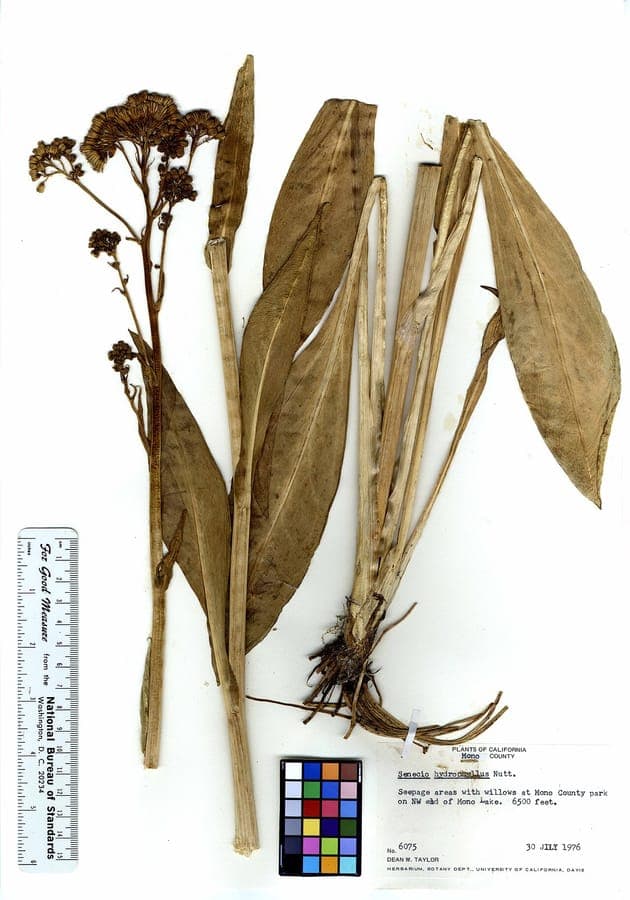
Dean Wm. Taylor / CC BY 2.0, via Wikimedia Commons
Senecio hydrophiloides: complete guide
Senecio hydrophiloides
Want to see Senecio hydrophiloides: complete guide in your garden?
1 minute, no credit card
Overview
Senecio hydrophiloides, commonly known as tall groundsel, sweet marsh ragwort, or stout meadow groundsel, is a robust perennial forb belonging to the family Asteraceae. First described by botanist Rydberg in 1900, this species is native to the western stretches of North America, including British Columbia, Alberta, California, Idaho, Montana, Nevada, Oregon, Utah, Washington, and Wyoming. It thrives in moist to wet environments: stream banks, marsh edges, wet meadows, and boggy mountain hollows.
The genus Senecio is one of the largest plant genera on Earth, containing well over a thousand species distributed across every continent. Senecio hydrophiloides stands out among its relatives for its tall, upright habit and prolific bright yellow composite flowers that attract pollinators throughout summer. In garden settings, it serves beautifully as a structural plant in wet borders or as a naturalizing species at the water's edge.
The plant is also recorded under the synonyms Senecio foetidus var. hydrophiloides, Senecio foetidus, Senecio pereziifolius, and Senecio oreganus. Despite the synonym 'foetidus' suggesting an unpleasant scent, the plant itself is not notably malodorous in the garden. Gardeners seeking a bold, naturalistic plant for reliably moist locations will find Senecio hydrophiloides to be an undemanding and rewarding addition.
The plant's single-crown growth form means it stays relatively well-behaved for a tall wildflower, spreading gradually rather than aggressively. When established in a suitable location, it requires minimal intervention and will reward you with consistent flowering year after year.
Appearance & bloom cycle
Senecio hydrophiloides grows as an upright, single-crowned herbaceous perennial. Under good conditions, mature plants reach 60 to 100 cm in height, with a spread of approximately 40 to 60 cm. The stems are sturdy, erect, and only minimally branched in the lower portions. The leaves have a noticeably coarse texture, and are deep green, broad to lance-shaped, and toothed along the margins. Basal leaves are the largest, sometimes reaching 15 to 20 cm in length; stem leaves become smaller and more stalkless as they ascend.
The flowers are the primary ornamental feature. Like all members of Asteraceae, Senecio hydrophiloides bears composite flower heads consisting of bright yellow ray florets surrounding a central disc. Individual heads are small - roughly 1 to 2 cm across - but they are produced in large, branched clusters that give the plant an impressively floriferous appearance from June through August. The blossoms are a rich, saturated yellow that shows well against the dark green foliage.
After flowering, the plant produces small, plumed achenes - similar in structure to dandelion seeds - that disperse readily on the wind. This means the plant can naturalize itself around the garden with ease. If self-seeding is not desired, clip the flower stems as soon as petals drop. If left to seed, you may find pleasant colonies establishing themselves in damp corners and along water features, which is often exactly what naturalistic gardeners want.
Ideal location
For best results, grow Senecio hydrophiloides in a position that mimics its natural habitat: full sun to partial shade, with consistently moist to wet soil. It is ideally suited to stream banks, pond margins, bog gardens, and rain gardens where soil moisture is reliably high. It will also perform well in a standard border provided the soil is kept consistently moist through irrigation or heavy organic mulching.
A south- or west-facing exposure in full sun produces the most abundant flowering. In hotter climates or in very exposed positions, afternoon shade helps prevent wilting and leaf scorch. In deeper shade the plant remains green and healthy but flowers somewhat less prolifically. When choosing a location, remember that this is a tall plant that can reach a metre in height; place it in the middle or back of a border where it will not overshadow smaller neighbours.
Spacing should be generous: plant individual specimens 50 to 70 cm apart to allow each plant to develop fully. Groups of three to five plants create the most naturalistic and visually effective planting. In larger naturalistic schemes it can be mass-planted at 40 to 50 cm centres for a dense, meadow-like effect.
Soil requirements
Senecio hydrophiloides is notably tolerant across a wide range of soil pH, thriving anywhere between pH 5.0 and 7.5. This means it succeeds on lightly acidic, neutral, and even mildly alkaline soils - a versatility that makes it a useful plant for a broad range of garden conditions. The one non-negotiable requirement is consistent moisture; this is not a plant for dry, free-draining sandy soils.
Heavy clay soils that retain moisture naturally are ideal, provided they are not completely waterlogged and anaerobic for extended periods. Loamy soils enriched with compost or well-rotted manure also produce excellent results. On sandy soils, incorporate a generous layer of organic matter - at least 10 to 15 cm deep - before planting, and be prepared to water frequently during dry spells. A permanent mulch layer of 5 to 8 cm of leaf mould, wood chip, or compost will help retain soil moisture and moderate temperature fluctuations.
Annual topdressing with a 3 to 5 cm layer of garden compost in early spring is sufficient to maintain good fertility. Avoid very poor, dry, or compacted soils - in such conditions the plant will struggle and may fail entirely.
Free design
Want to see Senecio hydrophiloides: complete guide in your garden? Make a free design now.
Watering
Consistent moisture is the cornerstone of successful Senecio hydrophiloides cultivation. In its natural wetland habitat, the plant rarely experiences drought, and it reflects this in its garden behaviour: it performs poorly when allowed to dry out for extended periods. During dry spells in the growing season, water twice weekly, applying enough to wet the root zone to a depth of at least 20 cm.
Drip irrigation is the most effective delivery method, directing water directly to the root zone without wetting the foliage, which can promote fungal leaf diseases. If using a watering can or hose, water in the early morning so foliage dries during the day. Avoid evening watering, which keeps foliage wet overnight and increases the risk of powdery mildew and other fungal problems.
In naturally moist spots - beside a pond, in a rain garden, or along a ditch - supplemental watering is rarely necessary. The plant can tolerate brief periods of waterlogging without significant harm. In winter, once the plant has died back to its crown, irrigation can be suspended entirely. The rootstock will remain viable through winter dormancy and re-sprout reliably in spring.
Pruning
Senecio hydrophiloides requires only light, seasonal maintenance pruning. There are three main interventions: clearing away dead growth in early spring, deadheading or cutting back after flowering to limit self-seeding, and tidying up in late autumn.
In March or early April, as new shoots emerge from the crown, cut back the previous season's dead stems to ground level using clean, sharp secateurs. This allows light and air to reach the new growth and gives the plant a tidy starting point for the growing season. If you prefer a low-maintenance approach, the dead stems can be left standing through winter as they add structural interest and may provide some frost protection for the crown.
In late summer, once most of the flowers have faded - typically by August or September - the flower stems can be cut back to the basal rosette if you want to prevent self-seeding. Alternatively, leave a proportion of the seed heads for birds and other wildlife. A hard cut-back of all stems in November works well: it keeps the plant tidy and removes potential overwintering sites for slugs.
Maintenance calendar
January - February: Full dormancy. No active care required. Check that mulch is intact to protect the root crown.
March: Growth resumes. Remove previous season's dead material. Apply a 3 to 5 cm layer of garden compost around the plant. First new shoots become visible.
April - May: Water regularly if dry conditions persist. Plant extends rapidly in height. Remove weeds to reduce competition. Check for aphids on young shoots.
June - July: Flowering begins. Enjoy the bright yellow display. Water twice weekly in dry spells. Deadhead spent flowers to prolong bloom if desired.
August: Peak flowering. Begin removing spent flower stems if self-seeding is unwanted. Continue regular watering.
September: Flowering concludes. Seed can be collected for propagation. Cut back flower stems.
October - November: Plant dies back. Cut all stems to ground level or leave for winter interest and wildlife. Apply a fresh mulch layer.
December: Dormancy. No care needed.
Winter hardiness
Senecio hydrophiloides is a genuinely hardy perennial whose native range extends through some of the most severe winter climates in North America, including subarctic Canada and the Rocky Mountain states. This gives the species excellent cold tolerance, estimated to correspond to USDA hardiness zones 3 to 7, meaning it can withstand temperatures down to approximately -40 degrees Celsius in suitable conditions.
In European gardens, the plant will overwinter without protection in virtually all regions including northern Britain, Scandinavia, and the Alps foothills. In areas with hard, persistent frosts and no reliable snow cover, a precautionary mulch of 8 to 10 cm of leaf mould, straw, or wood chip placed over the crown in November provides useful additional insulation. Remove the mulch in March once new growth emerges.
After a cold winter, the plant may be slow to show signs of life in spring - sometimes not until April or even May at altitude. Do not write it off too early; wait until new shoots appear before deciding the plant has not survived. Once established, Senecio hydrophiloides is a long-lived, resilient perennial that will persist in the garden for many years with minimal intervention.
Companion plants
Senecio hydrophiloides is at its best in naturalistic, moisture-loving plant communities. The following companions share similar site requirements and make complementary planting partners:
Filipendula ulmaria (meadowsweet): similar height, creamy-white flowers that contrast beautifully with the yellow of Senecio. Both flourish in wet meadow conditions.
Lythrum salicaria (purple loosestrife): tall, upright plant with vivid magenta flower spikes that provide excellent colour contrast. A classic combination for wet borders and pond margins.
Iris pseudacorus (yellow flag iris): lower-growing, with elegant sword-like leaves and yellow flowers in early summer that precede the Senecio bloom.
Caltha palustris (marsh marigold): a spring-blooming companion with bold yellow flowers that extend the yellow theme from April into summer.
Eupatorium cannabinum (hemp agrimony): tall, later-blooming perennial with soft pink flower clusters that attract butterflies and extend seasonal interest into September.
These combinations work particularly well in bog gardens, rain gardens, and plantings along water features. For a full garden design that incorporates moisture-loving perennials and naturalistic planting schemes, visit gardenworld.app for tailored design ideas.
Conclusion
Senecio hydrophiloides is an underappreciated gem among wetland perennials. Its bold yellow flowers, naturalistic character, and minimal maintenance requirements make it a strong choice for any gardener wishing to bring wild beauty to a moist or waterside location. With a pH tolerance spanning 5.0 to 7.5, robust winter hardiness, and the ability to thrive in everything from partial shade to full sun, it is a genuinely versatile plant.
Plant it in groups of three to five at 50 to 70 cm intervals, combine it with complementary moisture-lovers, and let it settle in over its first season. By the second year it will reward you with a generous, summer-long display of bright yellow blooms that pollinators adore. Discover more planting ideas and create your own garden design at gardenworld.app.
Want to see Senecio hydrophiloides: complete guide in your garden? Make a free design now.
Upload a photo, pick a style, and get a photorealistic design with plant list in under a minute.
10,000+ gardens designed already
No credit card required


Similar plants
Calendula stellata: complete guide
Calendula stellata
Complete guide to Calendula stellata, the star-flowered marigold from Sicily: location, soil, watering and companion planting tips.
Korean chrysanthemum: complete guide
Chrysanthemum x rubellum
Chrysanthemum x rubellum is a hardy autumn perennial with single pink to copper flowers from August to November. Care and combinations.
Helianthus divaricatus: complete guide
Helianthus divaricatus
Helianthus divaricatus is a North American woodland sunflower with yellow summer blooms, ideal for naturalistic borders and shady edges.