
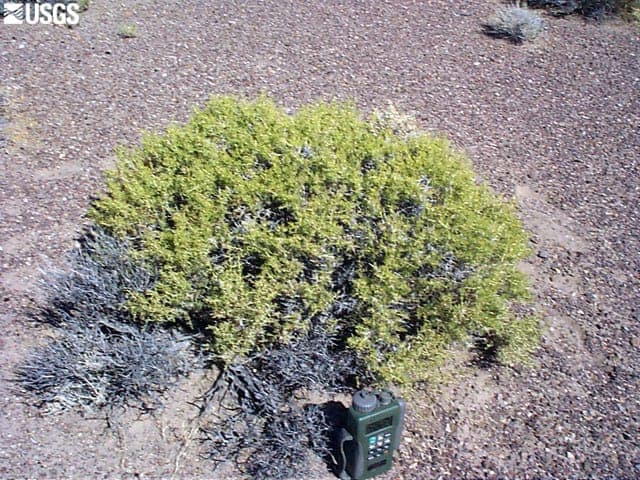
unnamed USGS employee / Public domain, via Wikimedia Commons
Greasewood: complete guide
Sarcobatus vermiculatus
Want to see Greasewood: complete guide in your garden?
1 minute, no credit card
Overview
Greasewood, scientifically known as Sarcobatus vermiculatus, is a spiny, densely branched shrub native to the salt flats, alkaline basins, and desert lowlands of western North America. It belongs to the family Sarcobataceae - a small family closely related to the goosefoot family (Chenopodiaceae) - and is the only widespread species in its genus. The plant's natural range extends from Alberta and Saskatchewan in Canada southward through the Great Basin, the Great Plains, and the Rocky Mountain foothills all the way to northwestern Mexico. While gardenworld.app focuses on garden design for a wide range of climates, greasewood represents the far end of the drought-and-salt-tolerance spectrum among North American native plants.
The common name 'greasewood' refers to the oily, resinous branches that burn with an intense, smoky flame - a quality long exploited by pioneers and indigenous peoples as fuel. Other common names include black greasewood, saltbush (not to be confused with Atriplex species), and seepwood. The species epithet vermiculatus (worm-like) refers to the shape of the narrow, cylindrical, fleshy leaves. Ecologically, greasewood is a keystone species in Great Basin salt desert communities, providing food and shelter for a wide range of wildlife and stabilising soils on saline flats otherwise prone to erosion.
Appearance and bloom cycle
Sarcobatus vermiculatus is a multi-stemmed, densely branched shrub that typically reaches 60 to 200 cm in height, with mature specimens in optimal conditions occasionally exceeding 250 cm. The plant's overall form is broadly rounded to irregular, with a dense, cushion-like mass of interlacing grey-white to pale grey stems. Young shoots are notably pale, covered with a waxy, salt-excreting film; older stems develop brown, peeling bark. Many shoot tips terminate in sharp, stiff spines that deter browsing animals.
The leaves are among the plant's most distinctive features: narrow, fleshy, worm-like cylinders measuring 1 to 3 cm long, in a striking yellow-green colour. Their succulent structure allows the plant to store water and manage the osmotic challenges of living in highly saline soils. Flowers are small and inconspicuous: male flowers are grouped into spike-like catkins at the tips of branches, while female flowers are solitary in the leaf axils and green-coloured. Bloom time falls generally in summer. The fruits are eye-catching winged nutlets of reddish colour that are dispersed by wind.
Ideal location
Greasewood is a specialist of extreme environments. It thrives in full sun on highly alkaline, often saline soils in places where few other woody plants can survive. Typical natural habitats include alkali flats, salt marshes, river valley bottoms with alkaline alluvial deposits, and the lower slopes of desert basins in the western United States. It tolerates very high soil salinity, low annual rainfall, and extreme temperature swings from bitter winter cold to intense summer heat.
In a garden context outside its native range, greasewood is a specialist choice, primarily of interest to gardeners dedicated to authentic North American native planting, xeriscape design in the American West, or botanical collections. It is not suited to typical temperate garden soils in Europe or other humid climates. In its native region, it is valuable for erosion control and habitat restoration on degraded alkali soils. Good specialist nurseries in the western United States carry it for these purposes, and seed is obtainable from native plant seed suppliers.
Soil
Greasewood's soil requirements are among the most extreme of any commonly discussed garden plant. It is specifically adapted to highly alkaline and often saline soils, with a preferred pH of 7.5 to 8.5. These are among the highest pH values found among woody plants. On neutral or acidic soils it grows poorly or declines. If growing it outside its native range for botanical interest, the planting medium must be alkaline; adding lime, gypsum, or small amounts of sodium-rich material can help approximate the right conditions.
Soil texture can be variable: greasewood grows naturally in sandy clay, loam, and compacted alkaline hardpan. Drainage must be good, however, as the roots cannot tolerate prolonged waterlogging. The plant is classified as a phreatophyte - a deep-rooted plant that taps into underground water tables rather than relying on surface rainfall. This explains its apparent paradox: it is a drought-tolerant surface plant that in reality requires access to moisture at depth.
Free design
Want to see Greasewood: complete guide in your garden? Make a free design now.
Watering
Established greasewood plants in the ground in suitable climates need very little supplementary watering. In their native habitat they survive on as little as 150 to 200 mm of annual precipitation by accessing deep groundwater through their extensive root systems. Their fleshy, waxy leaves further reduce water loss. In a xeriscape garden in the arid western US, young plants benefit from occasional watering during their first two growing seasons; after that they typically need no supplementary water at all.
In wetter temperate climates, such as those found in much of northern Europe, greasewood is challenging to grow outdoors because of the combination of high rainfall and non-alkaline soils. Container culture is more practical in such settings: use a very free-draining, alkaline substrate, water sparingly, and keep the container in the most exposed, sunny location available. Never allow water to stand at the roots. The plant's physiological tolerance of salt is not matched by a tolerance of prolonged waterlogging without the counterbalancing effect of salinity.
Pruning
In garden cultivation, greasewood can be lightly pruned in early spring to maintain a tidy, compact form. Remove dead, diseased, or damaged wood entirely. The plant naturally develops a multi-stemmed, dense structure and does not require heavy pruning for structural reasons; light corrective trimming is all that is needed. New flowers form on new wood, so light pruning does not compromise flowering.
Wear heavy gloves and long sleeves when pruning, as the spiny branch tips can cause injury. Avoid drastic renovation pruning into very old wood: greasewood recovers slowly from hard cutting. Dispose of prunings separately from regular compost if the plant has been grown in high-salinity soil, as elevated salt levels in the plant material can affect compost quality. In its native range, greasewood tolerates browsing pressure from livestock, which acts as a natural form of pruning.
Maintenance calendar
A year-round care overview for garden-grown greasewood:
- February-March: Check for winter damage; remove dead wood; light shaping if needed.
- April-May: New growth begins; water young plants if conditions are very dry.
- Summer: Flowering period; minimal watering for established plants; check for pest damage.
- September: Fruiting - watch for the characteristic winged red nutlets; no special action required.
- October-November: Prepare for winter; protect container plants in frost-prone areas.
- December-January: Rest period; no watering needed for plants in the ground.
Winter hardiness
Greasewood is remarkably cold-hardy for a plant of desert origin. In its native range it endures the severe winters of the Great Plains and Great Basin, where temperatures regularly fall far below freezing. It is likely rated to USDA hardiness zone 4, tolerating sustained temperatures of around -30 degrees Celsius in dry, well-drained soils. This cold hardiness, combined with its drought and salt tolerance, makes it one of the toughest woody plants of the North American West. For more information on selecting plants suited to different hardiness zones, gardenworld.app offers useful guidance.
In western European climates, winter cold is rarely the limiting factor for greasewood. The challenge is instead the combination of high rainfall, mild but damp winters, and the absence of alkaline, saline soils. Container-grown plants can be overwintered in a cold greenhouse or frost-free shed, kept barely moist and in as much light as possible. This is the most practical approach for growers in temperate climates who want to maintain this plant for botanical or educational purposes.
Companion plants
In its natural Great Basin habitat, greasewood grows alongside other salt- and drought-tolerant natives. Natural companions include fourwing saltbush (Atriplex canescens), big sagebrush (Artemisia tridentata), saltgrass (Distichlis spicata), and various other halophytic species. Restoring these plant communities in degraded alkali habitats is an active area of conservation work in the American West.
For decorative planting in an authentic xeriscape garden in the arid western United States, greasewood pairs well with other Great Basin specialists such as yuccas (Yucca spp.), agaves (Agave spp.), and various native bunchgrasses. In Europe, the plant is rarely available at standard garden centres; seek it from botanical gardens, specialist xerophyte nurseries, or native plant seed suppliers. A common and more garden-adaptable alternative for European gardeners who want a similar ecological character is sea buckthorn (Hippophae rhamnoides), which shares salt tolerance and a spiny, dense habit. More plant selection guidance for dry and challenging garden conditions is available at gardenworld.app.
Closing
Greasewood is no ordinary garden plant. It is a remarkable ecological specialist, perfectly adapted to the harsh salt deserts and alkaline plains of western North America, where it serves as a keystone species supporting entire communities of wildlife. For the gardener willing to provide its very specific requirements - full sun, alkaline to saline well-drained soil, minimal water - it is a plant of real character and considerable ecological interest. It represents the outer edge of garden horticulture, where cultivation meets conservation. In its native western American range, it is a valuable component of habitat restoration projects and xeriscape plantings. For the adventurous botanist or native plant enthusiast, greasewood is a unique and rewarding subject.
Want to see Greasewood: complete guide in your garden? Make a free design now.
Upload a photo, pick a style, and get a photorealistic design with plant list in under a minute.
10,000+ gardens designed already
No credit card required

